2011

Deck Analysis: Reshiphlosion

A big hello to all you OHKOers out there.  This is Pikkdogs here with a deck analysis.  The deck we will be spotlighting is Reshiphlosion, a very consistent and hard hitting deck in the current format.  Some are wandering if it can stand up to Pokemon Catcher, so lets find out.

I had realized a couple days ago that this website has not had a Reshiphlosion list on it.  So I thought I would change that.  I will be happy when this article is published because people always come up to me and shout, “Hey,when are you going to write a Reshiphlosion article? and stop staring down my shirt!”  Sometimes even girls say this.

Anyway, The deck was popularized at U.S. Nationals.  It seemed like everybody was going to play Reshiboar, and then everyone showed up with Reshiphlosion.  The deck is really powerful and really consistent because it can manipulate energies very well.  Just about every energy that you draw will be used and re-used thanks to Typhlosion Prime.  Its that energy manipulation that makes Reshiphlosion really good.

If you do not know the deck I will try my best to explain it.  The first goal of the deck is to get as many Typhlosion Primes out as possible.  His “Afterburner” Poke-Power lets you attach a fire energy from the discard pile to any of your Pokemon, and you also place a damage counter on that Pokemon.  Fire energies get discarded in two major ways, either from the discarding required from Reshiram’s “Blue Flame” attack or from Ninetales HGSS’s “Roast Reveal” Poke-Power.  “Roast Reveal” lets you discard a fire energy and discard 3 cards.  This is great for both drawing and energy acceleration.

When I play this deck I usually try to get at least 2 Typhlosions out and a Reshiram active.  If you have to sacrifice a couple prizes to get the primes out, it is no big deal, those cards are that important.  If possible I will try to get out the Ninetales once I get the Reshirams on the right track.

One unique thing about my Reshiphlosion that I haven’t really since in other decks is the inclusion of Sucine/Entei Legend.  Since it is a dual Water/Fire type, it can hit Reshiram for weakness making it a good tech against the mirror matchup.  It can also hit Donphan Prime for weakness, this is great because it is tough for Reshiram to OHKO Reshiram.  SEL has the “Bursting Inferno” attack that does 80 damage and causes the burn special condition.  This 80 is enough to OHKO Donphan Prime, Reshiram, Emboar, and Typhlosion Prime.  The only draw back is that if SEL gets knocked out your opponent takes 2 prizes, so make sure you use SEL in a wise way so it does not get knocked out.

I will now provide the list that I am testing with.  Just to let you know, this list is just a rough draft of what I am working with. It is not yet polished enough to be taken to a tournament.  I only provide the list to give you something to test with.

Pokemon-14

  • 4-Reshiram BW
  • 3-Cyndaquil
  • 2-Quilava
  • 3-Typhlosion Prime
  • 1-Vulpix
  • 1-Ninetales HGSS- I would like to get a 2-2 line, but so far 1-1 has been working.  If I did take this to a big tournament, I would go 2-2.
  • 1-Bottom Half of Suicine/Entei Legend
  • 1-Top Half of Suicine/Entei Legend.  I sometimes think of going 2-2 for SEL. I guess it depends on your metagame.

Trainers-32

  • 4-Professor Juniper-There are some people who don’t like to have 4 Professor Junipers in every deck,  these are what I like to call members of Al-Qaeda.
  • 2-Engineer’s Adjustments- Nice for getting energy in the discard.
  • 2-Professor Elms Training Method-  2-3 will be standard if Trainerlock is as prevalent as I think it will be.
  • 1-Energy Retrieval
  • 4-Pokemon Communication
  • 3-Junk Arm
  • 3-Pokemon Catcher
  • 1-Switch
  • 4-Pokemon Collector
  • 1-Dual Ball
  • 3-Rare Candy
  • 3-Plus Power
  • 1-Max Potion

Energy-14

  • Fire-14

So here is a some-what modified version of the Reshiphlosion deck that I am playing.  Of course my lists tend to have a lot of cards that have just 1 or 2 copies, just so I can see if I like the card.  If I were to make this a tournament list, I would probably play 2-3 of everything or take it out.  And of course, this list is adjusted to my weird play-style. So you are gonna have to adjust it to yours.

I will not do a matchup analysis for this deck because it is pretty simple.  Reshiram is great against almost everything, especially Yanmega Prime.  Use SEL wisely against the mirror and Donphan.  Against Trainerlock you might only get to have 1 or 2 Typhlosions.  This makes it tougher, but the situation is the same, you just need to hope they cannot match you blow for blow.  Against a disruption deck you should just use “Outrage” to knock out Ambipom or Sharpedo.  That is basically all you need to do.

Well that’s all for today.  If you would like to post your list in the comment box, everybody will be very appreciative for sharing your ideas.

So long and thanks for all the fish.

The Top 10 Impactful Cards of Emerging Powers

Hey all you OHKOers!  Yes, it is finally time for Pikkdogs to release his list of the top 10 impactful cards of the next set.

Emerging Powers is your 2nd Black and White Set.  It is made up of cards that were in the Japanese Black and White sets, along with cards from the “Battle Strength Decks” and random Promotional cards.  A lot of people are a little upset about this set because the current Japanese set seems to be a lot better than our Emerging Powers set.  But, there are some good and impactful cards in this set. It is not one of the better sets we have seen in a while, but at least it’s better than Call of Legends.  The thing I hate most about this set is that there is that it has another rare Unfezant that is useless.  It seems like I pulled just about all of the BW Unfeazants, and now I feel like I’m about to get 150 more crappy Unfezants.  But enough about my hatred of Unfeazant, let’s take a closer look at the set to get at the best cards.

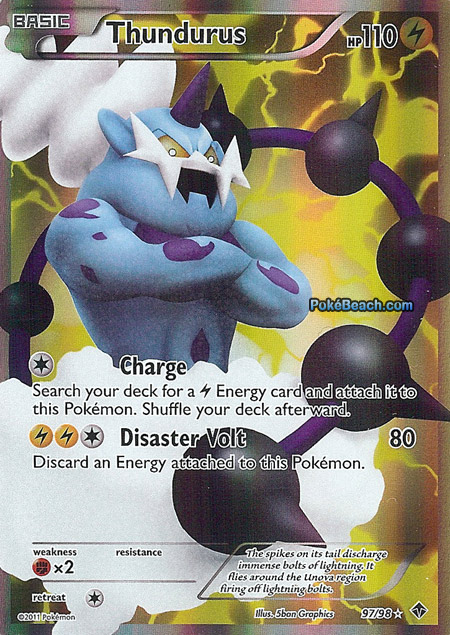
Honorable Mention (#12) Thundurus

Our first honorable mention of the countdown is Thundurus.  Thundrus has 110 HP, a 1 retreat, and a fighting weakness.  It’s first attack, “Charge” lets you attach a lightning energy from your deck to this Pokemon. Its second attack, “Disaster Bolt”, does 80 damage for LLC and a one energy discard.

At this moment I do not really see Thundurus as a great Pokemon in the modified format.  Some people have been talking about Thundurus being a secondary attacker in a Zekrom deck, but I don’t see that either.  It is OHKOable by Donphan Prime, and it takes 2 turns in the active spot to get charged up.  Perhaps later next year if Donphan Prime gets rotated this card could become good, but right now it’s too fragile and too slow.

Honorable Mention (#11) Cheren

Cheren is a supporter that lets you draw 3 cards.  It is kind of like Cheerleaders Cheer, except your opponent does not get the option of drawing 1 card.  I think this is a pretty good card and will see decent play.  If Cheerleaders Cheer were not in the format I think this card would be ranked around #6.  The reason why it is not is because this card will only replace C.C.  If a deck does not run C.C. they will not decide to run Cheren.  Cheren will just be switched in to decks that currently run C.C.  If I thought Cheren was a huge set above C.C. I would asl put it in, but it doesn’t seem to be that much better.

The format right now is really draw/hand referesh supporter heavy.  Cheren comes into a format where Professor Juniper, Professor Oak’s New Theory, and Judge are used a lot.  Cheren is really not in a position to challenge any of these supporters.  I don’t think that Cheren will see a lot more play then Cheerleaders Cheer has, just about the same.  For that reason although Cheren is a good card, it is not very impactful.

#10- Leavanny #7

At first glance Leavanny does not seem like a very impactful card.  It is a stage 2 Grass Pokemon with 130 HP, a fire weakness, and a 1 retreat cost.  Its second attack, “X-scissor” does 30 damage for GC and lets you flip a coin, if heads you can do 50 more damage.  But this card is possibly impactful because of it’s first attack.  “Nurturing” lets you search your deck for a Pokemon that evolves from one of the Pokemon on your bench, and put it on that Pokemon.  The current rules for this type of attack only allow you to place the next evolution line on the benched Pokemon.  This means that you can only go from basic to stage 1, not basic to stage 2 (even though the stage 2 does evolve from the basic).

This means that Leavanny is like a Spiritomb Ar with the “Darkness Grace” like attack.  This attack does not seem to great coming from a stage 2, but if put in the Lost Zone, Mew Prime can use “Nurturing.”  I’m not sure if this is a great startegy with Mew, but it does make it faster to evolve Vileplume, and Vileplume will be very important in the next season.  I am not sold on this card, but it could be somewhat impactful. 

#9-  Swanna

Swanna is a card that has received no hype, but it is good because it is a Donphan counter.  For WCC you can do 70 damage and a discard, with the “Air Slash” attack.  This makes it a pretty good Donphan counter.  Its stats are not all that great.  It has 90 HP, a 1 retreat cost, and a lightning weakness.

This will not be a great card, but if you need a Donphan counter, this card will take it out in one hit.  It also uses DCE, so it hits well into decks that already use that card.

#8- Recycle

Recycle is a simple Item card.  It lets you flip a coin, if you get heads you can put 1 card from your discard pile to the top of your deck.

This is not a great card considering the card does not go to your hand, and you have to flip.  But, this format is seriously thin on recovery cards.  If you do not use a supporter, you cannot get back evolution cards without Recycle.  I could see a lot of people running at least 1 Recycle since you can re-use it when needed with Junk Arm.

It will not change the format, but I think it will see some play initially.  When we get some better recovery cards you probably will never see this card, but I think a lot of Battle Roads decks will run at least 1 Recycle.

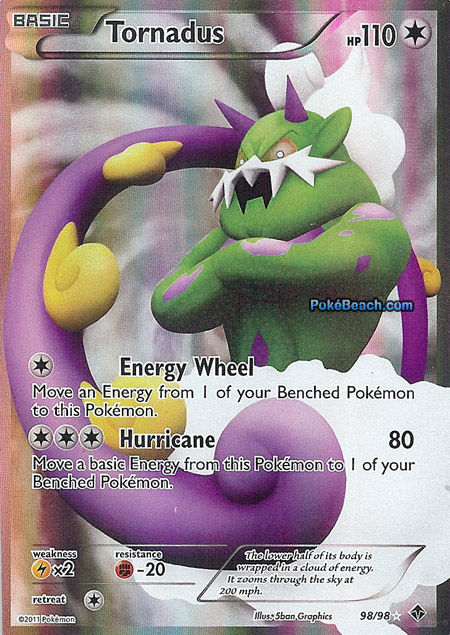
#7- Tornadus

Tornadus is a Donphan counter.  It has 110 HP, a 1 retreat cost,a resistance to fighting, and a weakness to lightning. Its first attack, “Energy Wheel”, lets you move an energy from your bench to Tornadus.  This attack doesn’t seem great, but it does work well with Manaphy.  You can use Manaphy’s attack to refresh your hand, then retreat and move the energy to Tornadus.  His second attack does 80 damage for CCC and you must move an energy from Tornadus to a benched Pokemon.

The good thing about Tornadus is that unlike the other BW high HP Pokemon, it can use DCE.  It can also benefit from Emboar BW.  Tornadus’s main job is to stop Donphan Prime, which it can do.  Donphan can only do 40 damage to it with “Earthquake”, and Tornadus can 2HKO it.  Tornadus can be used in almost every deck, and fits well into a Reshiboar or any deck with DCE.

#6- Beartic #30

Beartic is one of the cards that has received a lot of hype since its Japanese release.  I for one am not drinking the Beartic Kool-Aid (and not just because upon searching for the card on Google I once stumbled on a gay pornography site), I just don’t think that it can make a good consistent deck in this format, but I have been wrong in the past.

Beartic is a 130 HP Water Pokemon with a weakness to metal.  His first attack costs WCC, is named “Sheer Cold”, and does 50 damage and prevents the defending Pokemon from attacking next turn.  Its second attack, “Icicle Crash”, does 80 damage for WWCC. 

Now not allowing the defending Pokemon to attack is really useful.  It will not be as good against Yanmega since it has free retreat, but it is harder to retreat Pokemon like Magnezone, Reshiram, Zekrom, and Donphan.  I could see a lot of people running this card in a BR deck.  I’m still not sold on it being a great card, but I think it will be impactful in the short term. But the lesson we learned today about Beartic is that if you do a Google search for the card make sure to spell the name of the card right, awful things can happen if you don’t.

#5- Great Ball

The #5 card is Great Ball…………..well sort of.  Great Ball was a card that I knew from the LA set that let you search your deck for a basic and put it straight to your bench.  This card was fairly good until most decks used Pokemon like Uxie, Mesprit, Azelf, Crobat G, and Chatot G that had coming into play Poke-Powers.  But this card is not your father’s Great Ball, it is actually your father’s Master Ball.

The text on this Great Ball allows you to look at the top 7 cards of your deck and grab a Pokemon you find there.  If this card came out a year ago I would not even consider running this card.  We had other trainer/item cards like Pokedex, Luxury Ball, Premier Ball, and Bebe’s Search that let you get the cards you wanted fairly easily.  Now a days those trainer/item cards are all gone, all we have is Dual Ball which only works on basic Pokemon and requires a flip.

If you have a deck that has about 20 Pokemon in it, and a lot of them are Legend Pieces or Evolution cards, then this card would work fairly well.  If you are just running a Yanmega deck, your proabably will not look twice at this card.  But, I could see this card being used throughout the time that it is in the format.  It will not be a staple card, but I could see it being used in some decks.  

#4- Crushing Hammer

Our #4 card is Crushing Hammer, which is again just a reprint of another card from our past.  This time it is a reprint of Energy Removal 2.  The text is simple, you flip a coin, and if heads you can discard an energy attached to any of your opponent’s Pokemon.

Now we have a similar card in the format, “Lost Remover”.  Lost Remover also lets you take an energy away from any of your opponent’s P0kemon.  But there are three differences; the first is that thre is no flip involved, the second is that Lost Remover only works on Special Energies, and the third is that energies that have been removed by Lost Remover go to the Lost Zone while Crushing Hammer puts them in the discard.  These differences are very significant.

A lot of people have complained about Pokemon Reversal because it was a very powerful card that required a flip.  If you weren’t happy about that, you probably won’t be happy about Crushing Hammer.  It will be frustrating having a game come down to a coin flip (because that is what removing an energy can do, especially in a format with Pokemon Catcher), but that is what I think will be happening.  Crushing Hammer is much more playable than Lost Remover thanks to the fact that it works on all energies.  I know that I was very skeptical of using Lost Remover because I never knew for sure if it was going to be useful.  You now know that Crushing Hammer will be useful because every deck plays energies of some kind.  The difference in where the energies go is not very substantial because it is hard to get Special Energies back from the discard pile anyway.  The chances are that it will not matter whether you put a DCE in the Lost Zone or the discard pile, your opponent will most likely never get it back.

So after all that discussion do I think it will see some play, yes I do.  I am not sure how much play it will receive, but I’m sure it will at least be in disruption decks.  I could also see it becoming a staple, with Junk Arm being so popular.

#3- Gothitelle #47

The only actual Pokemon to be in the top 5 is Gothitelle.  It has 130 HP, a 2 retreat cost, and a weakness to psychic.  Its ability, “Magic Room”, prevents your opponent from play item cards when Gothitelle is active.  Its attack, “Mad Kinesis” does 30 damage for CCC, and will do 20 more damage for each psychic energy attached.

Decks next season will be unbeliebably trainer heavy, so having a trainer lock will be amazing.  I think trainer lock will be perhaps the best strategy in the next format, but I do not see Gothitelle in those plans.  I think that Vileplume is the way to go.

Even though Gothitelle does not item lock you, it does restrict the amount of damage you can do.  You will never realistically get 3 Psychic energies on it, and if you do that still will not even be 100 damage.  Realistically you are looking at a Psychic and a DCE on Gothitelle by turn 3, this means that your opponent has probably already setup and will probably be able to knock out Gothitelle. This is why I favor Vileplume, you can still attack with whatever Pokemon you want to attack with and have the item lock on.

But a lot of people are eying Gothitelle as a deck worthy card.  You will have the ability to have an item lock, while still use items yourself.  This means you can slow them down by not letting your opponent use Rare Candy, and then Pokemon Catcher up a basic to knock it out.  I think this card will see play early in the season and I think it will see play later, possibly 2 seasons from now when it gets a proper supporting Pokemon to go with it. 

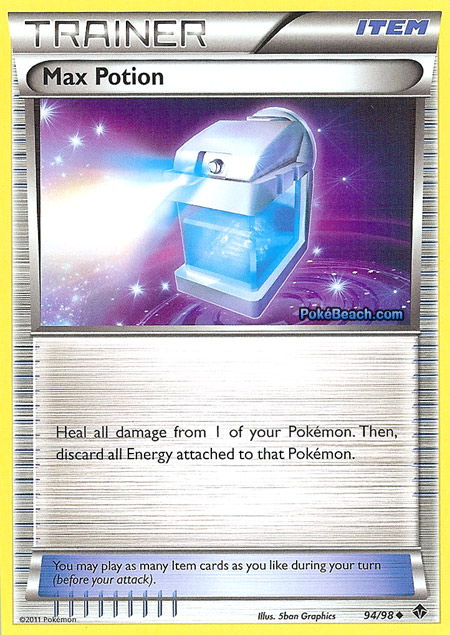
#2- Max Potion

The second to the most impactful card in this set is Max Potion.  This card lets you remove all damage counters and energies on any one of your Pokemon.  While removing the energies is not good, it does work well with low energy attackers like Yanmega and Donphan Prime.

The Stage 1 Rush deck gets a lot better in this set because of trainers like Max Potion.  It is very hard to OHKO Donphan Prime, now with Max Potion most decks can only hope to 3HKO it.

I have tested this card, and although it is very hard to get the card when you really need it, it still is an amazing card.  The only problems I have with this card is that it increases your reliance on trainers and it along with Pokemon Catcher hurt the consistency of decks by making less room for cards like Professor Elms Training Method and Pokemon Communication.

Despite these weaknesses, I think I can still say that this card will see a lot of play and become a staple in a lot of decks.  This card will live up to the hype that people are giving it.

#1- Pokemon Catcher

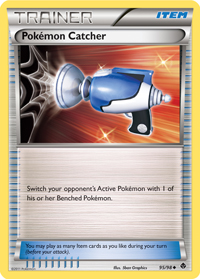
Of course the most impactful card of this set is Pokemon Catcher.  Heck, Catcher is the most impactful new card since Garchomp C.  Not only will it be a staple, but it will change the way that people play the game.  Of course, like Crushing Hammer, Pokemon Catcher is a reprint of a card that was formally in the modified format.  That card was called Gust of Wind.  Pokemon Catcher is just like Pokemon Circulator in the effect that you get to change your opponent’s active, but this time you can choose which Pokemon gets switched in.

This dyanmic creates a lot scenarios.  You can bring up something that has a high retreat and then attack your opponents bench.  You can bring up something that has a high retreat and then attempt to mill your opponent’s deck.  You can also bring up techs and knock them out before they can serve their purporse.  Or, you can bring up a basic Pokemon and knock it our before it comes a scary stage 2 Pokemon.

I wish I could say more about this card, but all I can say that it is huge.  Catcher will be one of the most important cards in the format.  It will help usher in the rise of Vileplume and item lock, and it will see a lot of success in tournaments.  Pokemon Catcher is kind of like SP Pokemon in the fact that you either have to play it or play against it (item lock).

A lot of people are against Pokemon Catcher, but although it will be very impactful, it will not be bad for the game.  Because the format is relatively slow, it is hard to get Catcher when you need it.  This means that as long as each player is prepared  by either playing 3-4 catchers or playing Vileplume, the game will not be unbalanced. 

Overview of the Impactfullness of Emerging Powers.

Unlike Black and White, there are no big Pokemon in this set to build your deck around.  But, that does not mean that this set is not impactful.  Just one card can change the format around, and that is what we got with Pokemon Catcher.  It may not turn the game on its side, but Catcher will be in all non item lock decks.

Besides Catcher, cards like Crushing Hammer, Great Ball, Max Potion, and Recycle could be very impactful in this trainer heavy format.  And although I do not think they are the best cards, Pokemon like Beartic and Gothitelle could see play in some moderately successful decks.  This set may not be the best, but I would say thanks to Pokemon Catcher this set is very impactful. Feel free to leave your top 10 in the comment box.

So long and thanks for all the fish.

Pikkdog’s Tips for Winning your Emerging Powers Pre Release

A big hello to all you OHKOers out there, this is Pikkdogs here.  Believe it or not, Emerging Powers pre-release tournaments are just around the corner.  Although most people go to these tournaments for the cards and trading, its always nice to win; plus a lot of organizers give an extra pack to the winner.  This article will hopefully give you all the advice you need to make the most of your pulls.

Of course the biggest goal of the event is to have fun and get the cards you want.  One of the biggest advantages of being at a pre-release is that a lot of people will trade you a good older card for a decent new card.  Values of these new cards are kind of high before and after the release the set, but they will eventually fall.  So make sure you get out there and get the best value for your trades.

Now, lets focus on the swiss rounds that are played.  Of course each player gets 6 packs and makes a 40 card deck complete with energies provided by the tournament organizer.  These decks are usually not nearly as fast as modified decks, so you need to use different strategies, here are some of my basic priniciples about pre-releases.

  1. Run about 12-13 energies.  Of course it depends on what your deck ends up being, but about a dozen energy cards is pretty standard.  You should have enough energies there, without having too many.  But, the more drawing supporters you pull, the less energies you can run.
  2. Play most of your trainers.  Draw and search power is limited, so if you pull 7 Cheren’s, then play them all.  The only trainer that I wouldn’t play a lot of is Crushing Hammer.  It is a good card for a PR but just don’t over due it.
  3. Stick to 2-3 Types.   You will not have any energy search cards, so if you run 5-6 types of energy you probably won’t be able to get the type of energy you want when you want it.  If you stick to about 2-3 types of Pokemon you should be fine.
  4. Be careful about stage 2’s.  Especially in this PR, Basic Pokemon are a lot more consistent than stage 2’s.  It is very hard to get a stage 2 out especially since you usually cannot get a decent line of Pokemon.  Just because you drew a 2-1-1 line of Klingklang does not mean that you have to play it.  If you can work it in your deck and get it out in a game or two, thats great, but just don’t rely on it.
  5. Starters are great.  As mentioned, you cannot run 4 PONT and 4 Juniper in a pre-release deck, so having anything that will let you draw or search is great.  Unfortunately, in EP there are not a lot of good starting Pokemon.  But you should be able to get a lot of the monkey Pokmeon, they all have an attack that lets you draw a card.  It’s not great, but anything is better than passing.

Strategies for winning your EP Pre-Release.

1.  Play the big HP basics.  All three of the Musketeer trio Pokemon (Coballian, Virizion, and Terakkion) and 2 of the Genies are in this set.  While not all of these Pokemon have great attacks, because of their HP, all of these Pokemon are great for Pre-Releases.  And since there are 3 of the Musketeer trio, and 4 versions (2 regular and 2 full art) of the Genies. you should have a decent chance of getting one of these big HP Pokemon. I would play any of these that I pull.

2.  Play the Monkeys.  I know I already said this, but play Panpour, Pansage, and Pansear.  They each have the “Collect” attack that lets you draw 1 card for one energy.  Their evolutions are also fairly good.  They each have an attack that costs CC and does 30 damage and a special condition.  Their other attack usually does 60 for that CC and the energy of their type. Its not mind blowing, but its not bad.

3.  The Stage 1’s are pretty good.  Even though there are a lot of good basics in this set, do  not sleep on the stage 1’s.  There are good Pokemon like Darmanitan, Zoroark, 2 Beartics, Sawsbuck, 2 Excadrills, and Braviary that can be very good in most decks.  If you pull any of these Pokemon I would probably try to play them.

4.  Sawk and Throh.  These Pokemon are not as bad as their BW counter parts.  The Sawk is fairly awesome.  For just FC, you flip 5 coins and do 20 damage times the number of heads.  This attack should be enough to knock out a lot of basics.  Throh has an attack that does 30 damage and lets you flip a coin for FC, if heads you prevent the defending Pokemon from attacking next turn.

5.  The Trainers here are great.  I would play any Cheren’s and Bianca’s that you find, they are great for draw power.  Pokemon Catchers are great in any format, Crushing Hammer is good as well, Great Ball is………well……..Great, and Recycle and Max Potion are useful.  I would use most if not all of trainers that you get.  As mentioned, the only one I would limit myself on would be Crushing Hammer. 

There are other good cards out there, but you will have to find them for yourself once you pull them in your pack.  The cards I alerted you to should be a good way to start.  Of course, PR’s are a lot about luck, but if you use these tips you will have a greater chance of having a better day.  Have fun at your PR’s everybody.

So long and thanks for all the fish.

PokeClass Episode 38 – Emerging Powers Set Review

[youtube width=”720″ height=”468″]http://www.youtube.com/watch?v=2P0b-2Cgjuw[/youtube]

This week, I debut a brand new format of bringing you PokeClass. I have added video content to make the presentation of the information a lot more ‘viewer friendly’ and hopefully you will all enjoy the changes.

Note: I’ve had a lot of feedback about the ‘live video’ additions with pretty much all of them being positive. I have taken into account that people like the full screen video better than the bottom-left corner so that will be a change for the next episode. I can assure you I’ve ironed out most of the creases from this episode, so bear with me ’til next week where I think I’ve got it mastered ;)

Emerging Powers is set for release in just a few weeks and we have just had the full set list released to us, so this week, I’m tackling all of the most interesting cards from the set and analysing each one of them. Stay seated for a fairly long episode!

Enjoy and comment below what you think of the changes :) Read More

Recapping Pokemon TCG Worlds 2011

A big hello to all you OHKOers out there. This is Pikkdogs here with a recap of worlds.

Before we start with what happened at worlds, lets take a look back at last week. Last week was the first ever www.onehitko.com guest writer week. We saw 6 writers give us some great articles. I feel that we got a lot of cool different information last week, and it was generally a great thing for the site. We would like to thank all of our writers that were in action last week, you all did a great job. Hopefully in the future you will be able to drop by and give us another article. Ed and I would also like to ask all of our readers to tell us what you thought about Guest Writer week. Please tell us if you think it was a good thing for the site by placing your thoughts in the comment box.

Last Chance Qualifier-Day 1

World’s weekend started off Friday night with the Last Chance Qualifier. The LCQ (known as the grinder) was full of a lot of players vying for just 16 spots at the main event.  There were no swiss rounds, instead there was a single elimination tournament with each match being decided by a best of three series.  The first round was kind of similar to a play in round, as a lot of the participants had a bye.  They were just trying to narrow the field down to the right number before the real tournament began.  These were the individuals who survived the Masters event:

Alan Kang
Andrew Occiano
Brandon Jones
Dan Richard
Elton Keung
Gabriel Arriola
Glenn Velazquez
Jackson Iler
Joshua Aaron
Kevin Kobayashi
Mike Schaefer
Milla Rantanen
Ricardo Garcia
Spencer Brown
Tsuguyoshi Yamato
Tyler Shelde

No real big American names managed to grind in.  Dan Richard from Michigan and Jackson Iller from Ohio did grind in, but if you don’t live near where I do this won’t be too exciting for you. As expected, the most played decks were the quick, disruptive, and hard hitting Primetime; and the durable Reshiphlosion.

The Last Chance Qualifier was good for fans of the U.S.  Grinders left the U.S. with the majority of participants and left traditional powerhouse Japan with only a hand-full of players.  Mexico, Great Britian, France, Canada, Argentina, Australia, and Finland also had a decent number of players.

The Main Event-Day 2

Saturday’s event started with just over 120 players in the Masters division.  The judges decided that the field will narrow itself to the top 16 in 7 rounds.  The field consisted of some familiar faces, and a lot of players that most people haven’t heard of.  Some of the bigger names were Jay H., Pooka, Jwittz, Con Le, and Chris Fulop.  The stage was set for some awesome  action on Saturday.  The day ended with a match between Sami Sekkoum of the U.K. and Jwittz of Illinois.  Sami was able to narrowly defeat the Youtube Sensation, but each player was happy because they each were able to get the top spot in their respective bracket.

The swiss rounds continued for 7 rounds and the top 16 players were taken to the next day.  According to Pokegym, here are the top 16 with their respective decks:

Sami Sekkoum (GB) Yanmega/Magnezone 
Dylan Bryan (US)
Luke Reed (US) Reshiram/Typhlosion
Josh Wittenkeller (US) Yanmega/Magnezone
Tom Dolezal (US) Reshiram/Typhlosion
Jeremy Jallen (US) Reshiram/Typhlosion
David Meulenbroeks (NL) Reshiram/Typhlosion
Lorenzo Voltolina (IT) Magnezone/Emboar
Filipp Lausch (AT) Yanmega/Magnezone
David Cohen (US) Magnezone/Emboar
Mitchel Silva (US) Reshiram/Typhlosion
Jay Hornung (US)
Miska Saari (FI) Reshiram/Typhlosion
Josue Palomino (MX) Reshiram/Typhlosion
Dylan Lefavour (US)
Ross Cawthon (US) Vileplume, Reuniclus, Blissey, and Dragons

The first thing I see when I look at this list is the good showing that the U.S. had.  Sure some European players snuck in, but the field featured 10 Americans.

The second thing I noticed is, what the heck was Ross Cawthon playing?  I knew Vileplume was going to be a good play, and I always liked the “Outrage” attacks of Reshiram and Zekrom.  But, I still don’t know exactly how it worked.  I hear that he also played Entei/Suicine Legend.  I assume that he tried to start with Donphan and putting damage counters on the dragons.  ESL was there for countering Typhlosion, and Blissey and Reuniclus were there to move damage counters around to power up the attack of the dragon’s.  Jwittz also has said that Cawhton also has played Pichu and Tropical Beach, two cards that are not that bad, but not thought of as that good.  It should be something to look for once we get more news more San Diego.

We have seen a lot of Reshiphlosions at the tournament.  Of the 13 decks we know about, 7 of them were Reshiphlosions.  That is an amazing number, it shows that the deck is crazy good and consistent.  I think we will see this deck doing good even in the Post-Catcher era.  Primetime also saw 3 decks in the top 16.  That deck is still versatile and disruptive.  I think that is another deck that we could be seeing around.  It also seems that Pokemon Reversal saw a lot of play.  Most of the reports that I have seen so far indicate that a lot of the decks have a large number of Pokemon Reversals.

One weird news story that came out of this day was in the last round of swiss with the game between Ross Cawthon and Chris Fulop.  Word from the Sixprizes forum is that in exchange for some of Ross’s prizes, Fulop scooped to Ross and let him go on to the top 16.  This is a very significant development because of how far Ross went in the tournament the next day.  I don’t think that scooping to a player that might be inferior is the wrong thing to do, it can be good in some places like if you are playing a friend or a team member.   But, I can understand if some people are disappointed with this news, because who knows if Ross would have won if the game was actually played.  This could have change the complexion of the rest of the tournament.  I like Chris Fulop, but with Nationals and now Worlds, it seems that he can’t seem to stay out of controversy.  If the news is indeed true, I have not spoke to either of the players to confirm it.

Day 3- The Top 16.

Well, Saturday left us with 16 players left, including famous players like Jay H. and Jwittz.  When Sunday rolled around we were all hoping that they would do well and go as far as they could.  On saturday night I looked at the top 16 bracket and picked the top 4 as: Cawthon, Jwittz, Palomino, and Cohen.  Little did I know that I was not too far off.

Sunday started off with wins by Cawthon’s weird deck, the Italian named Volotina, Tom Dolezal, Jwittz, Palomino, Jeremy Jallen, Dylan Lefavor, and David Cohen.  This left us with 2 Magneboars, Ross’s weird deck, 3 Reshiphlosions, and Jwittz’s Primetime. And then there were 8.

The round of 8 saw the loss of favorites J.Wittz and Dylan Lefavor; Jay. H had lost the round before. Tom Dolezal and his Reshiphlosion defeated JWittz in 3 games, while Ross Cawthon’s weird deck defeated the last remaining Italian player.  On the other side of the bracket, Josue Palomino beat Jeremy Jallen in the battle of the Reshiphlosions.  And David Cohen and his Magneboar grabbed the last ticket to the final four by defeating Dylan LeFavor.  This left us with the final four, and 3 American’s still alive.  The other final four member was a native of Mexico, making it an all North American final four.  I’m not sure if that has ever happened before. 

The final four saw the end of the Reshiphlosion run.  Cawthon and his weird rogue deck kept on going by beating out Tom D’s Reshiphlosion. And in the other side of the bracket, Cohen and Magneboar were able to outlast the last Reshiphlosion.  This left the field with 2 Americans, ensuring that the world championship title will be brought back to the U.S.  The big story here is Cawthon advancing to the top 2 of worlds with a hodpoge deck of Blissey, ESL, the Dragons, Reuniclus, and Donphan.  He must have found a way to make such a scattered deck to be consistent.  It almost seemed to work like a tool box, having an answer to ever kind of deck.

This left only the finals to play out.  Only one person will be able to call themselves a World champ.  Both Cawthon and Cohen have experience being the worlds final, both of them had been in the finals in the Senior and Junior divisions, and now they are back but this time at the big stage.   In the first game, Cawthon got an early Pichu which Cohen was able to knock out.  I am not sure exactly how this game played out, but it seems like Cohen had the advantage the entire game. In the second game Cawthon got setup early with a full bench including Vileplume.  He used his great setup to take the first prize, and was able to respond after Cohen took his first prize.  Cawthon then was able to get an SEL out and was able to knock out what I think was a Reshiram (but it could have been something else).  After the knock out Cohen scooped to conserve time.  As they were setting up for game 3 time was called setting up for sudden death for a worlds championship.  At this point, both decks seem to be pretty slow so no deck seems to have the advantage.  In the last game Cawthon started with Phanpy and Zekrom, while Cohen started 1st.  Cohen ends the game and wins the championship by getting a good top deck to get a turn 2 Magnezone.  He then was able to “Lost Burn” for 100 and the World Championship.

One thing we learned is that Rogue decks are not dead.  Cawthon came out playing things like Pichu, Reuniclus, and Blissey Prime; and see somehow came out with a great tournament.  It’s always nice to see a rogue deck do well, with a format with not  a lot of sets in the format, its great to see something rogue doing well.  We also learned that Magneboar is not dead. This deck also played Reshiram along with Magnezone.

In the next couple days make sure to keep on checking this site as well as www.thetopcut.net for worlds footage and news.

So long and thanks for all the fish!

Jordan’s Rogue Way and a Worlds Decklist

Hey everybody, my name is Jordan Baker. I’m 22 years old, I live in Michigan, and I’m a founding member of Team Warp Point. I’ve been playing Pokemon for just about two years now and you’ve probably never heard of me. My biggest accomplishment is making it to the top 16 round two years in a row with stupid ridiculous decks. Stupid, funny, quirky, gimmicky decks are sort of my specialty. I don’t really like playing meta decks and I despised SP decks with a passion when they were in format. However, I won’t play a deck just because it’s rogue, I also want it to be good.

I’m going to give you a really quick recap of some of the decks I’ve played over the past two years and then discuss my current deck that I’ll be playing for Worlds this year.

My love affair with rogue decks started last year at Regional’s.  Jumpluff had just come out and I decided that I wanted to play it. There were a lot of other people playing Jumpluff at regional’s, but most of these were JumpLux variants relying on Luxray G. Lv. X. My list played a heavy Sunflora line, and 3-2-3 Metagross LA, which has a built in Pokemon reversal in the form of a Poke-Power. For some reason the deck worked and I made it into the top cut, and past the round of 32 before being eliminated in the top 16 by JumpLux.

After regional’s we got Unleashed and my Nationals deck was born. I played Blastzel with 3-3 Floatzel and 3-3 Claydol. I started out 4-0 at Nationals before running into a Luxchomp list running Entei Raikou Legend. I had four Pokemon with 80 HP in play and my opponent took 4 prizes in one turn with Thunder Fall. I figured that ERL was going to be pretty rare and I went on with my day. Unfortunately my next opponent also played ERL and was able to pull of a quintuple KO. Needless to say, I wasn’t having a good day. I lost another game somewhere down the line and ended up dropping.

Probably my proudest rogue moment was playing Rampardos (PL) at this year’s regional championships. Nobody had a clue what Rampardos did or how to play against it. If I went second I was often hitting for 80 1st turn for just one energy. It had a surprisingly good Luxchomp match-up and I ended up making top cut. I beat a DonChamp deck in top 32 before running into my work nightmare in the round of 16. Mesprit. Rampardos relied heavily on Uxie drops and Unown R’s to get rolling as well as my own Mesprit and Crobat drops. My opponent’s Mesprit drops destroyed that plan.

OK, enough talking about out of format rogue decks that nobody cares about, or ever cared about. Onto what everybody actually wants to see.

Below you will see a different take on Stage 1 Rush. This is a list that myself and my brother Evan Baker have been testing for the past month.

Decklist? Decklist.

Pokemon T/S/S Energy
4 Yanma
3 Yanmega Prime
3 Zorua
3 Zoroark
3 Chinchou
3 Lanturn Prime
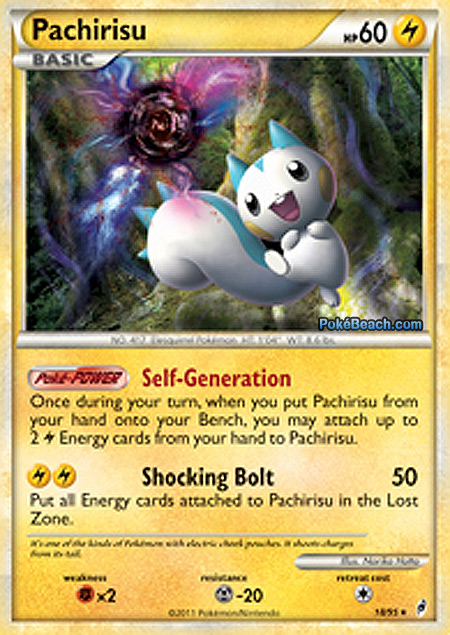
1 Pachirisu Cl
1 Cleffa
4 PONT
3 Copycat
2 Juniper
4 Communication
4 Reversal
3 Junk Arm
1 Switch
1 Pokegear
1 SSU
8 Lightning
4 DCE

In our testing this deck has a favorable matchup against just about everything except Yanmega/Magnezone. which is probably 40/60 unless you can get a good start and consistent energy drops.

I know many of you are going to be looking at Lanturn Prime and wondering why it’s in there. In actuality, it’s an awesome card right now and definitely overlooked. For a DCE and 1 lightning Lanturn OHKO’s just about everything that is big right now. Donphan, Reshiram, Yanmega, Typhlosion, Kingdra, etc. That much versatility in a single Pokemon is pretty impressive. Sure it get’s OHKO’d by some of these Pokemon too, but only Donphan is quicker and a smart player with this list should easily be able to outplay the traditional Stage 1 rush list. Being able to hit for two different weaknesses is really nice. 

Pachi is in here for the Magnezone matchup. A well-timed Pachi drop allows you to OHKO a Magnezone without your opponent ever seeing it coming. It is also useful in the rare occasion when you need to add a couple extra damage to Lanturn’s Powerful Spark attack. Super Scoop Up and Junk arm allow you to use this tactic multiple times if necessary.

The rest of the deck is pretty self-explanatory. It definitely takes some skill but the versatility of this deck allows you to outplay your opponents in a format that is basically luck based/attach and attack right now.

Who knows if this deck will still be viable when the new set comes out. It’s basically a Meta-counter right now so it really just depends on what the Meta is in a month’s time. Catcher will definitely help this deck. Everything retreats for cheap and reversal is already a huge aspect of the strategy.

Hopefully the deck works out at Worlds. I’ll be grinding in and Evan has an invite, so I guess we’ll see what happens.

This article is part of OneHitKO’s Guest Writer Week for August 2011. Please check out all the articles in the series, and please give the authors your feedback in the comment section below.

  1. Michael’s article about upcoming Japanese cards.
  2. Radu’s article about his Mew/Muk/Jumpluff/Vileplume deck and how it can be made better.
  3. Pooka introduces Worlds 2011.
  4. Alan’s article about how to run a Pokemon league.
  5. Jay. H takes a look at past formats of the game.
  6. Jordan’s article about running rogue decks and his worlds decklist.

That concludes our our first Guest Writer Week. Thanks to you authors and readers for making it a success! Hopefully we can do it again soon.

The History of the Pokemon TCG Through the Ages

Hey guys. Today’s article starts off with an apology from Jay. You need to realize that Jay is now at Worlds. I got this from him via email so late on Friday night that I didn’t even see it until Sat morning. Jay has better things to be concerned with at this point, yet he was up writing this article for you and I. I think, in his mind, he agreed to write something, and he wasn’t going to go back on his word. In that case, he could have just gotten behind and just gave it half an effort. Nope. He gave us a great retrospective and then apologized that he wanted to give us more but couldn’t. Thanks Jay! We hope you’re killin’ it at Worlds!

– Ed

So first an apology.   Originally I had intended this to be a very detailed look back on the formats of the past.  I always enjoyed looking back at some of the different formats and seeing what was competitive, what people liked to play, etc. and I was hoping you guys would to. I ran into two major problems when I was writing this article though.

First, I told Ed I would have this done the week I was leaving for Worlds, which, at the time, I didn’t think was a major issue.  This deadline snuck upon me much quicker than I thought it would, and real life got the better of me.  Those of you who have read my Underground Articles for Six Prizes, know how important good solid articles are to me, and I’m afraid this doesn’t live up to my normal standards.

Second, going in, I didn’t realize how lengthy this article could and should be.  I could write a full article about each one of these formats, and it wasn’t until I started writing did I realize how much information I was leaving out that I really wanted to put in.  All of this being said, I really do hope you get some enjoyment out of this article, since I do feel it does have some nice information in it people will enjoy.  I guess what I’m asking is for all of you to accept this more as rough draft or partial article rather than a finally polished one.  I will be more than happy to answer questions or comments about anything I talked about or a deck I didn’t get to you wanted to know more about.

-Jay

Something I’ve always found interesting is going back and reading tournament reports from previous years.  It normally brings back good memories of friends and tournaments, so for those of you who’ve been here since the beginning hopefully you’ll enjoy this walk through memory lane and for those of you who are more new to the TCG hopefully you’ll enjoy learning a little bit about our history.

The Early Years

I don’t remember how the divisions worked, but I knew there was two divisions an older and younger division.  The older division actually had a metagame that was mainly dominated by variations of Haymaker, Raindance, Mr. Mime/Alakazam, and Wigglytuff/Basics.  The younger was dominated by mostly random stuff.  Read More

Principles for a Healthy League

Hello OneHitKO readers! My name is Alan Traxler, and I’m a casual player who has been invited by Pikkdogs to write an article about my experience as a league leader in Ann Arbor, Michigan. I’ve decided to write about some basic principles I used when running the league; I hope you can apply them to your own league, as a leader or member.

Note: This article is not intended to be a guide for starting a league. For that specific information, here’s a great resource for getting your league off to an excellent start.

Here’s a little background: the Ann Arbor league was started in 2008 by a UM college student named Levester. He chose to meet on Sunday afternoons at a local game shop, Get Your Game On. When the league first started, I would occasionally fill-in as league leader when Levester needed to devote the Sunday afternoon to his studies. Later on in his academic career, Levester decided to study abroad for a semester. I agreed to take over as league leader during this time and took charge for several months. While I was the leader, the league experienced some growth and I attribute it to these ideas:
Read More

2011 World Championships – A Groundbreaking Weekend

Well folks, we’re just a couple days away from the 2011 World Championships, taking place in beautiful San Diego, CA. Players from all over the world are coming together to compete and share their passion for the game they love – the Pokémon TCG. At the end of the weekend, a new champion will be crowned in each division as usual. However, this year things are going to be much different with the Last Chance Qualifier, Worlds, and more. Are you excited? If you’re not, here’s why you should be!

            To kick things off, we have the LCQ, more commonly referred to as the Grinder. Of course the big change this year is that the tournament format will be single elimination best 2/3 matches, instead of Swiss rounds. Plain and simple, if you lose one match you are eliminated, and you keep playing until there are about eight players remaining. Although there have been some complaints about the change, the best 2/3 format should favor skilled players and reduce the luck factor, so it seems to be a positive change. Most importantly, if you lose a game on the first turn, you still have a chance to win the match; this certainly is welcomed in a format where first turn wins are not uncommon. In addition, the Grinder should be less stressful on the judging staff this year, which is something that most people overlook. When it comes down to it, we’ll have to wait and see how the changes affect things. While the new tournament format is huge news, it’s only the first of many groundbreaking announcements for this year’s World Championship weekend.

            For the first time in the Nintendo era, the format changed completely in the middle of the season. Even though most of the season was played using the MD-On format, Worlds will be played with the HS-On format. While some countries had their Nationals use this format, many countries have not had a tournament using HS-On yet; so it will be interesting to see how everyone adapts. Will players from the US, Canada, and Mexico have an advantage by experiencing the format at Nationals? Or have players from the other countries adapted already? With the amount of coin flips present in HS-On, will we see an established player win? Or will a new face rise to the top? Has someone figured out a rogue deck that can take everyone by surprise? Well, all of those questions will be answered this weekend! Just like at US Nationals, The Top Cut will be providing coverage of the event, so pay attention to Twitter (@topcutpokemon) and the website, http://thetopcut.net/, for updates.

            Speaking of The Top Cut, a truly unique event will take place this weekend – the Top Cut Invitational. What is the Top Cut Invitational? Basically eight National and World Champions have been invited to play in a special tournament with one purpose in mind – showing people what the Pokémon TCG is all about. Unlike a normal tournament where the focus is on the players, this event will cater to the spectators. Throughout the tournament, every game will be recorded with commentary, so you won’t miss anything that happens. Here is your chance to see some of the best players in the world duke it out! For a list of the competitors and for information concerning the tournament, visit http://thetopcut.net/tcinvitational/. If possible, the event also will be streamed live, so you can watch even if you aren’t in San Diego. For those attending Worlds, the event will take place in the Open Gaming Area (Sapphire Ballroom) around 6 PM PST, and all spectators are welcome! Without a doubt, this is the first time an event like this has taken place for the Pokémon TCG, and we are very thrilled to be hosting it.

            Between the LCQ, Worlds, and the Top Cut Invitational, the 2011 World Championship weekend is sure to deliver lots of fun and excitement for the whole community. For updates on the event, be sure to stay posted by checking out The Top Cut’s coverage throughout the weekend. In addition, there is an official site for Worlds updates, http://pokemon.com/worlds/. If you can’t make it to Worlds this year, rest assured there will be information on it one way or another. Now the only question I have left is this: are you excited yet?

-Kyle “Pooka” Sucevich

This article is part of OneHitKO’s Guest Writer Week for August 2011. Please check out all the articles in the series, and please give the authors your feedback in the comment section below.

  1. Michael’s article about upcoming Japanese cards.
  2. Radu’s article about his Mew/Muk/Jumpluff/Vileplume deck and how it can be made better.
  3. Pooka introduces Worlds 2011.
  4. Alan’s article about how to run a Pokemon league.
  5. Jay. H takes a look at past formats of the game.
  6. Jordan’s article about running rogue decks and his worlds decklist.

Be sure to check back throughout the week for more great articles from our friends!

Mew/Muk/Jumpluff/Vileplume: The Mistakes I Made With My Nationals List

At this year’s nationals, I had my best nationals finish.  I made Top 64, but it was bittersweet.  While I had done fairly well, I still made the same mistakes in deck building and deck choice which had led to my poor results in previous years. I played a build of a deck which was largely untested and that I was fairly unfamiliar with. While the list I played was by no means bad, it did suffer from being teched improperly.  In addition, there were logical flaws with the trainer engine and how it synched with the rest of the deck.

This article has two main points.  First, it will provide some insight into the Mew/Muk Jumpluff/Vileplume archetype.  Second, it will showcase some of my thoughts about the deckbuiling process highlighting what I did wrong with this deck.  Right now. I’m going to share the list I played and explain my reasoning behind my choices. Also, let me state that this list is not just my own. Emmanuel Divens is also a co-creator of this build and a lot of the ideas behind this list can be attributed to him.

25 Pokemon 23 Trainers/Supporters 12 Energy
4 Mew
3-3 Yanmega
3-1-2 Vileplume
2 Bouffalant
2 Muk
2 Jumpluff
1 Spinarak
1 Tyrouge
1 Cleffa
4 Judge
4 Collector
4 Copyct
3 Twins
1 PETM
4 Communication
3 Rare Candy
4 PSY
2 Grass
4 Rainbow
2 DCE


Read More