Pokemon Education

The Spirit of the Game.

A big hello to all you OHKOers out there.  This is Pikkdogs here with an article about the Pokemon document called, “The Spirit of the Game.”  This is a document that is rarely talked about on websites like this, but is supposed to be vital to any Pokemon player.  So I figured we should talk about it and analyze it.  We can talk about what we like about it, and what we don’t.  But first, we must get a news article from Pedro to start things out.  Hey Pedro, what do you have for us today?

Hey Pikkdogs.  Today, CNN is reporting that there is controversy with Sweden’s Minister of Culture.  It seems that she was attending an art exhibit opening and she ate a piece of a cake that was in the form of a stereotypical African figure.  Groups representing African Swedes are calling for the minister to resign after they feel that Africans were portrayed in a racist manner. 

Well this is quite a controversy, who knew there were black people in Sweden?

True, I always imagined that the whole country is full of blue eyed blondes who wear tight T-shirts and frolick in a meadow all day. 

That’s exactly what I imagine too.

The story gets even better.  It seems that the cake was made to bring awareness to female genital mutilation in Africa.  To strike home the point of the piece, the “artist” cut a piece of the African Girl shaped cake from the cake’s genital region and screamed loudly in pain. 

That sounds weird.

Agreed.

I think we should get that image out of our mind and just think about a bunch of Swedish blondes in tight T-shirts frolicking in a meadow.

Sounds good with me.  But, we should get to the article. 

Okay.

The Spirit of the Game

The Spirit of the Game (TSG) is one of the few documents that makes up official Pokemon TCG policies.  Along with the rule book and compendium, this is your Pokemon bible.  I am not sure of the history about TSG, such as when TSG was adopted, so if someone can fill us in on the historical information I would appreciate that.   

To start us off, here is TSG in its entirety.

  • Fun: The Pokémon TCG is a game, and games are meant to be fun for all parties involved. When a game ceases to be fun, players find other things to do.
  • Fairness: Games cease to be fun when players break the rules to achieve victory. A player should prefer to lose a game than to win by cheating.
  • Honesty: Players of any game should strive to act honestly while playing that game. If a player inadvertently breaks a rule during a game and becomes aware of the error before his or her opponent or a judge, that player should make the opponent and the judge aware of the misplay.
  • Respect: Players, spectators, and staff should be treated with the same respect that players would expect for themselves. Distracting an opponent or a judge to gain advantage shows disrespect to everyone involved in a Pokémon TCG event.
  • Sportsmanship: Winning or losing with grace is vital to the enjoyment of a game. The desire to continue playing a game can be soured by players that berate their opponents after winning or losing a match.
  • Learning: Players should strive to help each other increase their Pokémon TCG play skills. It is not a player’s responsibility to make his or her opponent’s plays for that opponent. However, discussing strategies, offering deck tips, or constructively critiquing game play decisions after the match has been completed helps both participants to become better players.

That is the exact text that is found of Pokemon’s website.  Although very brief and very broad, it does give us some interesting things to talk about.  I will go through each one of TSG’s six principles and give you my opinion on them and how they relate to how the game is actually played.  I will ask you guys to please use the comment section to tell us what you feel about TSG and how you see things happening in real life.  It will be interesting to see if these 6 principles are still important to us today.

Fun

TSG starts off with a simple statement.  The TCG is a game, and it is meant to be fun.  It sounds simple enough, games and fun seem to go hand and hand.  So no real problem there.  The second part of this principle says that when the game is not fun, people do other things.  This is really weird to put in here, I don’t really care what people do if they do other things, it just seems like a weird thing to put in here.

Even though the first statement is broad and understood by everyone, it is still very important.  It outlines the fact that the game is supposed to be fun, and that is the first and foremost rule of Pokemon.  If you are making things not fun for your opponent you are going against TSG, and the game itself.

I interpret this rule to mean that if someone plays a deck that is successful but not fun, it is unsportsmanlike.  I know that it sounds weird, but it is based on one of the foremost rules of the game.  I take this to mean that it is against TSG, and the game itself, to play a deck like Durant.  I don’t know if I ever heard anyone called Durant a fun deck.  Most people state that it is not fun, but tedious.  If this is so, Durant (and any deck that people generally do not find fun) does go against TSG and players should not play it.  This is a fairly standard interpretation of a very simple rule, that makes for a very interesting debate.

Since TSG is mandatory (we all signed that we would uphold these principles when we got our POP IDs), technically you should be kicked out of Pokemon for playing decks like Durant, if this strict interpretation is believed.  It all depends on how far you take the first principle.  Even if you don’t take this strict interpretation, it is significant to know that Pokemon is about fun first and foremost,  everything else takes a backseat to fun.

Fairness

The Fairness principle again brings fun into the equation.  The first part of it states that generally, games aren’t fun when one player cheats and wins.  The second part states that a player should want to lose before they want to win by cheating.

While I don’t want Pokemon telling me what is fun and what is not, this principle seems to state things very simply.  It states that cheating breaks the first principle of fun, therefore cheating is very much frowned upon.  Cheating in itself implies that it breaks the rules, so Pokemon is hitting it home for us that cheating is a good way to break the first principle of the TCG, fun.  It also gets us thinking that we should always have the concept of Fun in our hearts when we are playing the game.

The second part of this principle does not have anything to do with fun.  It implies that we all should have the morality needed to play a game as a civilized adult.  We should not try to win at all costs, instead we should take the rules to heart and live and die by them, not to forsake them for a chance to win.

This principle is very important.  I have seen some people cheat before, and it is not good for the game.  Winning should not consume you so much that you would break the rules of a game.  You should want to win, but you should want to have fun and interact with people more.  TSG spells this out very clearly and well.

Honesty

The principle of Honesty is closely tied to Fairness and cheating.  When they spell out Honesty, it does not have to do with cheating intentionaly, but unintentionally.  It says that if you break the rules without realizing it, when you do realize it , you need to tell your opponent and a judge.

This principle is all about being………well honest to your opponent and the game as a whole.  Mistakes happen, but you got to call yourself on them when they do.   It is actually a simple rule that is second nature to almost everybody.  You shouldn’t have to really tell people this, it should be done whether it was a rule or not.

Cheating by mistake does happen a lot.  It happened to me at a Cities this season.  I had to put my hand down to help someone get something behind me during a match, and I accidentally picked up my deck by mistake.  Mistakes like these happen and there is not much that can be done.  If it doesn’t effect the outcome of the game, like in my example, warnings are just given (the Pokemon equivalent of a slap on the wrist).  If it does hurt the game a lot, then you will see game losses being handed out, but that is fairly rare.  The most common occurrence now-a-days is when people use Pokegear 3.0 for a long time, and then shout out “N!”,  this sometimes can cause the other player to think you are playing N and shuffle his hand in the deck.  This wouldn’t happen if a player clearly announces his moves during the game, and if the other player pays attention.

Respect

haha I noozled you guys again!


The first part of this principle just re-states the Golden Rule, be kind to others as you would have them be to you.  That it is a real simple rule we all learned in Kindergarten and we all should know it by now.  The second part has to do with not distracting the judges or your opponent to gain an advantage.  This can be thought of as cheating and be put into the same category.  I don’t know why they put it with respect, it is just another form of cheating.

Sportsmanship

The principle is funny because it is just a restatement of the first principle, but includes winning and losing maturely.  It states that winning and losing with dignity are vital to the “fun factor” in the game, and if people become sore losers people will leave the game.

I’m sure we can all think of examples of people breaking this principle.  One profanity laced rant in Toledo comes to my mind.  It is probably the hardest one to uphold for a lot of people, but it is still a basic principle that you should have learned when you were 4.

We all should be adults here and be able to lose without sulking and win without taunting.  Its just a simple principle that everyone should follow, it is not that hard.

Learning

This final principle is one of the strangest in this list.  It states that it is your responsibility to help teach other players the game, and help them get better.  It also clearly states that you should go out of your way to help other people, and do everything short of telling your opponent exactly what to do while playing.

I find this principle to be really strange because during a tennis match, you never see Roger Federer telling John Isner that he should work on his backhand.  There is no parallel in sports to this principle, which is very strange.

While I do think that we should become a community and help each other learn the game, I do think that this principle goes a little too far by expecting everybody to help everybody else with their decks.  It isn’t practical or smart for that to happen.  I do try to follow this principle when I play a newcomer to the game, but I think it is a little arrogant to always be telling someone else what to do.  Up to a certain point people need to learn from their own mistakes and figure it out on their own.  It is not my responsibility to help each and every player to get to my skill level.  Make no mistake, I’m not being selfish here, just stating that it is not reasonable for Pokemon to expect us to be that dedicated to a principle.  So, they went just a little overboard in this principle.

Conclusion

I was really surprised when I started analyzing TSG.  I did not expect TSG to contain the things that it did.  It sets up a Pokemon world that is much more informal and fun based than the game actually is.  I think that the real world is more cut throat than TSG outlines. Should we all obey these rules more than we currently do?  I don’t know if we should say that.  Competitive play should be more aggressive than league play, and we need a slightly different attitude for it.  I would say while most Pokemon players do not follow TSG rules exactly, the game is not full of spoiled brats.  Most Pokemon players are nice people that don’t whine and cry when things don’t go there way.  There is no doubt that there are some of these players out there, but you can’t expect everybody to be nice.  It seems like most players are gracious about how they play the game, and that’s really what TSG is all about.  There are some players who do not follow TSG out there, but its not like making TSG more strict will change that.

So what do you guys think after you looked at TSG more closely?  Do you feel that we should change these principles at all?  Do other games have a similar set of principles?  I will be anxious to read your comments in the comment box.

Off the top of my head, I can’t really think of any principle that should be added.  Most things that I can think of are specific rules that need to be enforced on a local level.  TSG seems to be fairly balanced.

Okay, Pedro I am done.  Do you want to close things out for us?

Sure, today we have sad news from the world of entertainment.  Beloved TV host Dick Clark has passed away.  Clark hosted American Bandstand, which was a music show that inspired other shows like “Soul Train” and the UK’s “Top of the Pops.”  Producers of current music shows like American Ido and X-Factor all state that there would be none of those shows without American Bandstand and Dick Clark. 

Which is one bad thing about Dick Clark.

Yes, it seems weird like those producers would try to sully Clark’s name after he did all that.   

You know Pedro, a lot of celebrities and musicians preformed on American Bandstand.  Including people like: “The Polish Prince” Bobby Vinton, Johnny Cash, Run DMC, Richard Simmons, and Cher.

Richard Simmons and Cher are very different people of course.  One is an elaborate diva who is known for wearing dresses and thick makeup…………….and the other is Cher. 

Good one.  Good night everybody.

Ya Gotta Gear Up!!! Pokemon Style.

A big hello to all you OHKOers out there.  This article is for beginners, and it is about the tools that Pokemon players and collectors use.  When you first thought of playing a game, you probably never thought of using things like sleeves, binders, and deck boxes.  But, all these things are very important.  So let’s look at what some random douche, me, has to say about these things.  We will begin by looking at things you  need like randomizers, sleeves, deck boxes, binders, and playmats.

Randomizers/Damge Counters

There is a really good chance that one of the first Pokemon things you ever bought was a theme deck.  Theme decks are nice because they teach you the rules of the game, give you some cards, and give you a rule book with some other stuff.  That “other stuff” contains things like a coin and damage counters.  The coin is a cheap plastic thing, and is very hard to flip.  I have tried to flip those, but I end up either not flipping it or hitting my opponent, more often than I do a successful flip. The damage counters are not much better, they get too messy and obstruct the card so you can’t read it.  The better way to fix these problems is to use dice.

Almost everybody uses dice for both damage counters and randomizers.  When using as a randomizer, you treat evens as heads and odds as tails.  There are a couple rules for using dice as randomizers.  The first rule is that the dice must be transparent and have rounded edges.  To make sure nobody weighs a die so that its finally resting position is on one side, the dice must be see through when you hold it up the light, just so everybody can see there is no weight inside of it.  The die also must have rounded edges on it, I’m not really sure why this is a rule, maybe one of our readers can explain why.  The second rule is that die you use to flips must be different from the ones that you use for damage counters.  This rule is to avoid confusion when your randomizer die lands close to your damage counting dice. Read More

Leagues, and how they provide to the Pokémon Community

Hello everyone out there in Omar Nation, this is Joel here with another article. This time I want to talk about leagues, and how they are an important part of the Pokémon Trading Card Game community. As a league leader myself, I cannot stress how important leagues are, and how much fun participating in one can be. I have been running my league for the past 3 years now and it is one of the busiest leagues in the Metro Detroit area. But enough about my league, lets go on to discuss what a league is, how it is ran, what makes it different from a tournament, and how it’s important to the Pokémon TCG community.                         

What is a Pokémon League?

A Pokémon league is an official Play! Pokémon event that is usually run once a week. Leagues provide players with a casual playing and trading environment for players of all ages. Most leagues are free to enter, however some charge a small fee (usually under $5), the fee is usually to help cover the cost of renting the facility, or to help cover other costs such as additional prizes and snacks. All leagues are operated in a public location, such as a hobby shop, game store, toy store, malls, libraries, schools, churches, and coffee shops.

What makes Pokémon League different from tournaments?

The main difference between Pokémon League and tournaments is that league provides a more casual play environment rather than competitive. Unlike tournaments, league rewards players whether they win or lose. League also offers the opportunity to practice new deck strategies and test your game, most people get their tournament practice done at league. League also best for newer players who are just being introduced to organized play as they don’t have to feel pressured to win, nor feel discouraged when they lose. League is also the only place where you can get important staple cards such as Uxie or Azelf for free, as Play! Pokémon provides these cards to league leaders at no cost.

How a league is ran.     

One or two people usually run the league. These people are called League Leaders, and they’re there to assign POP ID numbers, scorecards, points and promo cards. The most important part is they are there to help new players and provide accurate rulings. When a player goes to league for the first time, they’re assigned a POP ID number, if they already have a POP ID, they give that number to the league leader. Most players obtain their POP ID number by attending a league. After a POP ID number is assigned, the player then receives a scorecard. Scorecards keep track of your points that you receive from playing games. Playing a game at league will get you a point on your scorecard, some leagues will give the winner of that game an additional point (NOTE: Not all leagues do this, it depends on the league leader running the event.). The scorecard has four rows of check boxes which are your points. At the end of each row there is a Poké Ball. Once that Poké Ball is checked, the player will receive a promo card. These promo cards are mainly reprints from other sets with a special holographic foil and the Play! Pokémon logo stamped on the card. These promos are exclusive to league and can only be obtained at leagues. Most of these promo cards are also hard to get staple cards as well, which is good for the players since it puts these hard to obtain cards in players hands. Past promos have included cards such as Claydol, Uxie, Azelf, Expert Belt, Dialga G, Bebe’s Search, and Special Metal Energy just to name a few. Another cool prize that is given to players is a heat seal patch that is obtained once all the check marks are filled on the scorecard.

Why are leagues important to the Pokémon TCG Community?

For many players, Pokémon League is the first step to organized play. While most league attendees are younger children, plenty of players in the senior and masters division use it as a chance to get plenty of play testing in. The Masters Division players also become great role models to the younger players and often help them become better players. League players tend to branch out into the tournament scene as well, as league players learn about tournaments from league leaders and other players with prior experience. The most important thing I would like to point out is that many friends can be made through league. I have made a lot of friends by attending leagues, and leagues just provide an overall fun time for everybody.

I hope this article provided you with the information you needed about leagues, and if you know some younger players or people who are getting into the game, have them read this article and hopefully you all attend a league and become an important part of the Pokémon Community!

Now for something totally unrelated: You can follow me on Twitter.

www.twitter.com/TheJoelHowe

Pokemon Black & White Mall Tour @ Mall of America

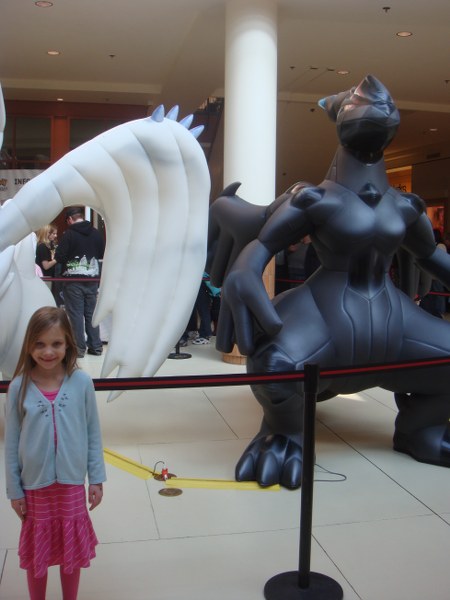
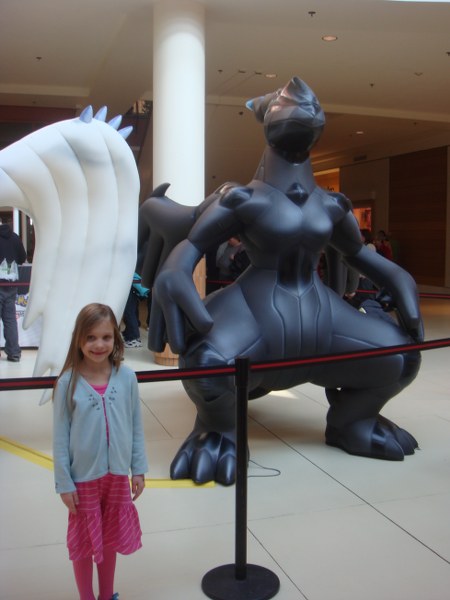
Ava and I attended the Black and White Mall Tour on Saturday. It was a pretty well run event for the most part. We were planning to meet some friends at about 9:45. Unfortunately, we had car troubles (dead battery), so we ended up arriving just after 10AM. The first showing of the Zoroark movie was at 10, and they got in. We missed it.

We kinda got hosed on the whole movie deal. We arrived at the first info booth at about 10:10. It was too late for the 10AM movie, but we were told that they hadn’t yet received the 12:00 movie tickets. We’d just have to come back.

Ava and I then proceeded to rush around the mall to get 5 stamps before the lines became unbearable. It’s a good thing we did. After getting 5 stamps, people then had to wait in line to spin a wheel to see what prize they would receive. When we got there (at about 10:45), there were exactly 0 people ahead of us. We waltzed up and spun. Ava got a Snivy stylus. I got a Snivy patch. And there was much rejoicing.

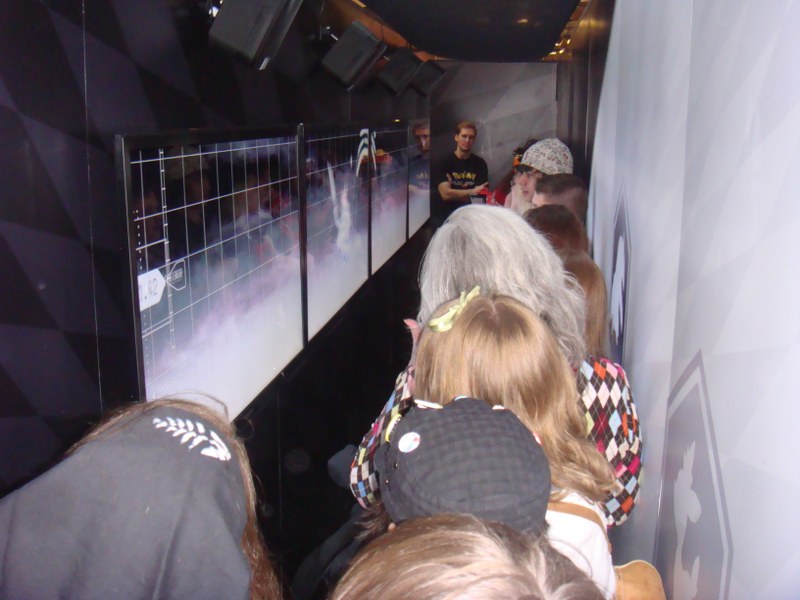
We then decided to go back to see some of the stuff we zoomed by before, so we headed back to wait in line to play the new videogame. In line just ahead of us was a loud group of Team Rocket cosplay girls and a bit behind us was the Lesky crew (with Troy sporting a new tattoo which I should have captured on film). All the cosplayers were one of the more interesting attractions of the day, actually. It gave the event a fun and friendly feel.

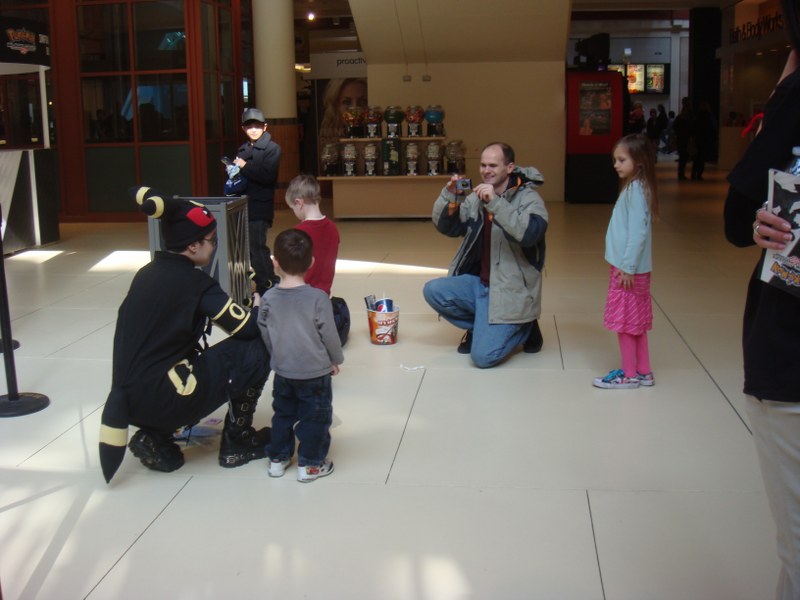
Speaking of cosplay, we ran into Umbreon along the way. After the event, I looked him up. Apricot the Gerbil had a password giveaway, which was quite cool. Ava really appreciates the Mew bouncy ball she received.

Oh yeah, at one point, we headed back to get our noon movie tickets. We were informed that they ran out. All they had was 2:00 ones. Well, Ava had to be at a hockey game at 4:15, so that wouldn’t work. We found a young couple of Pokemon trainers before leaving and donated our 2PM tix to them. Hopefully they had a good time at the movie.

We did finally meet up with our friends, but we were all done with the stamping by then. We walked around with them and ended up meeting Grumpig. When we decided to leave, they went to wait in line for the wheel spin. Man, that line was LONG. I’m so glad we bolted through the stamp process early.

Here are our pictures. It was fun. States is coming up on Saturday. I’m definitely not prepared.

MRDIF: Gyarados

What is MRDIF?

I am sure you all have heard of the new popular acronym (at least new to me) BDIF, witch stands for Best Deck In Format. Well I decided instead of writing an article about the Best Deck in Format I would write an article about the Most  Ridiculous Deck in Format, or MRDIF. For this article I chose to write about Gyarados as the MRDIF because I feel it really is!

How Do You Play Gyarados?

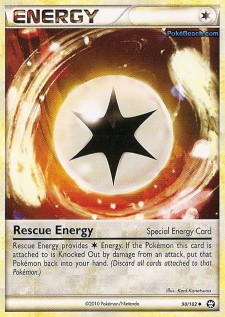
I realize that a lot of people already know how to play Gyarados but for those of you who don’t I’ll go over it briefly for you. Basically the goal of Gyarados is to discard Magikarp using cards like Regice and Junk Arm. You may ask “why would I want to get rid of your basics?” Well that’s because Gyarados’s “Tail Revenge” attack does 30 damage times the number of Magikarp in your discard pile for no energy. There are some cases where you do need to use cards like Pokemon Rescue to recover a Magikarp because Gyarados got KOed but you mostly rely on Rescue Energy now to recover Gyarados.

Ways to Play Gyarados!

In all of my experimenting with Gyarados I have found a couple of effect ways to play Gyarados and it is actually quiet versatile now. I have found that the best ways to play it are with Warp Energy and Seeker, just plain Gyarados with Sableye (similar to the original), playing it with heavy Warp Point and Cyclone Energy lines, and also with Giratina and Mesprit.

Warp Energy With Seeker:

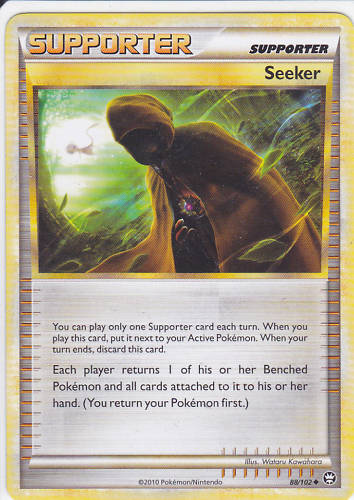
I have tested Warp Energy and Seeker the most and I love it! Even though I love it so much it lacks something! I played it at a local City’s and I didn’t do so well (mostly because I played 3 Vilegars) but I still love the deck. Just in case you don’t know how Warp-Seeker Works I’ll explain it a bit it’s pretty self explanatory. The idea is to tank with Gyarados and then heal it instead of recovering Gyarados like usual. You heal by attaching a Warp Energy to Gyarados to force it to the bench then you bring up something with free retreat. After you get a damaged Gyarados to the bench you use Seeker and pick Gyarados back up and lay it back down if you have Broken-Time Space (witch you should) and then retreat your active and continue to attack with Gyarados. This version usually runs less Rescue Energy because of the healing factor but a couple Rescue Energy isn’t a bad idea.

Original:Sableye - SF

I have found a lot of people just run Gyarados like it was originally. By “run it originally” I mean like how the original Gyarados ran where you used Sableye to do a bit of discarding. As you probably know there is no more Felicity’s Drawing so in place of it they use Volker’s Philosophy to discard one then draw cards till there 6 in their hand. Although I don’t really like this method and think that the other ways are more effective, this is still a good way to play the deck. Besides most of the Gyarados lists I looked at played 2 Volker’s Philosophy anyway. This version usually plays a couple Warp Points and has plenty more room for techs if you would rather have a more teched out list.

Heavy Warp Point and Cyclone Energy Lines:

Another version I like a lot is Gyarados with heavy lines of Warp Point and Cyclone Energy. This is a very effective deck and a great way to play Gyarados. The idea of this is that Gyarados is to take a prize a turn. If there is  a tank in your way you Warp Point of Cyclone for something you can easily kill to take a prize. Most of the time this deck runs extremely heavy Crobat G lines and Poke Turns to ensure a KO (or possibly a KOs turn 1) or even a quick DONK. This version of Gyarados tends to do very well and you should definitely watch out for it.

Mesprit and Giratina:

Last but not least we have Gyarados with Mesprit (LA) and Giratina(PL). I really have no idea how to recommend lines for this because a guy at one of our City’s won with this deck and I have no idea what his lines are. If I had to guess I would say 1 Giratina and 2 Mesprits. Please remember that is just my guess but I haven’t got to do any testing with it but I plan to. Sorry about not being able to explain this version but at least you get an idea! Another more common version of Gyarados is Gyarados with just Mesprit (as in no Giratina) and I believe these list tend to do pretty well in tournaments and I believe there was one of these Gyarados at worlds last year.

Deck Staples:

Gyarados has a lot of staples as well. In case you don’t know what a staple is, it is a card that is essential to a deck. Here is a list of some staples:

-4 Magicarp (SF)

-3 Gyarados (SF)

-2-4 Sableye (SF I say 2 depending if you run another starter or not)

-1 Unown Q (MD)

-1 Regice (LA)

-2 Uxie (LA)

-1 Azelf (LA)

– 3 Pokemon Collector (HS)

-1 Bebe’s Search (RR)

-2 Pokemon Rescue (PL)

-2 Rescue Energy (Triumphant)

-3 Broken-Time Space (PL)

-1 Combee (SF)

*NOTE: Please remember that this is a list of what every Gyarados list should run, however the number of each card you play may change depending on what version of Gyarados you choose to play.

Possible Techs:

As I said before Gyarados is a very versatile deck now and can be played many different ways. I went over each version and a couple of the techs above so I may repeat a few below more in deaf.

Seeker:

Seeker is a great tech for Gyarados weather you run Warp Energy or not (although I would highly recommend you do) because it improves your matchup against decks that trainer lock because you can reuse cards like Uxie. Seeker is also a great card now because Gyarados has a huge DONK potential and Seeker could help ensure your DONK by making them pick up their last bench and being stuck with a lone active. Seeker is definitely a tech you should consider!

Dialga G LV.X:                                                                                                                                

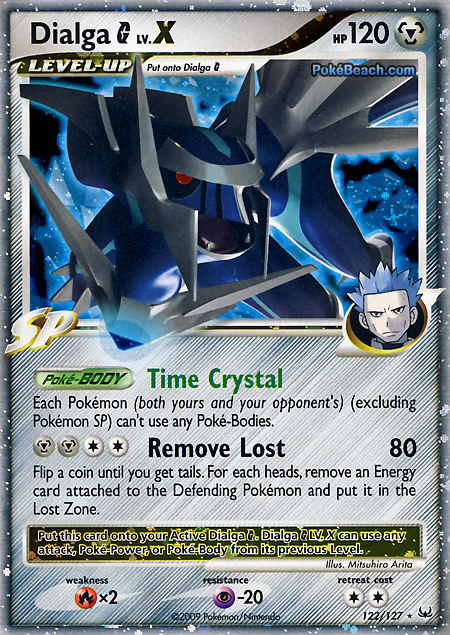
Dialga G LV.X is a card that I don’t tech in a lot but everybody tells me it’s great in Gyarados so I thought I should still say something about it. Basically the idea of Dialga is to break yourself out of sticky situations like a Vilegar match where you are trainer locked because Dialgs’s”Time Crystal” Poke-body blocks Spiritomb’s “Keystone Seal” Poke-body as well as Vileplume’s “Allergy Flower” Poke-body, witch both prevent you from playing trainer cards. Please note that Dialga doesn’t really work well without Warp Energy in the deck as well. You could get away with playing Warp Point in this case though because you are blocking their Poke-body that prevents you from playing trainers. Overall Dialga is a decent tech I just thinks it’s more of a personal thing.

Mesprit:

Mesprit is a very good card to play in Gyarados because of it’s “Psychic Bind” Poke-Power witch prevents your opponent from using any Poke-powers during their next turn. I did talk about Mesprit above because it is a good card but I would be extremely worried about if you have the bench room to actually play Mesprit on the bench. If you run Mesprit I would definitely run Seeker to help keep your bench from clogging. This is a really great tech for Gyarados though, and in many other decks as well!

Warp Energy:

Warp energy is an extremely good card in Gyarados. This can be used in a lot of situations such as a quick retreat or getting rid of a Regice you starting with. It is also great for if Regice or a high retreat Pokemon gets drug active. Like I said a couple times now if you play Seeker you should probably run 2 or 3 Warp Energy and if you run Warp Energy you should run Seeker as well!

Smeargle:

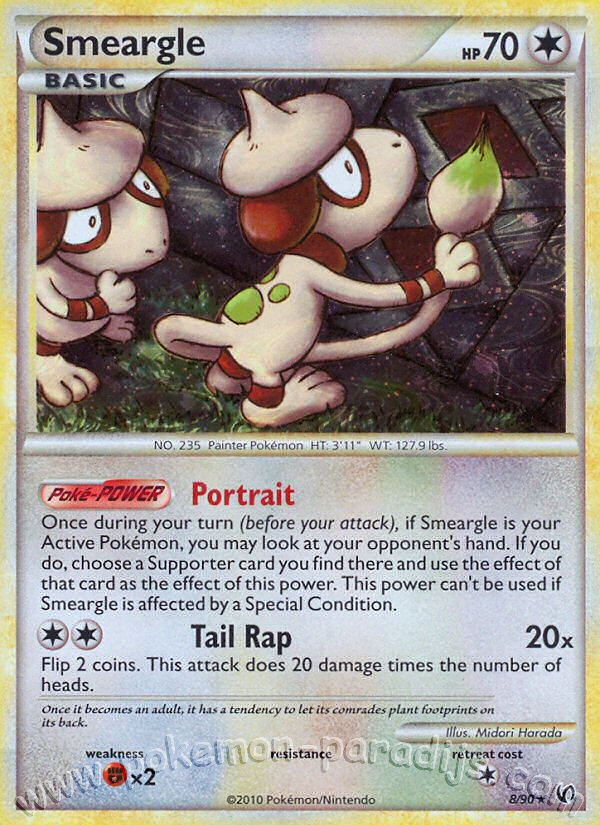
This is a tech that a lot of people find odd in Gyarados. There are 3 main uses for Smeargle in Gyarados mainly because he is a great starter. Another reason Smeargle is good is it gives you some recover late game. You bring Smeargle active and use 2 Supporters a turn to hopefully recover Gyarados. The last reason Smeargle is good is because if you play Warp Energy you can attach a Warp Energy to Gyarados and bring Smeargle active the play Seeker heal and possible use another Supporter or if your opponent uses Seeker in there deck you could use Smeargles “Portrait” Poke-power to use their Seeker. Also if you choose to run Smeargle you should consider playing a second Unown Q.

There are a lot more techs I could go on about but these are the main techs you should consider. On this short list I tried to name ones that would fit into all of the different versions but things like Mesprit won’t fit into every version of Gyarados. Don’t be afraid to try out your own tech ideas either, or tech ideas I haven’t listed.

Conclusion:

Gyarados is definitely the Most Ridiculous Deck in Format (MRDIF) by a long shot! I believe Gyarados is mainly so ridiculous because it can be played in so many different ways, shapes, and forms and is definitely a competitive deck. I have also found that Gyarados has very few bad matchups, even Luxchomp is a decent matchup depending on what version of Gyarados you run. Well I hope everyone enjoyed ready my long article about Gyarados and I would love to read any comments and answer any questions you have so be sure to leave a comment bellow!

-Bitty-

Opinion: Pikkdogs says stick to your age group.

Hey all you members of Omar-Nation.  This is Pikkdogs here. I will speak to you soon about the release of the new triumphant set, but today I will talk about age divisions in Pokemon.                                                                          

Speaking of Triumphant, this weekend is the start of pre-release tournaments.  So if you can, head out to your local tournament this weekend and get involved in the tournament.  This set should be pretty impactful, even with the recent news that Lost World will not be in the set.

We all know that Pokemon is a game that is popular with younger people.  I admit that I too played the game when I was young.  But, the fact is that Juniors and Masters are different.  We run different decks and play different styles.

We also know that because of this fact TPCI has made three age divisions: Junior, Senior, and Master.  With younger people laying in the junior category, the tweens playing in seniors, and high school age and older in the master category.   These divisions were a great idea, it keeps people of similar skill levels together.  There are a couple great senior players that can play with any master, but for the most part the age divisions are great.

What isn’t so great is when people are forced to play outside of their divisions.  These matchups are embarrassing, unfair, and pointless.  These matchups usually happen when one age group doesn’t have enough players for their own tournament.  When this happens age divisions mix and people are forced to play outside of their age division.

This article will try to argue that Play Pokemon should outlaw playing outside of your age division at all tournaments that effect your rating.  This  article will be written in the perspective of a masters player.

First, playing outside of your age division is pointless.  It does not effect your rating, so why are we playing this matchup?  It would be better to play a player in your own division who has a lesser record, then to play a game that has no effect on your rating.  It would even be better to take a bye, and get a win then to play a no-win game.

Why is this type of game a no-win game?  This is because, if a masters player defeats a junior it is doing something that he/she is supposed to do, and if the masters player loses it is a complete embarrassment.  I admit that sometimes a junior player can beat a master’s player.  But, for the most part a Master will always beat a Junior, they usually have better decks and more advanced skills.  It isn’t fair for the junior who has to play out of his league, and its not fair for the masters player who will face infinite embarassment if he/she does lose.

Another reason is that playing down in your division seems to take the player off of his/her game.  Every game that I play with a junior or a senior seems to feel like a practice game.  Personally, playing down makes me feel like I’m doing my opponent a favor and take me out of the game.  At a Pokemon tournament, a player needs to concentrate and keep momentum going, playing a younger person can throw someone off of his/her game and ruin his/her tournament.

So I propose, that except in cases where both the junior and senior divisions don’t have enough players, that combining divisions should be abolished.  If the senior division only has 4 players, let them play 2 or 3 games and call it a day. This would be a smart business decision for TPCI, because it might encourage those seniors to bring their friends to the next tournament, so more people will join the game.  Also, adding byes will be preferable to pairing people outside of their own age division.

So what do you guys think?  Am I crazy?  Well of course I am, but is my opinion of this topic crazy?  Do you guys feel the same, or do you like playing younger people.

Until next week this is Pikkdogs signing off saying, So long and thanks for all the fish.

The Truth About Trainer Lock

Hey everyone in Omar-Nation, this is Pikkdogs here with an informative strategy article.

As we know, after this month’s Worlds tournament, SP decks have become even more popular.  But since then the new Vileplume card has come out, some people think this will change the format.  The interweb has been abuzz lately with players talking about trainer lock.  There is two distinct camps, one saying that SP decks will endure past trainer locks easily, and others who have tested the matchup and don’t see a way for SP decks to continue.                                                                                                                                                                                          

While I don’t think I am qualified enough to settle the debate today, I will write an article for beginners about all aspects of trainer lock.  At the end of the article, I will add a little of what I have learned.  So without further interuption lets talk about trainer lock and highlight some of the cards that have started this controversy.

How does it work?

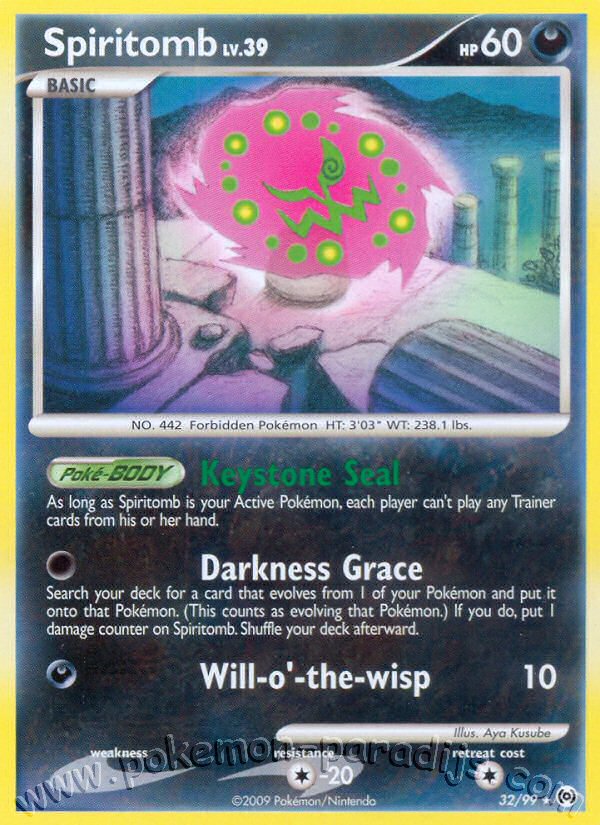
So what is trainer lock?  Well that is a very easy question, it involves not letting your opponent use any trainers.  That seems simple right, but it is something very important.  If you can maintain a trainer lock all game, you can possibly shut down all SP decks, Gyarados decks, and all speed decks that require trainers.  Trainer lock is nothing new to this format, Dialga G and Gastly Sf have been doing it for a year, but now with some new cards the trainer lock can be applied the entire game.  A new trainer lock deck that maintains a lock all game will usually start with Spiritomb Ar, and then set up Vileplume Ud.

Vileplume UD

This card is the card that makes trainer lock a real possibility.  This isn’t a card review, but I will break down some basic stats of the card.  It has 120 HP, is a stage 2 Grass Pokemon, with a 2 retreat. Its Poke-Body, “Allergy Flower,” prevents both players from playing any trainer card from his/her hand.

So whats good about it?  A trainer lock that works from the bench.  Whats bad about it?  It is a stage 2 so it will take a while to set up, it has a 2 retreat cost, and a bad attack.

Spiritomb Ar

Spiritomb Ar is a great card that lets you start a trainer lock from turn 1.  If Spirtomb is your active Pokemon, his Poke-Body “Keystone Seal” kicks in and no player can play any trainers.  It also has a good attack called “Darkness Grace” that lets you search your deck that directly evolves from a Pokemon on your bench and put it onto that card.

So whats good about it?  It lets you apply a trainer lock early and helps you set up.  Whats bad about it?  Its body only works from the active spot, it has a 1 retreat cost, has only 60 HP, you have to run 4 of them to have a decent chance of starting with it, and it can be “Chatterlocked” (locked into place with Chatot Md’s attack “Chatter”.)

Gastly-Haunter-Gengar SF                                                                                                                                                                        

This Pokemon line has often been combined with both Spiritomb Ar and Vileplume Ud to complete a trainer lock deck.  Gastly has an attack called “Pitch Dark” that doesn’t allow your opponent to play any trainers during his/her next turn.  So if you don’t start with Spirtomb, then Gastly is second best.  Haunter has an attacked called “Hoodwink” with does 30 damage for 1 Psychic Energy, and lets you put 3 trainer, stadium, or supporter cards from your opponents discard pile to their hand.  This attack powers up Gengar, who for PC can do 30 damage for each trainer, stadium, or supporter card in their hand.  This is important because you can take advantage of all the trainer cards that are clogging up your opponent’s hand.

So whats good about the Gengar Sf line?  It has synergy with the Viletomb combo and is a good heavy hitter in this deck.  So whats the drawback about the Genar line?  It takes up a lot of space because you are incapable of running any Rare Candies.

Dialga G Lv.X

Dialga G is going to see a lot of play early this year, that is because the Lv.X has the “Time Crystal” Poke-Body that turns off all non SP Poke-Bodies.  But it can also lock trainers itself with its “Deafen” attack.  But here we will talk about Dialga G Lv.X as a counter to the Viletomb trainer lock.  His Pokebody will turn all Poke-Bodies off, including those of Vileplume and Spiritomb.  So if Viletomb decks do not have a Dialga G X counter they will lose.

So whats good about Dialga G X.  As mentioned the Poke-Body shuts down this deck, and can fit into almost any SP deck, and other normal decks.  So whats the catch?  A Gengar Viletomb deck can use Gengar Lv.X’s Poke Power “Level Down” to get rid of Dialga G’s Lv.x.  Making a matchup between these two decks very exciting.

That takes care of the big names in the Trainer Lock debate, but here are some other names that I have used in this matchup

Gengar VileTomb Techs

The tech that I have tried in this deck the most is Crobat Prime.  Crobat Prime has an attack that can poison the defending Pokemon for 4 damage counters between turns, for just 1 psychic energies.  This makes it an ideal counter for Dialga G, since it has a Psychic resistance and a high retreat cost.  Another tech that I have yet to test, but am sure it will work, is Kingdra Prime.  In this deck I would not run any water energies to allow Kingdra to attack, but instead just his Poke-Power “Sea Spray.”  This power lets you place on damage counter on one of your opponents Pokemon each turn.  This means that with “Sea-Spray” Gengar can KO any Uxie, Mesprit, or Azelf in just one attack with “Shadow Room”.                                      

Anti-VileTomb Techs

One anti-VileTomb tech that I think has potential is Muk Ud.  Muk has an attack that lets you switch your opponent’s active Pokemon with one of their bench, the new Pokemon is now poisoned and burned.  His second attack costs PCC and does 50 damage plus 30 more if the defending Pokemon is effected by a special condition.  This is a good tech  because if you  Muk’s first attack on Vileplume, and your opponent is unable to retreat Vileplume, you will be able to knockout Vileplume for just 1 more DCE. Other techs for SP decks include an extra Bebe’s Search, to get Dialga G LV.X back after he was leveled down, and a 2-2 Dialga G Lv.x Line.  But be careful in teching your list out too much, or it will lose to other decks.

My Thoughts

So those are the basics of Trainer lock and the counter to it.  Most decks in this format run a lot of trainers, so locking them can be key.  The Gengar VileTomb deck can change the game by locking all other decks down.  But then again, perhaps Luchomp decks can counter them with just a simple 1-1 Dialga G Lv.x line.  This is what I found:

Just a disclaimer before I tell you about my testing, I did build an anti VileTomb Luxchomp deck, but I consider myself a bad SP player so this fact can skew the results.

Well in all my testings I have found that the Gengar VileTomb deck is one of the best in the current format.  No deck that I can think of can effectively counter the trainer lock.  Sp decks can snipe VileTomb, but it will take a long time thanks to the lack of Energy Gain.  SP decks can also use “Bright Look” and “Luring Flame” from Luxray Gl and Blaziken Fb (respectively) to bring Vileplume active.  But the Vileplume player can just attach an unown Q, attach an energy, then retreat for Gengar.  Dialga G Lv.X can also possibly cause Vileplume problems by turning off “Allergy Flower.”  In response  the VileTlume player can just use Judge or Lookers Investigation (to get rid of Power Sprays) and then use “Level Down”.

To me it seems like trainer lock decks will be very good, I don’t really see a way around them. I don’t consider myself a great player so I am probably wrong, but thats what all my testing has proven.  This conclusion is just my opionion, feel free to test the matchup and draw your own.

The only way that we will know the truth about the trainer lock debate is when the new season starts up again.

Besides Gengar, other trainer lock decks can use Mismagius Ud Bellossom LA or other Pokemon as main attackers.

So what do you guys think, can trainer lock decks really rule the format?  Or will Luxchomp still rule the day?

Strategy Article: Harnessing (or Repelling) the Power of Power Spray

A big hello to all members of Omar-Nation, your buddy Pikkdogs is here to bring you a quick strategy article.

We all know that most decks in the upcoming format will rely on Uxie LA for draw power.  Just by putting him on your bench you can draw until you have 7 cards in your hand.  A lot of decks will be counting on getting good draws with Uxie for their deck to work.                  

But we also know what the counter to Uxie La is, Power Spray.  As long as you have 3 Pokemon SP in play you can play this card on your opponents turn and cancel out the effects of your opponent’s Poke-Power.  And without drawing those extra cards, most decks are locked down.

So Power-Spraying Uxie is good, but what are the best ways to use Power Spray, and what ways can you get around Power Spray?  Here are a list of ways to use Power Spray effectively and how to play against it effectively.

Ways to use Power-Spray

1. Use it Early– The most effective Power Sprays come early in the game before your opponent can fully setup.  You might want to run Call Energy or 4 Pokemon Collectors in your SP deck to get a lot of basics out quickly, which allow you to Power Spray. These things should help you have enough basics so you are able to Power Spray an Uxie.

2.  Run 4 in your Deck–  Power Spray is a good card and should occupy 4 slots in a normal SP deck.  There are some situations in which I only run a couple, but most SP decks should run 4 so you have a good chance at starting the game with it.  Drawing into the card is also key to keeping the surprise factor, as opposed to showing it to your opponent as a part of Cyrus’s Conspiracy.

3. Keep it a Surprise– This goes with the last step, if at all possible don’t show Power Spray to your opponent.  If your opponent knows you have a Power Spray in your hand he/she will either play around it or use a card like Judge or Looker’s Investigation to send your Power Spray away.

4.  Think it Through– Just because your opponent is using a Poke-Power and you have a Power Spray in your hand doesn’t mean that you have to spray it.  Save your sprays for something you really don’t want your opponent to do, don’t let your opponent play you like a fiddle.

5. Don’t Sleep on the Spray–  Your opponent may take a long time on his/her turn, but don’t zone out.  Keep close watch on what he/she is doing and the minute they try to use a Power that you don’t want them to, drop that spray.  This also goes back to the fact that before a tournament you should get enough rest and a good breakfast, so you don’t lose focus (yes, the Frosted Mini-Wheat commercial is right “Keeps em full, Keeps em focused.)

Ways to Avoid the Spray

1. Know Your Opponent–  Before the tournament do some studying and find out what decks run Power Spray and what decks don’t.  And if you think your opponent runs Power Spray then be aware when your opponent gets the card.

2. Decide when to use a Poke Power–  So what do you do if you need to use Uxie La, but you know your opponent has a spray?  You can try to use it quickly if you think your opponent is sleeping, but that doesn’t work against good players.  You first can try to use a Poke Power that you don’t really need and see if the opponent will spray that instead.  SP decks can drop extra “Flash Bites” or normal decks can include a Pokemon that has a sole purpose of using  up opponent’s Power Sprays (the new Smeargle comes to mind).  If all those options don’t work you can use Uxie anyway to make your opponent burn the Power Spray or choose to use your resources so you can try to run your deck without Uxie.  It may be worthwhile to play Uxie just to evolve into Uxie Lv.X.

3. Get Rid of the Sprays– It may be helpful to include a lot of Judges or Looker’s in your deck to get rid of your opponent’s Power Spray.  But also make sure to include a lot of  Pokemon Communications and Uxies in order to get an Uxie after to use Judge.

4. Lock em up–  One of the best ways to protect against Power Spray is to make sure that they can’t use the card.  If you have an active Spiritomb Ar or a benched Vileplume UD, your opponent cannot play any trainers, so they can’t play Power-Spray.  Spiritomb makes an excellent shield for you to drop as many Uxies as you want, then use Unown Q’s power, “Quick”, to retreat Spiritomb and then attack with your main attacker.   Vileplume may be a little slower then Spiritomb, but it will be very hard for an SP deck to get the win over any deck that gets Vileplume out in the first several turns.

So that’s what I learned about using and playing against Power Spray.  I encourage you guys to share your stories about playing and playing against this card.  My favorite moment was when I was playing against a BlazeRay deck.  I had a Claydol out and I knew my opponent had a Spray in his hand.  I only had one card in my hand, which was a Level X that I wanted to play next turn.  So Power Spray or not, I didn’t want to use “Cosmic Power” this turn because that would take away my Level X.  But since I knew he had a spray in his hand, I used “Cosmic Power” anyway, he sprayed it, I laughed, and next turn I used “Cosmic Power” for the cards I needed.

Thats all for today, once again this is Pikkdogs signing off saying So long and thanks for all the fish.

Breaking News: Format Rotation Announced

It looks like the post-rotation format has been officially announced. Take a look at the official announcement at Pokemon.com.

Here’s what the new format will include.

  • Diamond & Pearl—Majestic Dawn
  • Diamond & Pearl—Legends Awakened
  • Diamond & Pearl—Stormfront
  • Platinum
  • Platinum—Rising Rivals
  • Platinum—Supreme Victors
  • Platinum—Arceus
  • Rumble
  • HeartGold & SoulSilver
  • HS—Unleashed
  • HS Trainer Kit

What do you think about that? Personally, I’m disappointed. I was hoping for more of a clean slate to start working on new decks. The metagame will shift, but it doesn’t look to be a major change.