A big hello to all you OHKOers out there. This is Pikkdogs here with a deck analysis. The deck we will be spotlighting is Reshiphlosion, a very consistent and hard hitting deck in the current format. Some are wandering if it can stand up to Pokemon Catcher, so lets find out.
I had realized a couple days ago that this website has not had a Reshiphlosion list on it. So I thought I would change that. I will be happy when this article is published because people always come up to me and shout, “Hey,when are you going to write a Reshiphlosion article? and stop staring down my shirt!” Sometimes even girls say this.
Anyway, The deck was popularized at U.S. Nationals. It seemed like everybody was going to play Reshiboar, and then everyone showed up with Reshiphlosion. The deck is really powerful and really consistent because it can manipulate energies very well. Just about every energy that you draw will be used and re-used thanks to Typhlosion Prime. Its that energy manipulation that makes Reshiphlosion really good.
If you do not know the deck I will try my best to explain it. The first goal of the deck is to get as many Typhlosion Primes out as possible. His “Afterburner” Poke-Power lets you attach a fire energy from the discard pile to any of your Pokemon, and you also place a damage counter on that Pokemon. Fire energies get discarded in two major ways, either from the discarding required from Reshiram’s “Blue Flame” attack or from Ninetales HGSS’s “Roast Reveal” Poke-Power. “Roast Reveal” lets you discard a fire energy and discard 3 cards. This is great for both drawing and energy acceleration.
When I play this deck I usually try to get at least 2 Typhlosions out and a Reshiram active. If you have to sacrifice a couple prizes to get the primes out, it is no big deal, those cards are that important. If possible I will try to get out the Ninetales once I get the Reshirams on the right track.
One unique thing about my Reshiphlosion that I haven’t really since in other decks is the inclusion of Sucine/Entei Legend. Since it is a dual Water/Fire type, it can hit Reshiram for weakness making it a good tech against the mirror matchup. It can also hit Donphan Prime for weakness, this is great because it is tough for Reshiram to OHKO Reshiram. SEL has the “Bursting Inferno” attack that does 80 damage and causes the burn special condition. This 80 is enough to OHKO Donphan Prime, Reshiram, Emboar, and Typhlosion Prime. The only draw back is that if SEL gets knocked out your opponent takes 2 prizes, so make sure you use SEL in a wise way so it does not get knocked out.
I will now provide the list that I am testing with. Just to let you know, this list is just a rough draft of what I am working with. It is not yet polished enough to be taken to a tournament. I only provide the list to give you something to test with.
Pokemon-14
4-Reshiram BW
3-Cyndaquil
2-Quilava
3-Typhlosion Prime
1-Vulpix
1-Ninetales HGSS- I would like to get a 2-2 line, but so far 1-1 has been working. If I did take this to a big tournament, I would go 2-2.
1-Bottom Half of Suicine/Entei Legend
1-Top Half of Suicine/Entei Legend. I sometimes think of going 2-2 for SEL. I guess it depends on your metagame.
Trainers-32
4-Professor Juniper-There are some people who don’t like to have 4 Professor Junipers in every deck, these are what I like to call members of Al-Qaeda.
2-Engineer’s Adjustments- Nice for getting energy in the discard.
2-Professor Elms Training Method- 2-3 will be standard if Trainerlock is as prevalent as I think it will be.
1-Energy Retrieval
4-Pokemon Communication
3-Junk Arm
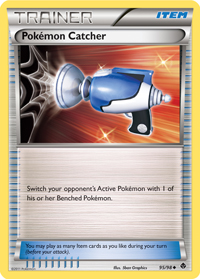
3-Pokemon Catcher
1-Switch
4-Pokemon Collector
1-Dual Ball
3-Rare Candy
3-Plus Power
1-Max Potion
Energy-14
Fire-14
So here is a some-what modified version of the Reshiphlosion deck that I am playing. Of course my lists tend to have a lot of cards that have just 1 or 2 copies, just so I can see if I like the card. If I were to make this a tournament list, I would probably play 2-3 of everything or take it out. And of course, this list is adjusted to my weird play-style. So you are gonna have to adjust it to yours.
I will not do a matchup analysis for this deck because it is pretty simple. Reshiram is great against almost everything, especially Yanmega Prime. Use SEL wisely against the mirror and Donphan. Against Trainerlock you might only get to have 1 or 2 Typhlosions. This makes it tougher, but the situation is the same, you just need to hope they cannot match you blow for blow. Against a disruption deck you should just use “Outrage” to knock out Ambipom or Sharpedo. That is basically all you need to do.
Well that’s all for today. If you would like to post your list in the comment box, everybody will be very appreciative for sharing your ideas.
Hey everybody, my name is Jordan Baker. I’m 22 years old, I live in Michigan, and I’m a founding member of Team Warp Point. I’ve been playing Pokemon for just about two years now and you’ve probably never heard of me. My biggest accomplishment is making it to the top 16 round two years in a row with stupid ridiculous decks. Stupid, funny, quirky, gimmicky decks are sort of my specialty. I don’t really like playing meta decks and I despised SP decks with a passion when they were in format. However, I won’t play a deck just because it’s rogue, I also want it to be good.
I’m going to give you a really quick recap of some of the decks I’ve played over the past two years and then discuss my current deck that I’ll be playing for Worlds this year.
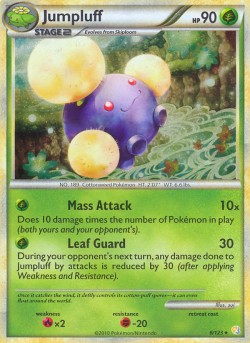
My love affair with rogue decks started last year at Regional’s. Jumpluff had just come out and I decided that I wanted to play it. There were a lot of other people playing Jumpluff at regional’s, but most of these were JumpLux variants relying on Luxray G. Lv. X. My list played a heavy Sunflora line, and 3-2-3 Metagross LA, which has a built in Pokemon reversal in the form of a Poke-Power. For some reason the deck worked and I made it into the top cut, and past the round of 32 before being eliminated in the top 16 by JumpLux.
After regional’s we got Unleashed and my Nationals deck was born. I played Blastzel with 3-3 Floatzel and 3-3 Claydol. I started out 4-0 at Nationals before running into a Luxchomp list running Entei Raikou Legend. I had four Pokemon with 80 HP in play and my opponent took 4 prizes in one turn with Thunder Fall. I figured that ERL was going to be pretty rare and I went on with my day. Unfortunately my next opponent also played ERL and was able to pull of a quintuple KO. Needless to say, I wasn’t having a good day. I lost another game somewhere down the line and ended up dropping.
Probably my proudest rogue moment was playing Rampardos (PL) at this year’s regional championships. Nobody had a clue what Rampardos did or how to play against it. If I went second I was often hitting for 80 1st turn for just one energy. It had a surprisingly good Luxchomp match-up and I ended up making top cut. I beat a DonChamp deck in top 32 before running into my work nightmare in the round of 16. Mesprit. Rampardos relied heavily on Uxie drops and Unown R’s to get rolling as well as my own Mesprit and Crobat drops. My opponent’s Mesprit drops destroyed that plan.
OK, enough talking about out of format rogue decks that nobody cares about, or ever cared about. Onto what everybody actually wants to see.
Below you will see a different take on Stage 1 Rush. This is a list that myself and my brother Evan Baker have been testing for the past month.
Decklist? Decklist.
Pokemon
T/S/S
Energy
4 Yanma
3 Yanmega Prime
3 Zorua
3 Zoroark
3 Chinchou
3 Lanturn Prime
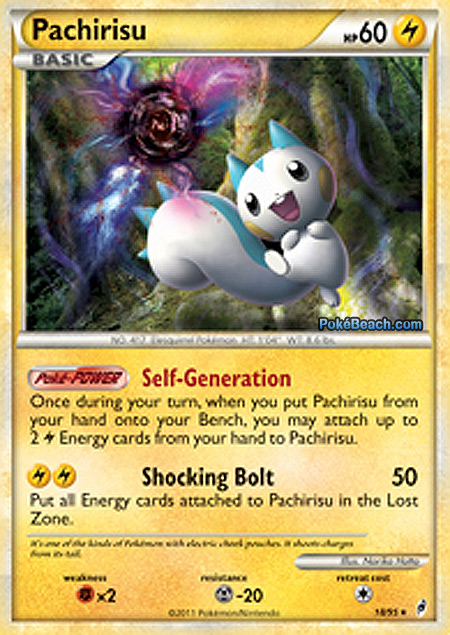
1 Pachirisu Cl
1 Cleffa
4 PONT
3 Copycat
2 Juniper
4 Communication
4 Reversal
3 Junk Arm
1 Switch
1 Pokegear
1 SSU
8 Lightning
4 DCE
In our testing this deck has a favorable matchup against just about everything except Yanmega/Magnezone. which is probably 40/60 unless you can get a good start and consistent energy drops.
I know many of you are going to be looking at Lanturn Prime and wondering why it’s in there. In actuality, it’s an awesome card right now and definitely overlooked. For a DCE and 1 lightning Lanturn OHKO’s just about everything that is big right now. Donphan, Reshiram, Yanmega, Typhlosion, Kingdra, etc. That much versatility in a single Pokemon is pretty impressive. Sure it get’s OHKO’d by some of these Pokemon too, but only Donphan is quicker and a smart player with this list should easily be able to outplay the traditional Stage 1 rush list. Being able to hit for two different weaknesses is really nice.
Pachi is in here for the Magnezone matchup. A well-timed Pachi drop allows you to OHKO a Magnezone without your opponent ever seeing it coming. It is also useful in the rare occasion when you need to add a couple extra damage to Lanturn’s Powerful Spark attack. Super Scoop Up and Junk arm allow you to use this tactic multiple times if necessary.
The rest of the deck is pretty self-explanatory. It definitely takes some skill but the versatility of this deck allows you to outplay your opponents in a format that is basically luck based/attach and attack right now.
Who knows if this deck will still be viable when the new set comes out. It’s basically a Meta-counter right now so it really just depends on what the Meta is in a month’s time. Catcher will definitely help this deck. Everything retreats for cheap and reversal is already a huge aspect of the strategy.
Hopefully the deck works out at Worlds. I’ll be grinding in and Evan has an invite, so I guess we’ll see what happens.
This article is part of OneHitKO’s Guest Writer Week for August 2011. Please check out all the articles in the series, and please give the authors your feedback in the comment section below.
Hey guys. Today’s article starts off with an apology from Jay. You need to realize that Jay is now at Worlds. I got this from him via email so late on Friday night that I didn’t even see it until Sat morning. Jay has better things to be concerned with at this point, yet he was up writing this article for you and I. I think, in his mind, he agreed to write something, and he wasn’t going to go back on his word. In that case, he could have just gotten behind and just gave it half an effort. Nope. He gave us a great retrospective and then apologized that he wanted to give us more but couldn’t. Thanks Jay! We hope you’re killin’ it at Worlds!
– Ed
So first an apology. Originally I had intended this to be a very detailed look back on the formats of the past. I always enjoyed looking back at some of the different formats and seeing what was competitive, what people liked to play, etc. and I was hoping you guys would to. I ran into two major problems when I was writing this article though.
First, I told Ed I would have this done the week I was leaving for Worlds, which, at the time, I didn’t think was a major issue. This deadline snuck upon me much quicker than I thought it would, and real life got the better of me. Those of you who have read my Underground Articles for Six Prizes, know how important good solid articles are to me, and I’m afraid this doesn’t live up to my normal standards.
Second, going in, I didn’t realize how lengthy this article could and should be. I could write a full article about each one of these formats, and it wasn’t until I started writing did I realize how much information I was leaving out that I really wanted to put in. All of this being said, I really do hope you get some enjoyment out of this article, since I do feel it does have some nice information in it people will enjoy. I guess what I’m asking is for all of you to accept this more as rough draft or partial article rather than a finally polished one. I will be more than happy to answer questions or comments about anything I talked about or a deck I didn’t get to you wanted to know more about.
-Jay
Something I’ve always found interesting is going back and reading tournament reports from previous years. It normally brings back good memories of friends and tournaments, so for those of you who’ve been here since the beginning hopefully you’ll enjoy this walk through memory lane and for those of you who are more new to the TCG hopefully you’ll enjoy learning a little bit about our history.
The Early Years
I don’t remember how the divisions worked, but I knew there was two divisions an older and younger division. The older division actually had a metagame that was mainly dominated by variations of Haymaker, Raindance, Mr. Mime/Alakazam, and Wigglytuff/Basics. The younger was dominated by mostly random stuff. Read More
At this year’s nationals, I had my best nationals finish. I made Top 64, but it was bittersweet. While I had done fairly well, I still made the same mistakes in deck building and deck choice which had led to my poor results in previous years. I played a build of a deck which was largely untested and that I was fairly unfamiliar with. While the list I played was by no means bad, it did suffer from being teched improperly. In addition, there were logical flaws with the trainer engine and how it synched with the rest of the deck.
This article has two main points. First, it will provide some insight into the Mew/Muk Jumpluff/Vileplume archetype. Second, it will showcase some of my thoughts about the deckbuiling process highlighting what I did wrong with this deck. Right now. I’m going to share the list I played and explain my reasoning behind my choices. Also, let me state that this list is not just my own. Emmanuel Divens is also a co-creator of this build and a lot of the ideas behind this list can be attributed to him.
A big hello to all you OHKoers out there. This is Pikkdogs here with a deck analysis. This deck is a disruption deck that became popular after its great showing at Canadian Nationals. Like all of my lists from the last week or so on, this deck will be in the post Pokemon Catcher format. Even though the card is not out right now, it is very important to start testing Pokemon Catcher right now so you will be ready for it in the fall.
This deck is all about hand disruption. The goal is to have Ambipom attacking and disrupting, while Weavile is on the bench knocking out helpful cards from your opponent’s hand, and Slowking is on the bench making sure your opponent does not draw anything good.
Ambipom is a stage 1 that has two attacks. His first attack, “Astonish” lets you do 20 damage and then choose 2 random cards from your opponent’s hand and have them shuffled back in the deck. The second attack, Tail Spank (is that code?) does 60 damage and you must discard 2 cards. 60 might not sound like a not of damage, but it can be enough if you are able to attack weaker Pokemon with Pokemon Catcher, or if you attack a basic or stage 1 before it can fully evolve. Weavile is used because of his “Claw Snag” Poke-Power. Whenever you evolve a Weavile you can look at your opponent’s hand and discard 1 card from that hand. Weavile can snipe for 30 damage, but this attack is not used that much. Slowking is used for his “Second Sight” Poke-Power. This power lets you look at the top of either decks and re-arrange the top 3 cards.
The goal of this deck is to make sure your opponent cannot draw anything useful. The first thing you should do is get a Pokemon Collector and get 1 of each basic Pokemon, that means a Slowpoke, an Aipom, and a Sneasel. I would first try to get an Ambipom active with a DCE. Then I would use Judge to cut your opponent’s hand to 4. Then I would hopefully be able to use “Claw Snag” to get rid of any supporter or other helpful card. After that, I would use “Astonish” to shuffle in two cards of your opponent’s back to their deck. At this point your opponent will draw a card and have 2-3 cards in his/her hand. Usually your opponent will not be able to do too much. Next turn you should be setting yourself up for another “Claw Snag” soon, and should be setting up another Ambipom. Now, the most important thing would be to do a “Second Sight” so that your opponent’s hand will not improve. Then, hopefully you should be able to use “Tail Spank” for a knockout. Then you should be able to take it from there.
Matchups
Right now SAW does not have the best match-ups, so I won’t list all the matchups up like I normally do. This time I will list what this deck is good against, and what this deck has problems with.
What the Deck is good against
This deck is really good against decks that take a little while to get going. This is where decks like Magneboar come in. Decks that rely on 2 Stage 2 Pokemon are really easy for this deck to play against. The disruption that this deck has makes it very tough to get more than 1 Stage 2, and Ambipom should be able to easily knock out important basics and stage 1’s with Pokemon Catcher. It should only take you about 3 turns to get a hand lock going on them with Slowking Prime, it should just be a matter of time before you knock out 6 Pokemon. This deck is also good against deck that need high energy like Blastoise. You should be able to keep energy and other important cards away from the Blastoise player.
What the deck struggles against.
The deck struggles against decks that can attack early. Donphan is a really tough matchup for this deck. If the Donphan player gets a T2 Donphan with a fighting energy, the game is about over. The fast attacking Donphan is really hard to play against because he doesn’t need a lot of maintenance once he is setup. The other thing this deck struggles against is Zekrom and Reshiram, with the latter being the bigger problem. Ambipom can only do 60 damage at a time, and these Pokemon require 130 damage for an OHKO. If you do not OHKO these Pokemon, they can use the “Out Rage” attack to OHKO Ambipom. Zekrom is not as much of a threat as Reshiram, since it is a little easier to keep energy away from Zekrom.
The List.
I built a SAW deck when I was first testing Post Catcher decks. I ended up modifying it to a different deck with Sharpedo, so I do not have my original list. The list was nothing special anyway, so I do not have a problem trying to guess at my original list. The deck does work with this list, but of course the list is not perfect. I only post lists on decks like this so you can start testing with it and try to make it better and bend it to your play style. This deck needs some work, but it is a good list to start with. SAW is a decent deck that can be good in the Post Catcher Format. So if disruption is your thing you should copy this list and then change it to make it your own.
Pokemon-18
4-4 Ambipom
1-1 Slowking Cl- I would like to run a 2-2 line, but Slowpoke is such a horrific starter that I don’t want to.
3-3 Weavile-Important to have a bunch of these since you can evolve to Weavile, Seeker, and evolve again.
1-Boufallant-Can be dropped if you don’t have lots of RDL in your area.
1-Manphy
Trainers: 30
4-Pokemon Collector
3-Professor Elms
4-Judge
3-Professor Juniper
4-Pokemon Communication
4-Pokemon Catcher
3-Junk Arm
1-Flower Shop Girl
1-Switch
1-Dual Ball
2-Seeker
Energy-12
Double Colorless Energy-4
Special Darkness Energy-4
Darkness Energy-4
As you can see, the deck is not polished. It is just a place to start for your testing. Since I no longer have my list I did estimate some things, but this should get you going on your testing just fine. I think because of this decks bad matchups this deck may be just for fun. But, it is a really good deck that can surprise a lot of people. The only reason this isn’t tier 1 is because of the bad matchups that it is. Once the format changes a little, this deck could be really good. Regardless, it is a really cool fun deck that you should try if you haven’t already. What do you think of the deck? Please leave you thoughts in the comment box.
A big hello to all you OHKOers out there, this is Pikkdogs here with a post Pokemon Catcher deck analysis.
The subject of this article will be a deck that features Magnezone Prime and Floatzel. One of the most popular decks going into Battle Roads will be Prime Time (Magnezone Prime and Yanmega Prime), this deck is a little different. I consider this deck to be the spirtual successor to Mangeboar. I am unsure if this a tier 2 deck or a fun league deck, maybe you can help decide.
Since Pokemon Catcher will make it more difficult to run a deck with bench sitting Pokemon, I decided to try a deck that had energy acceleration and free retreat from the bench sitters. Now, you can still run Magneboar but in the Post Catcher (PC) format, the deck that started out a little shakey is about to get even shakier.
The decks main goal is to use Magnezone Prime’s “Lost Burn” attack to get a One Hit Knock Out each turn. To get more energies on the field, Floatzel is used. His “Water Acceleration” Poke-Power lets you attach a water energy to each Floatzel you have in play per turn, that does not include the 1 energy you can attach for your turn.
Of course this deck is very similar to Magneboar, so lets look at the pro’s and con’s of using this deck over Magneboar. Read More
A big hello to all you OHKOers out there, this is Pikkdogs here with another article for you guys. For the top 40 players in North America and the players in Southern California all eyes are on World Championships. All these people are thinking about is either countering the format or making a deck that will be consistent enough to grind into the main event. But, for the rest of us, we have our eyes on Battle Roads and the new season. And the new season means dealing with Pokemon Catcher.
Pokemon Catcher is a trainer card that lets you pick a Pokemon on your opponent’s bench and switch it with the active. The last time this card was released, as a card named Gust of Wind, it was the best card in the format. It ushered in an era of dominance for a very fast deck with all basic Pokemon. The question was will Pokemon Catcher have the same format changing effect as Gust of Wind did? To answer these questions I decided to test multiple decks in the PC (Post Catcher) format. The testing yielded some surprising results. To start this article off I will begin by running a “Mythbusters” type list about statements people made about Pokemon Catcher.
Mythbusters- Pokemon Catcher
1. Myth-Kenny Wisdom in his Sixprizes article said that some decks will be unplayable because they get destroyed by Pokemon Catcher. It would make sense that decks that rely on bench sitters would no longer be playable.
Verdict–Plausible. I have not tested a deck with a bench sitter like Reuniclus and Vileplume, but I would assume that it will be hard to setup 2 bench sitting stage 2s. But, if you need a bench sitter, it would be best to have either Gothitelle active or Vileplume on the bench.
2. Myth: On the SixPrizes forum, a user named Johnny Blaze wrote that all Stage 2 decks will be horrible because you can just catcher up the basic first.
Verdict– Busted. Stage 2 decks are still very playable. In fact one stage 2 Pokemon named Vileplume could become one of the most important cards in the format. Since everyone will be playing trainer heavy decks, the ability to take away the trainers will be amazing. Also, decks with 4 Pokemon Catcher don’t always get one when they need it, and they can’t always knock out a basic or stage 1 if they do find a Catcher. I think what is worse off than Stage 2’s are bench sitting stage 1’s like Weavile. If you don’t also have Vileplume in play, those quick stage 1’s become a problem because anytime the opponent draws a Catcher, they can then stall by bringing up a bench sitting stage 1. But when it comes to stage 2’s, it will be harder to get them out, but I would say they are still very viable.
3. Myth: Pokegym User Mew723 wrote that Emboar will be unplayable in the next format. If you think about it, catchering up a Tepig or Pignite would be hard to deal with.
Verdict– Busted. I have tested an Emboar deck, and while it is no longer quite as consistent as it once was. it is not unplayable. The same principle works in the PC era as it did in the BC (before catcher) era. You might have to alter the decklist a little, but for the most part you can still run a Reshiboar deck about as good as you could before.
4. Myth: This myth will address some of the comments made on my Pokemon Catcher article. The comments are: Cincinno will be big, Zekrom is good, babies won’t be as effective.
Verdict– Plausible. Cincinno is now a much more effective Pokemon than he was before. He can attack fast and is almost on par with Donphan and Yanmega in some respects. Zekrom was always good, he might be a little better now thanks to Yanmega being that good. Babies will not be as popular as they once were. Its just really easy to Catcher them up when you need, or to Catcher around them when they are asleep. But, a lot of decks will run at least 1 Cleffa to help as a hand refresher.
Pokemon Catcher does change the format, but you know what they say about change. The more things change the more they stay the same. While some decks will be gone because of Pokmeon Catcher, the format will still come down to Donphan, Yanmega, Reshiram, Zekrom and other Pokemon that are currently popular. Decks that run benched Pokemon can still win, players just need to change their decklist a little to adjust. From my testing, it looks like all of those who say that Pokemon Catcher will ruin the format will be wrong. So thats all for the Mythbusters episode, lets go to the list I promised you.
Mew/Yanmega: The Other Prime Time.
I gotta give the credit for this deck idea to Radu C. from Minnesota. I heard Radu was running this crazy good deck during Nats. It had Mew Prime, Yanmega Prime, Spinorak, Muk, and Jumpluff. The deck was like a tool box, it could lock, snipe, stall, or do lots of damage; it was a really cool deck. After I had my rest after Nationals, I came home and made my own version of the deck. It was not a polished list that was even near where Radu’s actual deck was, it was just a rough version of the deck. My deck did okay, but nothing special.
Then I updated the deck to deal with Pokemon Catcher. I took out Muk, because Pokemon Catcher does what he does, and I added Pidgeot instead. Pidgeot is great for stalling against Pokemon like Reshiram, Zekrom, and Donphan. Its “Headwind” attack adds an extra CC to each attack cost on the defending Pokemon. If you first were able to Catcher up the Typhlosion or Emboar, Reshiram will be stuck active for a long time.
Goal of the Deck
The goal of this deck is to attack with Jumpluff’s attack or Yanmega while setting up a Trainerlock. What you want to do first is to get Mew Prime active with a Psychic energy attached, and have him put Jumpluff and Pidgeot in the Lost Zone. While doing this, get Oddish on the bench and try to evolve him to Vileplume. If they catcher up an Oddish, wait until you have stalled with “Headwind” and then try a second time to get Vileplume up. If they are able to catcher up 2 Oddishes, don’t worry. This deck works better with Vileplume but it does not need it. Sometimes getting the opponent to look at Oddish when your setting up Yanmega and Mew will be worth the loss of Trainerlock. You should also try to get Yanmega going. Once Yanmega is evolved and you have 2 Pokemon in the Lost Zone, you just need to judge what attack is best to use.
Good Things About the Deck:
It is so versatile that it can work against almost any deck, so far it has been the deck that has worked the best in my testing.
It is disruptive. The ability to lock trainers is HUGE since almost all decks will be trainer based. Judges also work well in this deck.
Bad things about the deck:
If you don’t get an early Mew Prime you will be behind the Eight Ball all game.
This deck does not feature Stantler, which means it can be hard to setup Vileplume. The deck is not as good without Vileplume, but it is possible to get it evolved later in the game after a Judge.
The List.
Okay here is the list. This is still a very early list, so don’t beat me up on this list. I don’t think its polished at all, I am only posting it so that you can copy it and start testing.
Pokemon-17
2-Oddish
1-Gloom
2-Vileplume
4-Mew Prime-Your starter and main attacker, can use Pidgeot or Jumpluffs attack.
2-Pidgeot CL or TM
2-Jumpluff HGSS- Has the attack that you will use the most.
2-Yanma
2-Yanmega Prime-Great for Sniping and a backup attacker incase you can’t get Pokemon in the Lost Zone.
Mew as seen by Ava
Trainers-30
2-Professor Juniper-The best Supporter in the format.
3-Copy Cat-A supporter that works with Yanmega
4-Judge- Disruption and working with Yanmega
3-Professor Elms Training Method- If you trainerlock yourself, here is how you get Yanmega, or this is how you get a Vileplume setup.
4-Collector
1-Flower Shop Lady
1-Seeker- Can Seeker up Vileplume, use trainers, then Rare Candy on a 2nd Oddish to get the lock setup again.
3-Rare Candy
3-Communication
3-Pokemon Catcher
1-Dual Ball
2-Junk Arm
Energy-13
4-Rainbow
4-Psychic- needed for an early “See Off”
3-DCE-For Pidgeot’s attack and works well if your run Bouffallant
2-Grass
I admit this is a weird list, but its just something to test around and fix yourself. It is weird to have so many trainers in a trainerlock deck, but this is the one trainerlock deck that is not really reliant on the trainerlock deck. It doesn’t matter if your opponent either uses his/her resources to knock out an Oddish or 2 while you setup with Mew, or they get trainer locked; either way you have an advantage. Whether you lock them up, or you lure them into a false sense of security, it does not matter. This deck can work with or without trainerlock.
Techs
Here are some possible cards to fit into your list.
A hand refresher: Something like Cleffa or Manaphy, either one helps consistency.
Boufallant: If you are thinking people will still play RDL, then you will need Boufallant. Though, Pidgeot’s attack will pretty much stop RDL from attacking anytime soon.
1-1 Yanmega: I originally built this deck with 3-3 Yanmega and I felt it a little overkill. If you like Yanmega and know how to use it well, 3-3 might be the better play.
1 Oddish– If you want a better chance to evolve into Vileplume early, here is a better shot.
1 Spinorak– The list originally had a Spinorak in it. The idea is to trap a starter, with it’s “Spider Web” attack, until the end of the game when you can retreat for Yanmega and kill that starter. I’m just not that good at that strategy.
2-2 Cincinno: This deck si great for Yanmega, but if just cannot afford Yanmega’s, Cincinno may be able to appropriately replace Yanmega.
So that’s all I gotta say about this deck. Expect more PC decklists coming soon. Feel free to tell us all what you think about this decklist by leaving your thoughts in the comment box.
Alright, let’s get this out of the way right off the bat. I did not do well at Nationals. Well, I didn’t do terribly. My record was positive (5-4). One of those “wins” was a BYE, so I was actually even on the day. If I had won my final match, I’d have been in the top cut. All that makes it sound better than I felt like I did, though. This isn’t about Nationals so much as it is about my deck, though. If you want to read more about my Nats experience, you can do that here, here, or even here.
First of all, I’d like to point out that I think that there really is (at the moment) multiple ways to build a Reshiram deck. To me, any deck that focuses on using Reshiram as the main attacker can be lumped together. The main 2 Reshiram decks now are Reshiram/Emboar and Reshiram/Typhlosion. Both decks strive to achieve the same main goal, but they go about it slightly differently.
When I built my deck, I was of the opinion that Typhlosion was unnecessary, and I was concerned that there would be many others running Reshiram, Zekrom, or Zoroark. Therefore, I did not want to put extra damage on my own Reshiram (which would make it easily OneHitKO-able by anyone that could do 120 damage). Ultimately, the Nationals field did not feature so many Reshiram or Zekrom based decks, so Typhlosion’s damage placement wasn’t as big of a concern as I first thought it might be.
Let’s jump right into the deck I ran at Nationals. Read More
A big hello to everyone in Omar-Nation. This is Pikkdogs here with a deck analysis. We just got done with a long card analysis series, now that we’re done with that we can talk about decks again.
Before we get to that, lets talk about Nationals. It’s looking like me and the team omar crew will be going to Indy. I would love to be able to meet some of you guys at Indy. If you wanna get in touch with me, the best way to do it would be to send me a tweet. My handle is “pikkdogs”, just tweet me. And for those of you who are wanting to keep up on national news at home, I will be sure to tweet what I see. You can either follow me now, or I will try to make my tweets public before the event.
Also, we should talk about the National tournament in the magical land of Can-a-da. Those Canadians took a break from watching hockey and drinking maple syrup to play a couple games of Pokemon. The popular card in Canada was Yanmega Prime. The free attacking made the card very quick and versatile. It was in a lot of the top 16 decks. Kingdra was a card that also saw a lot of unexpected play. Canada usually is a little more rogue than the U.S. and their nats is a lot smaller than the one south of the border. I do not expect to see a lot more Yanmega because of the Canadian Nats, so don’t change your deck too much. If you have a deck that does not have a favorable matchup towards Yanmega, you might wanna think about changing, but don’t overreact too much. Players in the U.S. have a lot of money and will play more expensive decks like Magneboar and Reshiboar. Read More
A big hello to all you OHKOers out there. This is Pikkdogs here with a deck analysis. I was struggling on whether I should call this article a “Deck Analysis” or a “Stupid Deck Idea.” The reason I wasn’t sure whether what to name it was because it is an all or nothing deck, it either works really well or falls flat on its face, but we can talk about that later. The deck that I will be spotlighting is a Kyogre/Groudon Legend build.
What the Deck Does
As far as I know, KGL builds can trace their history to an article on Pokegym by Elekid 957. KGL was a hyped card when it was released, so I’m sure it did see some play before the article, but that was the first time a real playable list was released to the masses. The problem with this decklist is that it is for the MD-CL format, meaning the list lost a lot of cards. This loss could have broken the playability of the deck, extensive testing has yet to show if a KGL build can survive in the HGSS-on format.
I made a KGL deck because I love the Ruby and Sapphire generation. To me, those games were the best Pokemon games, so the legendary Pokemon from that generation have always been special to me. Another reason why I like the deck is that I like the milling strategy (discarding cards from your opponent’s deck). The strategy of the deck is to use KGL’s “Mega Title Wave” attack to mill the opponent’s deck. Read More

 Pikkdogs
  hiphlosion, a very consistent and hard hitting deck in the current format. Some are wandering if it can stand up to Pokemon Catcher, so lets find out.


 Jordan

 Jay
Jay  TheRadu





 Ed
Ed 

