
PokemanDan’s PokeClass Episode 10 – Triumphant Pre Release Report
 PokemanDan
 This week is my Triumphant Pre Release report. Watch to see what we pulled and how we got on in the mini-tournament we had.
Dan Read More
This week is my Triumphant Pre Release report. Watch to see what we pulled and how we got on in the mini-tournament we had.
Dan Read More
This week, I’m analyzing a popular deck from the recent Battle Roads. Vileplume/Gengar locks trainers for the whole game and I’m analyzing what you need to do to play it. Read More
A big hello to all of the members of Omar-Nation, this is Pikkdogs here. I’ve had ideas for an article for a while just sitting in my brain, but they were too small for an entire article. So today I got the idea to combine them into one article. Both parts will be for beginners, to teach them the structure of some decks and also to teach them some SP history.
Part 1. Three Kinds of Decks
This part of the article is written for people who just entered the game and are thinking of finally making their first deck, but don’t know what decks are really like. In my opinion there are 3 basic forms of decks, the normal decks, the speed deck, and the SP deck.
1. The Normal Deck
I know this is a bad name for a deck type, but there isn’t really a better name out there. The normal deck is a deck that has a clear concise purpose using non-sp Pokemon, evolved Pokemon. I know thats a hard to understand definition, but I will give you some examples to clear it up. For example, the Gengar Viletomb deck is what I would consider a normal deck. It has a clear purpose and uses evolution lines to complete the purpose. The purpose of this deck is to provide a trainer lock the entire game, this is done to cripple the opponent. Once this is done, Gengar SF comes out and snipes the bench and uses the opponent’s trainers against them to get rid of anything that the opponent has put out. Another example is a Steelix deck. A Steelix deck uses a stage 1 Pokemon to deal out and take a lot of damage. Its purpose is to damage the opponents defending Pokemon a lot, while being able to absorb a large attack and to heal the damage counters away. 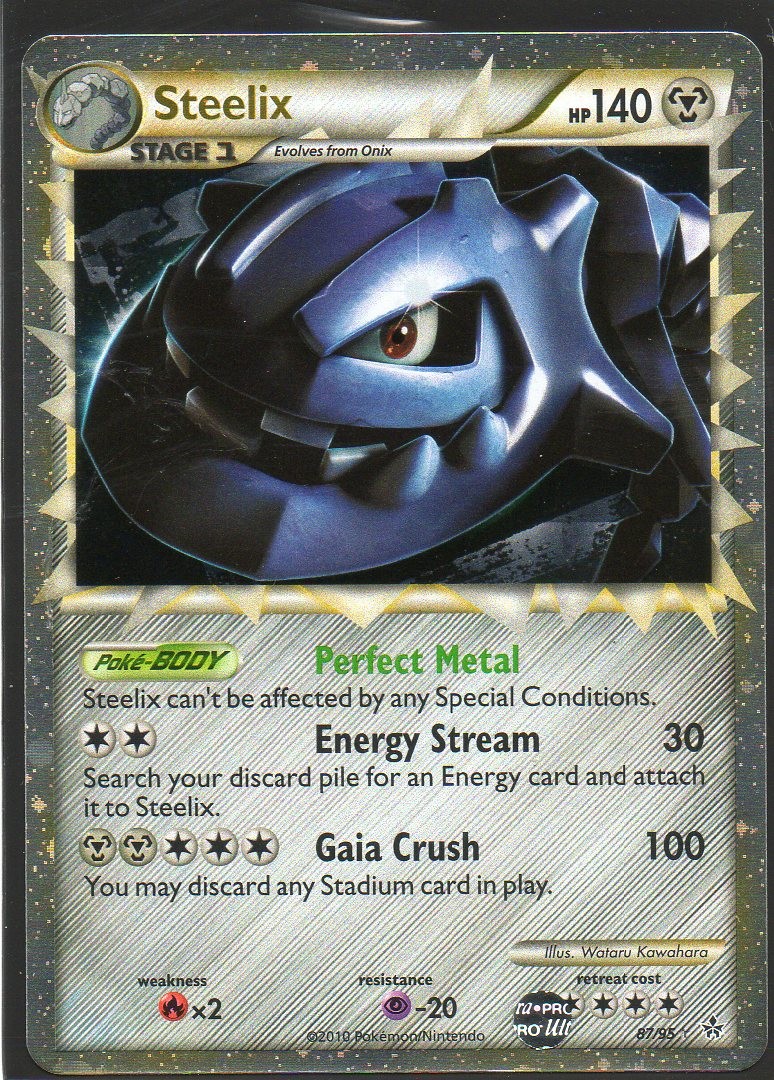
A normal deck usually plays more Pokemon than any other deck type. This type of deck normally plays around 20+ Pokemon. This type of deck also normally plays about 25 trainers/stadiums/ and supporters and 15 energies. Of course this is a gross generalization, some Gyarados decks don’t play any energies, and i’ve seen Octillery decks that play 34 energies. On the same note, Regigas decks might run a dozen Pokemon while Trainer lock decks might run 25 or more. So, the Pokemon/trainer/energy ratio depends on the deck, but it is usally around 22/23/15. Staple cards for this kind of deck vary, but some basic ones are: Pokemon Collector, Bebes Search, Rare Candy, Broken Time Space, Uxie La, Uxie Lv.X, Azelf, and Unown Q.
If your are planning to play against Normal decks there is one thing you should know. They are usually the slowest deck of all three, but they are the best type of deck when fully set up. So, if you can setup faster then your opponent, or disrupt their setup, you have a good shot at beating him/her, but if you let them setup you will have a hard time coming back.
2. The Speed Deck
Normal decks use evolution lines to carry out a distinct purpose, but speed decks are different. Yes each speed deck has a purpose, but it usually the same one for each deck; do as much damage as fast as possible. Speed Decks can also run evolution lines, but they use them differently then normal decks. Speed decks try to knock out the opponent early by doing a lot damage in the first couple of turns. The earliest speed deck is probably the haymaker deck of the base set days, though modern speed decks owe their existence to Shuppet and Uxie donk decks of last year’s format. 
In today’s format, Speed decks usually want to attack on the first turn and do a lot of damage. Because of this, almost all speed decks have a main attacker that can attack for one energy. The normal first turn for one of these decks would be use several trainers, play an energy, and any Pokemon they have especially Crobat G (for its Flash-Bite Poke-Power), then use Uxie La to “Setup” for usually 4-7 cards, then to repeat the process until you have used Crobat G many times, got out your main attacker, and attached any trainer or tool cards to the main attacker. Current decks that fit this definition include: Shuppet/Dunsparce donk, Donkphan, and Speed (straight) Machamp. Staples for these decks include: Broken Time Space and Rare Candy (if an evolution line is present), plus power, Pokemon Collector, Crobat G, 4 Poketurns, Super Scoop up, Pokedex, Poke Drawer +, Uxie la, Uxie lv.x, Unown q, and Unown R.
Of course all speed decks are different, but the p/t/e ratio for this type of deck is usually around 15/38/7. They usually only run around 15 Pokemon because this deck is very focused, there aren’t as many techs as there are in SP and normal decks. For Pokemon you usually see 4-8 cards devoted to the main attacker, 2 or 3 cards for Crobat G, 4 cards for Uxie and the lv.x, and about 4 spots for the Unowns. These decks run a lot of trainers because trainers help the player go through their deck as fast as possibly, which is the goal of this deck. These decks also run a low number of energy because the main attackers usually only require 1 energy, and the player normally goes through their deck very quickly.
The key to playing against a speed deck is to survive the early onslaught. These decks will normally come at you right out of the gate and try to get an easy win, if you can withstand the initial attack and setup, you should be okay. To do this it is always helpful to trainer lock, so cards like Spiritomb Ar, Gastly SF, and Spiritomb Ud are good counters.
3. The SP Deck
The newest deck form is the SP deck. SP Pokemon are powerful basic forms of Pokemon, usually based on Pokemon that were featured in the video game. For instance, the gym leaders each have their own SP Pokemon. They all have x2 weaknesses and usually have fairly high energy cost. These SP Pokemon don’t seem so powerful from my description, but they are great because of the trainer and supporter support that they have. I won’t talk about the history of the deck, please check below for that. An SP is mainly focused on two things, disruption and speed. They usually use cards like Power Spray to disrupt the opponent, and use cards like Energy Gain to help them attack quickly. SP decks are fairly fast decks, usually setting up their big attack in 2 turns, a speed matched only by speed decks. Not every Pokemon in an SP deck is normally an SP Pokemon, Pokemon like Uxie la, Sableye Sf, and Azelf La are intricate to some SP decks. In my opinion, qhat makes an SP deck SP, is usually the main attackers and the SP engine. 
SP decks are discussed more below, but the main SP decks today are Luxchomp, Dialgachomp, and Sablelock. The P/T/E ratio for SP decks are about 18/27/15. They don’t run very many Pokemon because they run very few evolution lines. Trainers/Supporters/ and Stadiums are very important for SP decks. The Supporter Cyrus’s Conspiracy makes SP decks what they are, because it lets the player get another supporter, a trainer card, and an energy card. This lets the user find just about everything he/she needs with just 1 card. But, a lot of different trainer cards are needed to support the SP deck. Sp decks usually run a lot of different types of energies. They usually run at least 5 basic energies (to use with Cyrus’s Conspiracy), 4 Double Color less energies (to use with Garchomp C), and 4 Call Energies (for an easy setup). There are too many staple cards to mention, but just google any SP deck and you will find that most decks run about 50 of the same cards, and then differ with the last 10.
It is very hard to beat SP decks. speed decks are faster, but they usually can’t put out enough damage to knock out the high HP SP Pokemon. Normal decks are normally better then SP decks, when fully setup, but SP decks can ruin the normal player’s setup just enough to gain the advantage. One way to beat SP decks is with trainer lock, these decks rely on their trainers and wouldn’t survive without them. Normal decks that Tank, like a Steelix deck, are good counters because if they setup, they become hard for the SP player to knockout.
#4 The hybrid
Okay, I know I said there were only 3, but there is kind of also a fourth sometimes, maybe. Hybrid Decks are decks that mix elements of two or more of the 3 basic kinds of decks. For example, one could make a speed deck out of Absol G and the cyrus engine, while still using Pokemon, Trainer, and Energy cards like they would in a speed deck. This deck would rely both on SP aspects and SP aspects. Last year of the most popular decks was Gengar C, a deck that was basically an SP deck that had a full Gengar SF line in it. It functioned both as a Gengar deck and an SP deck. And Ed, the crazy guy that runs this site, is the creator of T.O.S.S.E.D., a deck that can play like an SP deck at some times and a speed deck at others. There is a fine line between a hybrid deck, and just a regular deck with a tech. For example, the deck that won worlds 2 years ago was a Beedrill deck that had a Luxray Gl line in it. I would contend that this is still a regular normal deck, but others may say its a hybrid. Another example is a Luxchomp deck that has a 1-1-1 Machamp Sf line it. Just because it runs those 3 cards doesn’t mean its still not an SP deck that focuses on disruption and speed, or does it?
So thats my take on the basic structures of current decks. I hope you young guys learned something. And experienced players are welcome to leave their comments on these deck structures in the comment box.
Part 2. The History of SP Pokemon
A couple of weeks ago, my friend James and I were playing a game and talking about decks. He mentioned that he wanted to put Infernape 4 Lv.X in his Luxchomp deck, and I said something to the effect of, “Oh so your going old school.” And he said, “Huh?” So that made me think that a lot of the people who joined the game in the last year don’t know about the history of the SP deck, so that’s what this part of the article is about. 
As mentioned, SP Pokemon were first released in the Platinum set. They are known for being very fast and disruptive. This article will talk about the evolution of SP decks, and how each deck has changed with each set.
1. Deafen Lock, SP Toolbox, and Palkia Lock
There were three first generation SP decks, Deafen Lock, Palka Lock and the SP Toolbox. They each used cards almost exclusively from the Platinum base set, and were around for the spring and summer of 2009.
Deafen Lock was a deck built around Dialga G Lv.X. The goal was to get a turn 1 Deafen to lock your opponent, and then either load up Dialga G Lv.X or rely on the Toxitank Combo. Toxicroak G and Skunktank G were a good combo in this deck to work against the popular Gengar/Machamp deck. The SP Toolbox deck was basically a Deafen Lock deck, without Dialga G Lv.X. To make up for this players used the toxitank combo with weaville G, and hope their Power-Sprays were enough to even the playing field. The third first generation SP deck is a deck that is still around today, Palkia Lock. This deck relies on preventing your opponent from using Poke-Powers, with Mesprit La and Power-Sprays. Palkia G Lv.X was used to snipe Claydol and other crucial Pokemon.
These decks were good, some of the best in the format. But, they lacked a lot of what we call SP staples, such as SP Radar, Aarons Collection,Luxray Gl, Garchomp C, and Dragonite Fb, because they weren’t released yet. It is also worth mentioning that a lot of people combined the deafen lock deck with Palkia G lock, with a lot of success.
2. Luxape
The first modern SP deck is Luxape. Luxape was a deck ran by a guy named Pooka, at the 2009 U.S. Nationals. It relied on Luxray Gl and Infernape 4 Lv.x. This deck worked by forcing the opponent to switch their active Pokemon each turn to pick up easy kills. Pooka’s deck felt like a modern SP deck, but still didnt’t have a lot of the anti-sp techs that we see today. Pooka did well because he surprised people with this ingenious deck, and Luxray was able to shock all water Pokemon (like Palkia G) out of the game.
3. Blazeray
Pooka won U.S. Nats with his Luxape deck, then went to worlds with the same deck, and frankly got crushed. His efforts were not in vain however, his deck building skills laid the ground work for the current LuxChomp deck. Nationals was the last tournament that Luxape made a showing, after the new season started the deck had died. But, from its ashes, Blazeray was born. Blazeray is basically a Luxape deck that does not run Infernape 4, but instead runs Blaziken Fb. It is this deck that first starts using the known SP techs. Blazeray was popular in cities 09-10.
 4. The rise of Garchomp C- Lady GaGa and Luxchomp.
Towards the end of Cities 09-10 and at states 2010, our man Pooka once again changed the SP format. This time, he showed the world how great of a card Garchomp C was.
The first great Garchomp C deck was Pooka’s Lady GaGa deck. This deck suffers from a terrible name, but was very successful. It was very similar to today’s Dialgachomp deck. The second great garchomp deck was of course, LuxChomp. It quickly became a great deck, dominating at every big tournament, including States and Regionals 2010. The luxchomp of last year, is basically the same deck we see today, with a little changes.
5. Modern SP decks
At the rotation during this season, SP decks have proved that they are still the best in the format. At fall Battle Roads 2010, SP players were afraid of the new trainer lock decks, so they tweaked their decks to tech against this deck. Most Luxchomp players teched in a 1-1 Dialga G Lv.X line to shut off Vileplume’s Poke-Body. Towards the end of the season, Blaziken Fb started to replace Dialga G Lv.X, because it was more versatile then Dialga G. New cards added to most SP decks include Professor Oaks New Theroy, Staraptor FB, Pokemon Contest Hall, and Smeargle UD.
Lady GaGa decks were also updated after the rotation to include new cards like Energy Exchanger. With these new cards, Dialgachomp became very popular early in the BR season. The deck works by establishing Dialga G Lv.X as a tank, and then uses Garchomp C to heal all damage counters from Dialga G.
So that is the evolution of the popular SP decks. Of course there were other decks like Gallade 4 decks, but none of them made a great impact. The SP decks have changed as new sets have been released. They changed from being a disruptive deck, to being a quick disruptive deck that can easily snipe and heal. Cards like toxicroak G, Skunktank G, and Galactic HQ, were replaced by cards like Promocroak, Dragonite Fb, and Garchomp C. What does the futture hold for SP decks? Since there are no more SP Pokemon coming out, it is likely that Luxchomp decks will basically stay the same, with little tweaks being added as each new set comes out.
Hello to all members of Omar-Nation. This is Pikkdogs here bringing you the top 10 cards of the new Triumphant set. I have ranked them from 10 to 1, but these ranking aren’t that official. It is really hard to rank cards that aren’t released yet, so the rankings are just a fun thing and aren’t very official. So, now we got that away, lets get into the list.
 #10- Nidoking
Coming in at #10 is Nidoking. This card has a lot of upside, but may be a little slow for this format.
It has 140 HP, a lightning resistance, and the “Pheromone Stamina” Poke-Body that gives it an extra 20 HP for every Nidoqueen you have in play. When you combine Nidoking with Nidoqueen RR, you not only get +20 HP but you heal 1 damage counter each turn because of NidoQueen’s “Maternal Comfort” Poke-Body. If you add an expert belt and have 3 NidoQueens in play, Nidoking would have 220 HP. It’s attack also isnt bad, for FFCC “Venomous Horn” does 80 damage and poisons the defending Pokemon. The high HP and lightning resistance will make it hard for any LuxChomp deck to knock out a Nidoking.
But as mentioned, it can be a little slow. It’s attack costs 4 energies (or 3 if one is Double Colorless) which is possible to load up on Nidoking, but it might cause you to sacrifice some prizes. And in this quick 30 +3 format, it could be hard to make a comeback within the time limit. Also, with out Claydol Ge, it will be hard to get out a Nidoking and have a bench full of NidoQueens. It also has a x2 water weakness, which could be problematic with Gyarados SF is as popular as some experts say it will be. And finally, Dialga G Lv.X can shut off all Pokebodies, making Nidoking a lot less intimidating.
This deck could be good if the deck gets some new draw power, but until then it can be hard to get the deck fully set up.
#9- Victreebel
Read More
This week I am analysing Donphan Prime from HeartGold & SoulSilver.
This card pairs well with an array of different Pokemon and I’m going to be showing you a few today. Maybe you’ll decide to run it in your next tournament?
Dan Read More
Hey all you members of Omar-Nation. This is Pikkdogs here. I will speak to you soon about the release of the new triumphant set, but today I will talk about age divisions in Pokemon. 
Speaking of Triumphant, this weekend is the start of pre-release tournaments. So if you can, head out to your local tournament this weekend and get involved in the tournament. This set should be pretty impactful, even with the recent news that Lost World will not be in the set.
We all know that Pokemon is a game that is popular with younger people. I admit that I too played the game when I was young. But, the fact is that Juniors and Masters are different. We run different decks and play different styles.
We also know that because of this fact TPCI has made three age divisions: Junior, Senior, and Master. With younger people laying in the junior category, the tweens playing in seniors, and high school age and older in the master category. These divisions were a great idea, it keeps people of similar skill levels together. There are a couple great senior players that can play with any master, but for the most part the age divisions are great.
What isn’t so great is when people are forced to play outside of their divisions. These matchups are embarrassing, unfair, and pointless. These matchups usually happen when one age group doesn’t have enough players for their own tournament. When this happens age divisions mix and people are forced to play outside of their age division.
This article will try to argue that Play Pokemon should outlaw playing outside of your age division at all tournaments that effect your rating. This article will be written in the perspective of a masters player.
First, playing outside of your age division is pointless. It does not effect your rating, so why are we playing this matchup? It would be better to play a player in your own division who has a lesser record, then to play a game that has no effect on your rating. It would even be better to take a bye, and get a win then to play a no-win game.
Why is this type of game a no-win game? This is because, if a masters player defeats a junior it is doing something that he/she is supposed to do, and if the masters player loses it is a complete embarrassment. I admit that sometimes a junior player can beat a master’s player. But, for the most part a Master will always beat a Junior, they usually have better decks and more advanced skills. It isn’t fair for the junior who has to play out of his league, and its not fair for the masters player who will face infinite embarassment if he/she does lose.
Another reason is that playing down in your division seems to take the player off of his/her game. Every game that I play with a junior or a senior seems to feel like a practice game. Personally, playing down makes me feel like I’m doing my opponent a favor and take me out of the game. At a Pokemon tournament, a player needs to concentrate and keep momentum going, playing a younger person can throw someone off of his/her game and ruin his/her tournament.
So I propose, that except in cases where both the junior and senior divisions don’t have enough players, that combining divisions should be abolished. If the senior division only has 4 players, let them play 2 or 3 games and call it a day. This would be a smart business decision for TPCI, because it might encourage those seniors to bring their friends to the next tournament, so more people will join the game. Also, adding byes will be preferable to pairing people outside of their own age division.
So what do you guys think? Am I crazy? Well of course I am, but is my opinion of this topic crazy? Do you guys feel the same, or do you like playing younger people.
Until next week this is Pikkdogs signing off saying, So long and thanks for all the fish.
Ed’s Note: This is Team Omar’s 100th article! Try to imagine 100 balloons dropping from your ceiling and people blowing silly noisemakers as you read this. Anyway, I wanted to point that out and say THANKS to all you guys who read our ramblings. Well, without further ado, I’ll let you get back to your regularly scheduled PokeClass, and we’ll start working on our next 100!
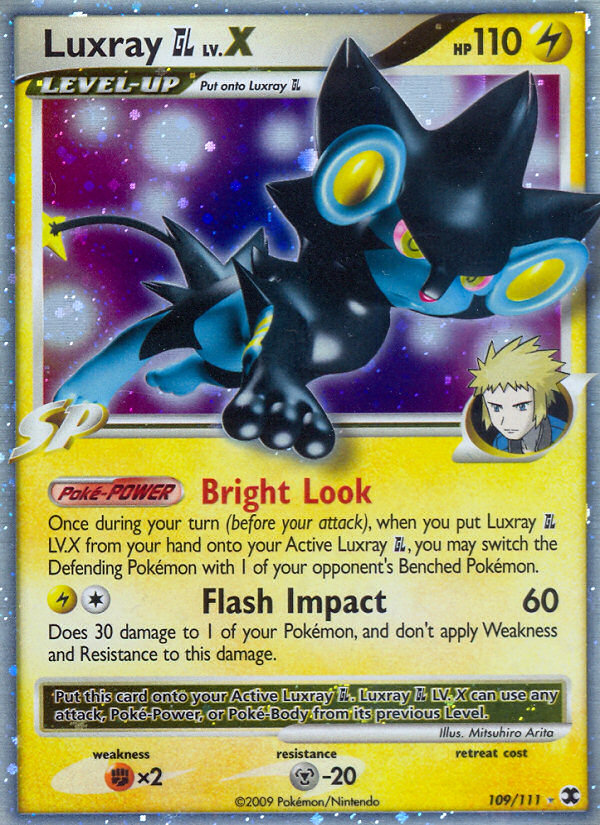 Greetings everyone. This is Pikkdogs, here to give you a rundown of the results of the Fall Battle Roads.
This is of course the first tournament season of the new format. There was a little amount of uncertainty coming into the season about how the loss of Claydol would effect decks. There was also the big SP question. Would it rule the format? Or would trainer lock decks or Machamp decks run all over them? To answer these and other questions I will give you a list of things we learned from the Battle Road season.
Not that much has changed: SP still ruling
Based on statistics provided by Pokegym; Luxchomp decks have won 34 BR’s, and Dialgachomp decks have won 26 times. These decks, which work similarly, have won many more times then any other deck. The next closest deck is Gengar Viletomb with 15 wins.
Time and time again Luxchomp decks have proved to be the most consistent decks out there. They mix in the best combination of speed and disruption to run the table.
The format has changed to make life a little tougher for SP players, so lets talk a little about that.
Read More
| Pokemon: 17 3 – Uxie – LA 43 1 – Uxie Lv. X – LA 146 2 – Crobat G – PL 47 1 – Shuppet – PL 92 1 – Dunsparce – HS 41 1 – Toxicroak G – DP 41 2 – Garchomp C – SV 60 2 – Garchomp C Lv. X – DP 46 1 – Unown Q – MD 49 1 – Dialga G – PL 7 1 – Dialga G Lv. X – PL 122 1 – Regice – LA 36 |
Trainers: 25 4 – Poke Turn 4 – Poke Drawer+ 4 – Plus Power 2 – Expert Belt 1 – Luxury Ball 3 – Energy Gain 2 – SP Radar 1 – Premier Ball 1 – Power Spray 3 – Warp Point |
Supporters: 10 4 – Cyrus’s Conspiracy 3 – Pokemon Collector 2 – Bebe’s Search 1 – Aaron’s Collection |
Energy: 8 2 – Psychic Energy 4 – Double Colorless 1 – Metal Energy (Basic) 1 – Cyclone Energy |
Essentially, the techs here come down to getting around Vileplume and Spiritomb. Regice can screw with your opponent’s Spiritomb, and it can work well in the SP matchup. Dialga G Lv. X shuts off both Spiritomb and Vileplume’s traier lock. Warp Point is essential here, because it helps you bench both Regice and Dialga when they are active (which is necessary to LvX Dialga). Warp Point is also an offensive weapon, because most of your attacks come off the bench. If you don’t want to attack their active, you can Cyclone Energy or Warp Point it away.
Read More
Hey everyone in Omar-Nation. This is Pikkdogs here to give you a report of my entire fall Battle Road season. I thought that instead of writing 4 BR reports, I would just write 1 big one at the end of it. So here it is. 
As you can tell from this article’s name, I had an up and down roller coaster ride of a Battle Road season. It consisted of 4 BR’s, one in Angola, Indiana and three in Michigan. I really enjoyed the season because of the time I spent playing the game i love, and hanging out with some cool people.
I started out the BR season playing Gengar Viletomb. Gengar Viletomb is a deck that is supposed to lock trainers all the way through the game. I won’t explain the strategy because I have talked about it in the past. I will share my current list of my Gengar Viletomb deck, and then talk a little about it.
Pokemon- 31
Energies-10 
Supporters- 19
So here is a little bit about my list that is diferent from most other decks.
Unown R- A great draw engine. Since Claydol is gone and Uxie is Power-Spray bait, you need some kind of draw engine. Most decks decide to use trainers or draw supporters instead, but this not an option here. You can’t play any trainers, so your supporters have to do all the searching, so using draw supporters is not an option. All thats left is Unown R. Most people don’t like to spray it, so its good in that regard. And it helps you thin your deck quickly.
Mightyena La– This is one of the better techs in the format. I gotta give it to my friend Cody B. for showing it to me. Its first attack is “BIte-On,” for 1 Darkness energy you can do 30 damage, and if the defending Pokemon is un-evolved the defending cannot retreat, attack, or use any powers. So that means if you are playing SP, and use “Bite On” the defending won’t be able to do anything in trainer lock, unless they can Level-Up or play a Warp Energy. It second attack “Harass” does ten damage for each Pokemon you have in play for CC. This means that if you are playing against a Gengar deck, you can just Harass the other Gengar for 90 damage (with weakness), then retreat for Uxie and Psychic Restore for Knock Out, and then put Uxie on the bottom of your deck to avoid “Fainting Spell.” Mightyena is a really great card, and is a must play for any Gengar Viletomb deck.
Sages Training– As mentioned, this deck is pretty slow, and needs some more speed. Sages will give you this speed, allowing you to almost always get an energy. It allows you to look at the top 5 cards of your deck, choose 2 to go to your hand, and the rest get discarded. Some people don’t like this card, if you are one of them you can substitute Underground Expedition, or Cheerleaders Cheer.
BR #1-Angola Indiana
Alright now we are to my first Battle Road in Angola Indiana. This was about a 2 and a half hour drive for me, but I went because I was pretty bored. This was probably the smallest BR that I went to, but the members of Team Warp Point Good Game were there to liven things up. I also got to meet the great Chris Fulop, at this BR, and made some trades with him.
First Round- James Hall BLG + Dialga G
Ever-since this game James has became a good friend of mine. We have spent many hours play testing on skype. James is a beginner at the game, so he was still getting used to his deck. He got a decent setup, and so did I. He was able to break the trainer lock a couple of times and did enough to stall me out, but could not stop a couple of the kills I got with “Shadow Room.” I grabbed my sixth prize on the second turn of the +3.
1-0
Second Round-Robert Hall: Luxchomp +Dialga G
Robert was a guy I have seen before, and have grown to to socialize more with. He’s a great guy and I enjoy talking to him everytime we meet at a tournament or on Skype. We shared an epic battle in Round 2. He got set up faster then I did, he had 3 or 4 top decks of whatever he needed. He got up 3 prizes on me, but I was able to come back. One turn I was able to “Level-Down” Garchomp C for a knockout and then Shadow Room Crobat G for a knock-out. Late in the game, the only thing Robert could do was “Flash Impact” with Luxray Gl, but the 30 damage he did to his bench each turn helped me pick up many knock outs with Shadow Room. We end up going into the +3 rounds, and I tie it on turn 0. On turn 2 I gave Robert a Lookers knowing that if I give him 4 Trainers Supporters and Stadiums, I win. I give him the Lookers, then use “Poltergeist” and look at his hand to find only 3 trainers. Next turn he knocks out Gengar and I roll tails on “Fainting Spell” and Robert wins.
1-1
Cody Badgley. Mirror
This game wasn’t very exciting. Cody ran Mightyena for the mirror and I didn’t (at this time). So he had a huge advantage, I still might have had a chance, but I prized two of my Gengars and I didn’t run Azelf (at this time). Cody “Harassed” my Gengar and then knocked it out with “Shadow Room.” After that, I decided to scoop.
1-2
???????- with Donphan ERL
This is one of the decks that don’t really care that I’m locking trainers. He used Donphan to knock out a couple Spiritiombs, then used ERL to knock out some Uxies. He actually knocked out 1 Gengar with ERL, and I forgot to flip for “Fainting Spell.” It could have been helpful for me if I had remembered, but I don’t think it would have mattered overall. 1-3
???????-with Luxchomp
This game was the protype game of trainer lock. We both setup fast, but with me locking trainers, there was nothing he could do. I was able to “Poltergeist” several times to take all six prizes, and he was unable to take 1.
2-3
So a 2-3 showing isn’t that great. I was disappointed, but was still happy to see some friends who I haven’t seen for a while. I did learn some tricks to help me at the next BR.
2nd Br- Rochester Hills, MI
This was the biggest BR in Michigan this year. There were 6 Swiss rounds and a top cut of 4. A lot of people showed up with some Meta decks and some rogue decks. I think two Giratina decks were able to go 4-2, causing some trouble.
First Round- Joel Howe- Luxchomp with Dialga G
Another great Trainer lock versus SP matchup. Joel is a good player and is a fun guy to talk with. We each get set up at the same time and go back and forth. I “Polterguist” for a couple prizes, and he responds with a couple “Dragon Rush’s.” The game goes until time is called, and is pushed into the +3 format. On turn 1 he knocks out my Gengar for his 5th prize. On turn 2 I have a benched Gastly with two energies on it, and a BTS in play. I Copycat for a new hand and I know I need a Haunter and a Gengar for a change at winning. I end up only getting the Gengar. I also get an unown R, so I play it and I “retire,” but the Haunter still alluded me. I am about to scoop and then I look down and see my Uxie X active, so I use “trade off” and get a Haunter! I evolve, retreat, and “Poltergeist” for a prize. Next turn he fails to top deck a DCE, and next turn I “Poltergeist” for the win. What a great win, it was a great game.
1-0
Second Round- Jumpluff
I get a Spirtomb start, and my opponent gets a bad start. She can’t seem to draw into anything except trainers that she can’t use. I get a Gengar and knock out her only Jumpluff, and apologize for being a jerk with my deck selection.
2-0
Third Round- Kingdra, Gyarados, Donphan.
This game is against a nice guy that I first met on this day. His deck was kinda slow, but it worked because mine was slow. The trainer lock really didn’t hurt him as he got a Kingdra and Gyarados out. He used “Spray Splash” to get around Fainting Spell, and I scoop. Good Game.
2-1
Fourth Round- Tyranitar
I still don’t know how I won this game. I went into this game knowing that I was at a real disadvantage, because Tyranitar can hit Gengar for weakness. I also knew that if I wanted to top cut, I had to win out. But, somehow I was able to prevail. I set up pretty fast, and got two Gengars Out. I was able to “poltergeist” one Tyranitar, and took another one out on “Fainting Spell.” After this he had no more basics and lost.
3-1
Fifth Round- SP kitchen sink
This is against another friend from “Team Warp Point Good Game.” I believe this was against Collin, but I could be wrong. Im not sure what Collin’s strategy was, but he had a lot of different SP Pokemon, and Shuppet. I was able to setup the trainer-lock all game and slowly take 6 prizes.
4-1
Sixth Round- Mirror
This one I think was against Sean Foisy, another good player. He probably had the better Gengar deck on this day, but mine was teched for the mirror, and his wasn’t. I set up faster and used Mightyena to my advantage. When time was called, I was ahead, and he was not.
5-1
Round of 4-Luxchomp with Dialga G
This was against the best player in Michigan, Tracey Key. Tracey went to a couple of Worlds Tournaments and is a great SP player. I know that if I want to beat her I need to be on top of my game.
Game 1-
In the first game I set up fast, and her Dialga G is prized or something. I get a chain of “Poltergeist’s” going and combo that with Mightyena. She scoops when I have 2 prizes left.
Game 2-
She sets up faster this game and gets up a couple prizes. In the middle of the game I misplay by knocking out a Garchomp C with Mightyena, leaving him active. The next turn she knocks it out,and am unable to respond. If I were able to retreat Mightyena and knock out the Garchomp with Gengar or uxie I could stall next turn with Mightyena and maybe turn the game around. The game goes on and I come back a little bit, but she is able to grab the second game as time is called.
In between games the judges take a long time setting up rules for the third game. Meanwhile, Tracey and I talk about what a ride we both had today. We were both exhausted after a long day of playing cards, my neck and back were sore and she claimed she was both hot and cold (I don’t know how this can be, but thats Women for ya). Then the person that won the other Top Cut game came to our table and said that he would love to play us, but he must leave to go play in his band. So me and Tracey knew that who-ever wins this game will win the victory medal.
Sudden Death-
The judges finally come back and announce that the next game will be Sudden Death. At this announcement I’m ready to pack it up. No Gengar Viletomb deck has a chance against Luxchomp in Sudden Death. Luxchomp is meant to do one thing, get cheap prizes early, and thats what wins Sudden Death. After a couple turns, I stall and she promotes Uxie and shows me a DCE and an Uxie Lv.X when I have Spiritomb active. I tell her to say no more and congratulate her on another Victory Medal.
Sure I was proud of my play that day, and happy for Tracey, but it was really hard to see someone take a picture of her and the victory medal, knowing that the medal could have easily been mine. I should have scooped early in game 2, so I could have had a better chance in Game 3. I went home that day physically drained and emotionally spent. I literally had nothing left to give, and limped home and tryed to recover for the BR the next day.
BR #3-Tecumseh, Mi
I woke up that day and knew I was in trouble. I was still tired from yesterday and found it hard to concentrate. But I went to the next BR anyway. There, I met Robert Hall and my friend Jonah. I got some good trading in and had fun talking to the guys.
Round 1- Luxchomp +Dialga
This first game was against a guy who ended up winning this tournament. I set up a little slower then him, and he was able to break the trainer lock for most of the game. Because I was still drained from the previous day, I made some mistakes and didn’t play my best. He was able to win before time was called.
0-1
Round 2- Jumpluff
This was against the girl that I played the previous day. This time she got a great start and was able to get going. I still had a chance to win, but flipped tails on two fainting spells. She gets her revenge fairly easily.
0-2
Round 3- Garchomp SV
This round I finally woke up and started playing. We had a great back and forth matchup trading KO’s each turn. I got just enough Fainting Spells to stay in the game. A game changing moment was when he played Ruins of Alph, negating my resistance. When time was called I was able to shadow room a Garchomp Lv.X for a knock-out.
1-1
Round 4- Honchkrow UD
Kind of a weird deck. I got a trainer lock on him early and thought that I would make easy work of this deck. But the weakness of Gengar made this an interesting deck. At the end of the game he makes a misplay and I end up winning.
2-2
At this point I had recovered from my bad start and was at 500. I looked at my phone and realized it was time to go. I had to go to a meeting in Detroit for school, so I dropped after round 4.
BR #4- Okemos (Lansing), Mi
This BR was about two weeks since my last tournament. In these past two weeks I have changed some of my decks around and began experimenting with some Machamp and Steelix builds. I decided that I was too tired of playing the trainer-lock deck to play that again. So I decided to play either Machamp or Steelix. Either deck would have preformed well in my Meta, but I decided with Steelix because I feel Machamp decks are luck based and a little cheap, while Steelix decks make for fun games. I will post my Steelix deck here later, but for right now I will just explain it a little. 
The objective of playing Steelix, is to set up Steelix with Blisseys on the bench to heal him. When you get an expert belt with 4 Special Metals on Steelix, it is hard to knock him out. His attacks can do 30 damage for CC and 100 damage for MMCCC.
Round 1-v.s. BLG (Blaziken Fb, Luxray Gl, and Garchomp C_+ Dialga G)
I set up pretty well and was able to get Steelix going with special metals. He was playing Blaziken FB, but since I got the special metals, I was able to survive, heal, and knockout the blaziken next turn. He had a hard time using Jet Shoot more then once, and tried to stall with “Luring Flame.” But I am able to retreat and use Warp Points to get knock outs. I finish the game on a “Warp Point, Good Game.” Always been a goal of mine to do that.
1-0
Round 2-Shuppet and walls
One of the funnest games all day. I start Chansey and am able to donk his Nincada (with Pulled Punch), but he has a benched uxie. He sets up spirtombs and slows me down with those. The tombs block my expert belt, so that hurt. He ends up using dunsparce and cyclone to knock out some benched Uxies and Chansey’s. I was able to get 5 energies two Steelixes, so he forgoes the tombs for Shedinja. I then am able to bring up a chansey, attach a DCE and belt and get a knock on the shedinja, With his main walls either knocked out or proven useless, he plays out a couple more rounds and then scoops.
2-0
Round 3- Donphan ERL
I am a little nervous because if I don’t have 4 special metals on steelix, ERL is a problem. But, my nervousness is not needed because he prizes the bottom half of ERL. He sets up a couple donphans and ends up “Earthquaking” for 40, but when I heal 2, it only ends up doing 20 each turn. And with that low damage output and my pokehealers, he starts to get mad and just scoops.
3-0 
Round 4- Robert Hall-BLG
This game goes much like my first game with BLG, but this time I can’t find ANY special metals, so Blaziken gets the OHKO. This happens twice, and I scoop.
3-1
Round 5- The Younger Faust-BLG
This game was against the son of a regular Michigan player, since Seniors are grouped with Masters today. In this game, the Younger Faust makes a deal with the devil and gets a good start (your welcome, 2 people that got that reference.) This game has a similar result as last game, except this time I find 2 special metals, but he gets a good draw and uses flash bites to make up for the difference. I have 2 pokehealers in my hand, but it does no good, if Steelix can’t take the hit.
3-2
So I end the tournament with 2 losses, and don’t get to Top Cut. I didn’t lose because of the Blaziken Fb’s,but I lost because I couldn’t get Special Metal’s at the right time. Steelix is a great deck and is not played half as much as it should be. Blaziken Fb is a matchup that the Steelix player can deal with. The only two decks that are a problem for Steelix are Scizor Prime and Charizard SV, the rare Infernape 4 matchup is also tough. I encourage you all to give it a shot, it is a great deck and is really fun to play.
So my Fall Battle Road Season is over. I did not end up getting any Victory Metals, but I did get a top cut. But, I think I sent a message to the Michigan players that Im going to come to a tournament and play you tough. I did meet a lot of new people and had fun talking to everyone. I also learned a little more about the game, and became a little better player. So I guess those are all good things.
So long and thanks for all the fish!
 Pikkdogs
  Ed
Ed