Card Discussion

Guide to Winning Your Noble Victories Pre-Release

A big hello to all you OHKOers out there.  This is Pikkdogs here with my sidekick Pedro, and we have an article about strategy for Noble Victories pre-release tournaments.  Now people don’t normally go to Pre-Releases for the thrill of victory.  Pre-Releases are for fun and for getting the new cards.  But, while your there, you might as win right?  Some tournament organizers also give a free pack to the winner of the pre-release, so it s a good thing to win.

Pedro, are you going to a pre-release this weekend?

Well, no.  I’m going to watch the UFC event.

Oh, you like the MMA hey?  MMA is kinda cool, it’s like boxing but with colorful shirts.

Gotta love the colorful shirts. 

John McCain doesn’t like MMA though, he said it’s like human cockfighting.

No, I’ve seen human cockfighting, and they don’t wear the colorful shirts.  They don’t wear much of anything.

Well, there goes our hope of having a clean article, let’s get off the subject of cockfighting and let’s get onto the article.

How to Build a Pre-Release Deck

Pre-Release tournaments are held with a 40 card deck that you make out of 6 packs(unless your area holds a theme deck event).  It is pretty much like a regular game, but you play with 4 prizes instead of 6.  Since you get random cards, consistency is key.  You won’t be able to run 4 Junipers and 4 Collectors in this deck, so you will have to build it as focused as possible.  We’ll get in to what cards to play later, but for right now just focus on making your deck centered on a couple Pokemon that are similar.  You usually play almost all of your useful trainers, and you play around 15 energies.  You might want to add an extra energy or two this time around, because the only draw power that we get in this set is N.

Pokemon to look out for.

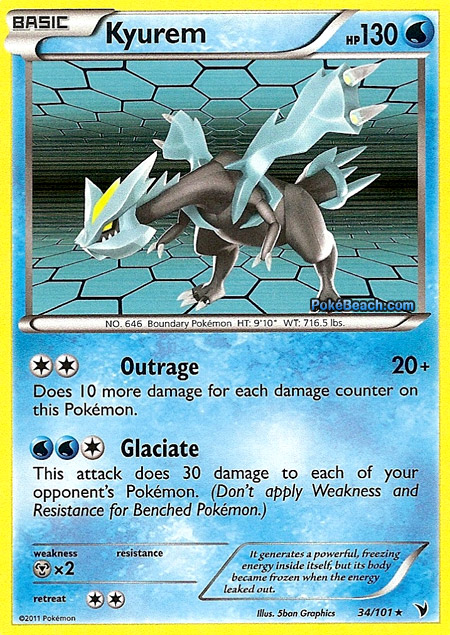
This set is not great for really impactful Pokemon, but it does have a lot of Pokemon that make Pre-Release tournaments fairly easy.  There are a lot of good high HP basic Pokemon.  The three members of the Musketeer trio are represented (Virizion, Terrakion, and Coballion), as well as the last member of the energy (Kyurem) and Kami (Landurus) trios.  There is also a non legendary high HP basic, in Drudiggon.  If you get any of these, you should probably play them.  You have 2 shots at getting the members of the Musketeer trio, because they each have a Full Art form, so there is a decent chance of pulling one of those.  All three of these Pokemon are great, but my favorite is Virizion because he has an attack that let’s you draw cards.  Drudiggon is nice because he takes colorless energy, so you can throw him into any deck.  But the best of all the high HP basics is Kyurem.  If you are able to get an Eviolite on Kyurem, he will be almost impossible to knock out.  Kyurem has 130 HP and has the “Outrage” attack that Reshiram and Zekrom have.  If you are able to get Kyurem about, you should be able to “Outrage” for about 2-3 prizes before your opponent can knock it out.  It is the best card in this limited format.

This is usually the spot where I tell people to play Pokemon that let them draw cards.  But right now only Virizion does that, and it is a rare.  So this format will be extra slow and inconsistent.  Karrablast and Shelmet do have an attack that lets you evolve one of them if both are in play, but the chance of you getting an evolution with a bunch of each of the basics is not that great.  So not a lot of consistency Pokemon to talk about.

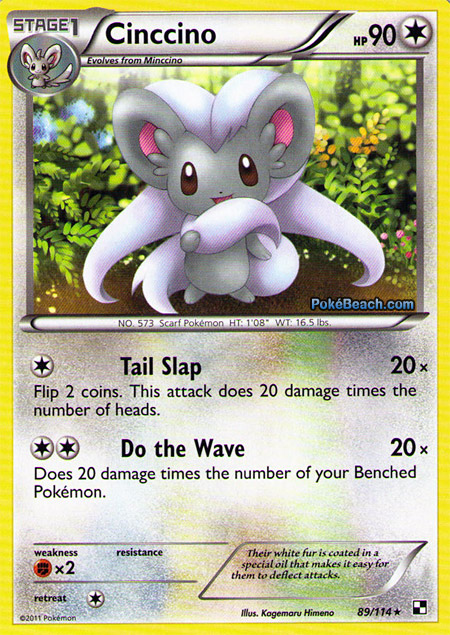
The Stage 1 Pokemon in this set are pretty good, but nothing to write home about.  If you pull a decent one like Amoongus you should play it, as long as you don’t have too many other energy types to begin with.  Audino has a decent attack. “Do the Wave” will do ten times the number of your benched Pokemon, which is not great, but is decent.

As always, playing Stage 2 Pokemon in a Pre-Release is tricky.  If you don’t pull at least a 3-2-1 line, it will be very hard to get your stage 2 Pokemon out consistently.  If you can pull a good line, then play the good ones like Conkeldurr and Chandelure.  But in this set, basic Pokemon will have more impact on games then the stage 2s.

For trainer cards, this set is pretty shallow.  Play every N you have, it is the second best card in this set for this type of format, so make sure to try to play it.  I would even play, Xtranciever, so you can search for it.  Eviolite, Rocky Helmet, and Super Rod are great, but I wouldn’t play much more than two to three of each of them if I pull any more.  I don’t know what to think about the fossils in this set. If you can pull a lot of the fossils and their corresponding Pokemon, then it is a good play.  But if not it will not be consistent. 

Conclusion

This set looks like a pretty tough one for Pre-Releases.  There are basically only two consistency cards in the whole set, meaning that it will be very hard to get what you want out.  And the consistency cards we have are fairly poor, one lets you draw 2 cards as the effect of an attack and the other let’s you draw a maximum of 4 cards. The winners this weekend will have to get very lucky.  Because of the lack of consistency cards, I would probably run a couple more energies and just hope for good draws.  The big HP basic Pokemon will be your best cards, but it will be hard to get them consistently because there are no search cards in the format.

Good luck to everyone, because in this format you will need it.  Do you have anything to say Pedro?

Cockfighting.

Well there you go.  Even though we had a short article, we did manage to say the word “cockfighting” 5 times.  That’s pretty good.

Always good when you can say “cockfighting” a lot. That is six times.

We better stop saying “cockfighting” now, seven times.  I wish ya good luck at your PR’s this weekend and I hope you have a good time and get some good trades going.

So long and thanks for all the fish!

Pedro’s Corner: A Review of the Lost Zone

Hey all you earthlings, this is Pedro here.  Pikkdogs receieved a one article suspension for his cussing last week.  And because the show must go on, Ed asked me to fill in for him.  While I don’t know much about this game, I should be able to  do better than a fat kid that doesn’t know his grammar rules. 

Before we get into the article, we should take care of these italics.  Even though my normal langauge translates into italics, it would be hard to read an article full of italics, so I bought an italics converter.  If I just pop it into my inter-dimensionary porthole like so, that should do it.  Okay lets get to the article. 

Obviously I am an extra-dimensionary being, so I don’t know that much about Pokemon, but one thing that interests me is the Lost Zone.  Since I have to travel through an inter-dimensionary porthole, a portal to the Lost Zone feels very familiar.  So I will start talking about Lost Zone cards and Lost Zone decks. 

The Most Versatile Lost Zone Card- Lost Remover
Read More

The Draw and Hand Refresh Supporters In the Current Format

A big hello to all you OHKoers out there, this is Pikkdogs and his sidekick Pedro here with an article about the drawing and hand refresh supporters we have available to us in the current format.  A big thanks to www.onehitko.com reader “Quarter Turn” for the idea for the article.

You mean someone actually asked you for advice on cards?

Yep.

Don’t they know you’re a crappy player?

I guess nobody has told him yet.  Hey Pedro, I was wondering something.  Why do you always speak in Italics?

Well that’s how all people from my dimension speak.

Huh.  What dimension is that?

Well I can’t tell you that, the people have to go about and buy my auto-biography.

You wrote an auto-biography?

Oh hell yeah.  It’s called “Stick it in my inter-dimensionary port hole”.

I suppose it’s available on Amazon.com?

Well yes, but not in this dimension?  You have to go to my own dimension’s Amazon. 

Your dimension has an Amazon?

Of course, how else do you think South American countries get their water.

Oh so you live in Earth just a different dimension.  Hmmmmm interesting!!. Anyway let’s just go to the article.  Today we are talking about the drawing and Hand Refresh Supporters.  We will start by talking about the history of using these cards.  Then we will examine the most used cards and examine what their ups and downs are.

History

Well I haven’t been involved in the game for more than 2-3 years, so I don’t know what originally happened with draw/ hand refresh (DHR) supporters.  So I will just pick up in the Diamond and Pearl era.  After the release of Great Encounters, anybody who used a DHR supporter was thought of as a noob.  Hand Refreshing was done solely with Claydol Ge (and a couple sets later Uxie La would join him).  You got all you needed in the drawing department with your Poke-Powers, and your Supporter slot was filled with search cards like Bebe’s Search or Roseanne’s Research.

A couple decks did use Draw Supporters, Gyarados used Felicities’ Drawings and Scizor/Cherrim used Buck’s Training.  But, these cards were mostly used for their other effects rather than the draw power.  Felecities’ was used to discard Magikarps, and Buck’s Training was used for the extra Plus Power.  And some disruption decks did use Team Galactic’s Wager, but that was just because people liked to play Rock-Paper-Scizors.

And people think that the current format is a “Rock-Paper-Scizors” format, they should have played when that card was used.

As we moved into the SP era, things again changed.  SP decks dominated the format, and this deck rarely used Claydol.  Instead, it used Uxie La for a little draw support.  They didn’t really need to draw a lot of cards because they had a lot of trainers and supporters that could search.

That changed at Worlds 2010 when the winner used Professor Oak’s New Theory.  A lot of SP players decided to copy the winner, and PONT became a staple card in SP decks and others.

DHR supporters were first used exclusively as Claydol and Uxie started to rotate out.  We could no longer rely on Poke-Powers for Draw Power (there were still Pokemon like Magnezone Prime and Ninetales, but Magnezone is too slow as a Stage 2 and Ninetales is not as reliable throughout the game like Claydol was), so we had to use supporters.  As mentioned, PONT was the first DHR supporter to gain wide spread acceptance.  But as the HGSS sets were released, more DHR cards were being used.  Judge was used because of its disruption power,  Cheer Leaders Cheer was used a little, as was Copy Cat and Sage’s Training.

The world of DHR supporters was thrown on its side when Professor Juniper came out.  The ability to draw 7 cards at once gave you a draw power that we haven’t seen since Uxie, and cemented DHS supporters as very important in the current format.  So let’s look at what these cards bring to the current format.

Current Drawing and Hand Refresh Supporters

The cards are ranked according to how well I like them in the current format, but I’m sure Pedro will tell you that I don’t know too much.

It’s more like you don’t know enough.

However you wanna put it, let’s look at the current supporters we have.

Professor Juniper

Effect– Discard your hand and draw 7 cards.

Positives– No other card in the format will let you consistently draw this many cards at once.  There is no reason not to like drawing 7 cards at once.  It is very good for this format that relies on quick knock outs, because you can easily play out your hand on the first or second turn, and then draw a new 7 card hand.  It also is nice because after you discard your hand, there is no chance that you will then draw them with Juniper, like you could with the shuffle and draw supporters.

Negatives– It does make you discard your entire hand.  If you run a deck that has evolutions, there will is a significant chance that you will not want to use Juniper every time you get it, because you will not want to discard everything in your hand.  Yes shuffling these cards in your deck does force you to lose those cards, but at least then there is a chance to get them back.  Using Juniper could put you into a situation where you will either lose if you don’t use a draw supporter or you lose if you discard your valueable hand.

Best Used in Decks Like– Juniper is best used in decks that require a fast start and don’t run a lot of evolutions.  This makes Juniper good in decks like Donphan and Dragons, Zekrom, Reshiram variants, and Mew Lock. 

Professor Oak’s New Theory

Effect– Shuffle your hand into your deck and draw 6 cards.

Positives– A fresh hand of 6 cards is great to have.  6 cards is basically a full hand, and should give you the resources that you are looking for.  It also does not make you discard your hand like Juniper forces you to.

Negatives– Once you shuffle your hand into your deck you are vulnerable to drawing those same cards that you tried to get out of your hand.  It also only lets you draw 6 cards.  Although 6 cards is great, Juniper does give you 7.

Best Used in Decks Like–  PONT is basically great in any deck.  But, I would rely on it more heavily in decks that don’t utilize Juniper too well.  This would be decks like Ross Deck, Gothitelle, Stage 1 Rush, decks with Kindgra Prime, and Prime Time (and other Magnezone Prime decks).

Judge

Effect– You and your opponent shuffle your hands into your decks and draw 4 cards.

Positives– There is nothing more disruptive than a first turn Judge.  A first turn Judge will set the pace, and should give you a good advantage (as long as they don’t get a lucky draw on the Judge).  It is also very disruptive later in the game.  If your opponent is trying to setup an evolution line and they just lied  a basic down, you can use Judge to  make it harder for them to evolve next turn.  But the thing that Judge is used for the most is to equal hand size in decks that run Yanmega.  It can be hard to equal hand size so you can use the “Insight” Poke-Body, but Judge makes this very easy.

Negatives– It only gives you 4 cards, no other cards will consistently give you a more pitiful number.  I know that Judge is used more for disruption and Yanmega-ing  than hand refreshing, but still it is considered a hand refresher.  Another negative for Judge is that you never know if Judge will be disruptive or not.  Your opponent may have a 10 card hand, but he/she might not have the card he/she wants for next turn.  So if you Judge that big hand away, you might be giving him/her a better hand.  

Momma always said Judge is like a box of chocolate you never know what you’re gonna get.

Well said Forrest, I mean Pedro.

Best Used in Decks Like– Judge is best used in decks that use Yanmega like: Stage 1 Rush, Primetime and Mew Lock.  It is also a very crucial card in disruption decks like Slowking/Ambipom and Sharpedo (which will be big once we get that good Victini card).

Sage’s Training

Effect– Look at the top 5 cards of your deck and put two of them in your hand, discard the rest.

Positives– This card lets you look at the top 5 cards and choose which two cards you want while keeping your current hand.  No other card gives you access to your deck 5 cards deep while keeping your current hand.  This card is great because it lets you keep what you got in your hand, then pick 2 more.  The upsides of this card are off the charts.

Negatives– Unfortunately, the negatives of this card are also off the charts.  It seems like every time I play this card there are at least 3 cards that I don’t want to discard. Infact, if you get a really “good” top 5 in your deck, you could cost yourself the game.  I have encountered situations where I have almost shot myself in the foot during the game by using a Sage’s.

Best Used in Decks Like– Sage’s is best used in decks that don’t have a lot of big evolution lines and require 1 or 2 cards in certain situations.  This means that good decks to play this card in are Stage 1 Rush, Donphan and Dragons, and Zekrom.

Cheren

Effect– Draw 3 cards

Positives– This card lets you draw the top three cards of your deck and keep your current hand.  No other supporter lets you consistently draw this man cards while not giving your opponent an advantage and keeping your current hand.  A lot of decks like to keep their current hand and just add a couple cards, like Stage 1 Rush.  It also works well with Junk Arm, if you need to use Junk Arm and you don’t have enough cards, Cheren will give those cards to you.  It also is nice with Junk Arm because if you are looking for a trainer like Pokemon Catcher, Cheren gives you a good shot at either drawing the Catcher or a Junk Arm which you can use to get a Poekmon Catcher.

Negatives– Three cards isn’t always enough to get the cards you need.  In a lot of decks it is better to jettison your entire hand for the 4 extra cards.  It just doesn’t stack up to cards like Proffesor Juniper in most decks.

Best Used in Decks Like–  Stage 1 Rush, Gothitelle, Prime Time, Reshiram variants, and Ross Deck.  (Note: I would never rely on this card in my deck for consistent draw Power, a bigger card like Juniper or Pont is needed more than Cheren.)

Copy Cat

Effect– Shuffle your hand into your deck and draw as many cards as your opponent has in his/her hand.

Positives–  This card can give you a hand of about 20 cards in some situations.  There is almost no limit to the number of cards you can grab with Copy Cat.  It also works great with Yanmega Prime.  And unlike Judge, Copy Cat does not set a cap at four, you could use this card to equal hand size and still get a lot of cards out of it.

Negatives–  This card is just not consistent and reliable.  This format does not give you any insurance that your opponent’s hand size will be good.  Your opponent’s hand size could be big or it could be small, you don’t know if you can count on the hand size to be big.  There were times that I have used Copy Cat to give me 1 card, or 3 cards.  It was not a pleasant experience.

Best Used in Decks Like–  Anything that uses Yanmega Prime, like Stage 1 Rush, Mew Lock, or Prime Time.

Other Draw and Hand Refresh Supporters

There are some other decent DHR supporters out there, here is a little bit about the best of the worst.

1.        Bianca– It lets you draw until you have 6 cards in your hand.  I would rather use PONT or Juniper unless you can consistently play out your entire hand fairly early.  So if you run a lot of trainers, Bianca is not a terrible choice.  But I would wait until there are more trainers in the format to use this card.

2.       Team Rocket’s Trickery-It lets you draw 2 cards and your opponent discards one card from his/her hand.  Yes the disruption is nice, but unless the year is 1998, only drawing 2 cards is not a good thing.

3.  Engineer’s Adjustment’s– It lets you discard an energy and draw 4 cards.  It is good for decks that run a lot of energy and decks that have ways to get energy back from the discard pile.  That means it fits excellently into Reshiphloison and Steelix.  It is a good card, but unless you run the kind of deck that you want energy in the discard pile, it’s not really that great of a card.

So I guess that’s all I got for you today.  Do you have anything to add Pedro?

Ummmmmm!! stay in school?

Okay we officially ran out of material.  Let’s just end the article.  How do we usually end the articles here?

Well we usually share our favorite bones. 

Is that code?

Well yes we do do that too, but I actually do want to talk about our favorite bones.

Okay?  What’s your favorite bone?

I think you know.  The Coccyx.

Oh yeah, that’s a funny sounding bone.  Speaking of funny bone, my favorite bone is the Humurus.

Ahhh, the original funny bone.  I thought you were going to with Clavicle, but the Humurus is a classic choice.

Good Bye Everybody!

The Changing Face of Stage 1 Decks + a Deck List.

A big hello to all you OHKOers out there, this is Pikkdogs and his extra dimensionary sidekick Pedro here with kind of  strategy/deck article for you.  Pedro, would you be kind enough to introduce the article?

Why I would be happy to.  Stage 1 decks can be traced to U.S. Nationals 2011.  Kyle “Pooka” Suceveich, among others, did very well with a deck that featured Donphan Prime, Zoroark, and Yanmega Prime.  While Pikkdogs did not do so well with Donphan/Samurott.

What does that have to do with the article?

Nothing, I just thought I would mention it while we were on the topic.  As I was saying, the deck was refered to as Stage 1 Rush, because  every important  Pokemon was a stage 1 Pokemon.  It also emphasized the fact that this deck was both hard hitting and fast since it didn’t have to use Rare Candy, or just rely on puny basic Pokemon.  The deck itself was very fast and could counter almost any deck.  It is almost like a tool box in that it has so many options on what it wants to run.

Fast forward to the end of the summer when Emerging Powers came out.  With the new set came new changes to the stage 1 rush deck.  Cincinno BW became more popular because it could attack for 100 damage for only one energy.  Another Pokemon that recieved play was Tornadus, because it could be a decent attacker and a great Donphan counter.  The other Pokemon that saw play in this deck was Mew Prime, it could “See Off” a Jumpluff and then be a great Gothitelle counter. 

Thank You Pedro.  But these changes left the deck with many variants.  And not all the decks relied on stage 1’s any more!  Mew and Tornadus are both basics.  With all these changes how are we supposed to know what to run?  Well to settle this we will look at each of the Pokemon and how they impact the game.  Then at the end of the article I will give you the list that I am working with right now, and give you some pointers for running stage 1.

Since you do it so well?

Well, not exactly, but I don’t see anyone else writing this article, so they gotta settle for me.

I see that “settling” is very popular around here.

You’re telling me.  Anyway, lets look at those Pokemon.

The Pokemon

Donphan Prime

Basics– It is a 120 HP Stage 1 Fighting Pokemon.  It’s “Exoskeleton” Pokebody reduces all damage done to him by 20.  The attack that is used the most is “Earthquake”.  This attack does 60 damage for 1 fighting energy, and does 10 damage to each of your own benched Pokemon.

What it’s good against– Donphan Prime has always been a great Pokemon since the rotation occured in early July.  That is because a lot of good Pokemon are weak to fighting, like Zoroark, Magnezone Prime, Zekrom, and Cincinno.  If you are playing any deck that relies on a lightning attack, Donphan Prime is a great option.  It can single handidly give you a victory against any Magnezone or Zekrom deck.

It is not only a good attacker, but it is fast and hard to knock out.  Any deck with Donphan Prime should be able to get a prize on turn 2.  It is also very hard to get a knockout on Donphan Prime.  The Poke-Body makes it so your opponent would have to do 140 damage at once to knock it out.  And if they do not make the 140 damage mark, you can just use Max Potion to heal all the damage counters and start again.

What it’s not so good against– One knock on Donphan is that limits your starter choices.  What I mean by that is if you want to include Cleffa in your deck either as a starter or hand refresher, you will probably knock it out with “Earthquake” on your 4th turn.

Another bad thing about Donphan Prime is that it can be stuck active.  If you don’t really want to attack with Donphan but have it out, your opponent can use Pokemon Catcher to make it active and you will have a hard time paying the 4 retreat cost.  

Donphan Prime also isn’t great against Pokemon like Reshiram and Gohtitelle.  Since Donphan Prime basically maxes out at 60 damage, you will need a Plus Power to even get a 2HKO with Donphan.  Gothitelle is a whole nother problem, because Donphan will never be able to get the 130 damage that you need for a knock out without trainers.  So if your opponent sets up a Gothitelle all your Donphans are basically dead cards.

Donphan can also be easily countered with Tornadus and Yanmega Prime, if you don’t also run either Zekrom or Ruins of Alph.  Ruins of Alph will negate the resistance that these two Pokemon have, and Zekrom will be able to OHKO both Pokemon for only a DCE if you have 4 damage counter on it.

Usefulness– On the whole I would think that Donphan Prime should be in most Stage 1 Rush Decks.  Unless your metagame is full of Gothitelle and Donphan counters, I think Donphan will be a great play.

Zoroark BW

Basics– Zoroark is a 100 HP Stage 1 Dark Pokemon.  The attack that most stage 1 rush decks use is the “Foul Play” attack.  This attack lets you copy any attack of the defending Pokmeon, and use that attack as Zoroark’s own.  What is great about this is that it sometimes lets you avoid some bad effects of the attack.  Like if you were to copy Reshiram’s “Blue Flare” attack, you would not need to discard the customary 2 fire energies, unless Zoroark has them attached.

What it’s good against– Zoroark is a versatile Pokemon that can be used for many things in many different situations, but it is most frequently used as a Reshiram or Zekrom counter.  Usually this deck has a hard time of doing enough damage to knock out these dragons, but Zoroark can copy either “Blue Flare” or “Bolt Strike” and get a OHKO on them for just a Plus Power and a DCE.

One cool thing that can be done with Zoroark is that if you don’t plan on using him too often, you can put him in the Lost Zone with Mew Prime’s attack, and then have Mew use Zoroark’s attack.  This will cut down on the number of cards you need to dedicate to Zoroark, and will give you more room for other techs.  But this should only be done if you don’t plan on seeing Zekrom or Reshiram too often.

What it’s not so good against– Zoroark is not so good against a lot of things.  It has weakness to Donphan, so it won’t even be put on the bench in a Donphan matchup.  It also is not good against Mew Prime, unless it has the neccessary energy attached it will not be able to copy attacks of any Pokemon in the Lost Zone.

Another weakness of Zoroark is that it takes up a lot of space.  If you want to use Zoroark you need to run a 3-3 line and 4 DCE, that is 10 slots taken up in your deck (unless you already run DCE for something else like Cincinno).

Usefulness– This will be a metagame choice.  If you expect to see a lot of Zekroms or Reshirams, then you need to commit to Zororark.  But if you are able to play without Zoroark, your deck may be better off.  It is still a great Pokemon that is very useful.

Yanmega Prime

Basics– This is the so called best card in the game.  It is a 110 HP stage 1 Grass Pokemon.  It’s “Insight” Poke-Body allows you to not have to pay for the cost of an attack, as long as you have the same hand size as your opponent.  It’s first attack, called  “Linear Attack”, lets you snipe for 40.  While its second second attack, “Sonic Boom”, does 70 damage.  The basics aren’t over whelming, but when combined with cards like Judge, Yanmega becomes a very fast and disruptive card.

What it’s good against– Yanmega is known as a good all around attacker.  It doesn’t really have a speciality but it is basically good at almost everything.

A jack of all trades and a master of none?

Exactly Pedro.  It is good at sniping Pokemon like Oddish and Sunkern, but it is also good against fully evolved Pokemon like Donphan Prime.  I would say most Stage 1 decks should use Yanmega Prime.

What it’s not so good against– The Zekrom matchup is a problem as is the Magnezone matchup.  If it gets hit for weakness it can go down really easy.

It can also struggle against decks that run something like Ninetales, because it would be difficult to match your opponent’s hand size without relying on supporters.

Another strike against Yanmega is that it is very expensive.  Playing Yanmega might be cost prohibitive to some people, so they may not play it because they cannot get their hands on one.

Are you using the phrase “cost prohibitive” correctly?

I don’t know

Usefulness– Yanmega is very useful in every Stage 1 Deck.  It is nice to have a 3-3 line in every deck, it is a card that has the versatility to win almost every matchup and is a great partner to Donphan Prime.

Cincinno BW

Basics– Cincinno is a stage 1 Pokemon with 90 HP.  It’s attack “Do the Wave” does 20 damage for every Pokemon you have on your bench for just one DCE.  This means that you should be able to do 100 damage for just 1 or 2 energies.  And doing triple digit damage very quickly is what Stage 1 decks are all about.

What it’s good against– Like Yanmega Prime it also is a jack of all trades.  It doesn’t really have one use,but it is good against a lot of different things.  It should be able to knock out anything if it first got a “Linear Attack” from a Yanmega Prime.

It is especially good if your opponet is trying to get damage counters on Zekrom so that they can knock out Yanmega Prime.  You can just pull up the Zekrom that has 3 damage counters on it with Pokemon Catcher, and then knock it out with “Do the Wave”.

It is also a good Yanmega Prime counter.  All it needs to do to knock out Yanmega Prime is one Plus Power.  Although it doesn’t really have a speciality, it just a good, fast, and consistent attacker.

What it’s not so good against– The main weakness here is Donphan Prime, which can OHKO it for just 1 energy.  If you see your opponent playing Donphan, don’t put a Mincinno down because it will just get knocked out.

Cincinno is also not that great against Reshiboar.  Since Emboar doesn’t place any damage counters, it will be hard to get to the magic number of 130.  If your opponent is playing Typholosion instead, it mgiht get a little easier but not with Emboar.  In fact, Cincinno does struggle a little against the big tanks.

Usefulness–  All in all Cincinno is very useful.  It is a very versatile card that can do a lot of things.  It can knock out most Pokemon with the help of Plus Powers, and is very fast and easy to get out.  It would be a good addition to most stage 1 decks.

Tornadus EP 

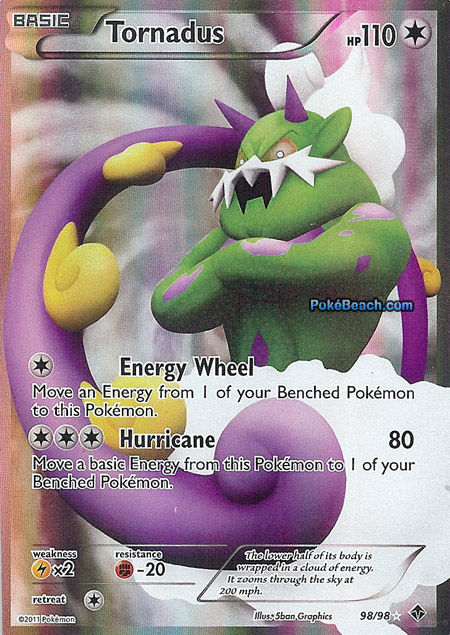
Basics– Torandus is a 110 HP basic Pokemon.

Hey wait, this is supposed to be an article about Stage 1 Rush.  How come you are putting basic Pokemon here.

Well, while I won’t speak to how certain variations change a deck, I think you are taking the Stage 1 thing too literally.   “Hot Pockets” aren’t actually warm pouches off fabric are they?   No they are a bunch of crap rolled into some stale bread.  What I am trying to say is that the name “Stage 1 Rush” does not define the deck, but it describes it.  And there are still some Stage 1’s in those decks.

Kind of like how there is still like 1 music video a day on MTV, so they can still call themselves Music Television?

Exactly…..kind of.  Anyway, who cares let’s talk about the attacks of Tornadus.  The one that makes a difference is the second one, called “Hurricane”.  This attack does 80 damage for CCC.  The effect of this attack moves a basic energy from Tornadus, if there is one.

What it’s good against– Although Tornadus can be used to attack other things, Tornadus is included to almost exclusivley counter Donphan.  Since Donphan Prime runs over Cincinno, Zoroark, and Mew Prime; you need something to counter it.  Tornadus has a fighting resistance, so Donphan Prime can only hit it for 40 damage.  That means Torandus can do 60 damage to Donphan, and 2HKO it without being knocked out itself.

Although Tornadus is not a perfect counter to Donphan, it’s a lot better than not having a counter at all.

What it’s not so good against– If you don’t expect to see a lot of Donphan at your tournament, than don’t ever run Tornadus.  Sure Tornadus isn’t bad against other things, but it is basically just a Donphan counter.  If Donphan is not big in your area than there are other good things to run.

Usefulness–  Yes it is not the best card overall, but if you expect to see Donphan Prime, Tornadus is your only shot.

Mew Prime 

Basics– Mew Prime is a basic Psychic Pokemon with 60 HP.  It’s “Lost Link” Poke-body lets you use any attack of any Pokemon in either Lost Zone.  Its one attack, “See Off””, lets you search your deck for a Pokemon and put it into the Lost Zone.  In the context of this article, Mew will be used only as a way to use Jumpluff’s “Mass Attack” or Cincinno’s “Do the Wave.”

What it’s good against–  Although you can use Mew against other things like Mew Lock, by far the most popular use would be to counter Gothitelle.  No Pokemon that is used in Stage 1 Rush stands a chance against Gothitelle.  No other Pokemon can hit it for weakness, or hit it for 130 damage.  So the idea is to attack with Mew Prime, who can hit Gothitelle for weakness.  You either see off an attacker, like Cincinno, or you “See Off” a special tech like Jumpluff.  That way you will be able to knock out a Gothitelle.

What it’s not so good against– Well, the only reason that you would play Mew is so that you will have a chance against Gothitelle.  So if you don’t plan to see Gothitelle, you do not need to add Mew.  However, if you don’t play Mew, you will be almost auto-loss to Gothitelle.

One bad thing about Mew is that it will take at least 3 (probably more like 5) or so spots in your deck.  So if you do play Mew your consistency will suffer, and it could all be for not if you don’t play any Gothitelle.

Usefulness– Well it is not a very versatile choice for this deck, but it is a great counter.  If you think you will play Gothitelle, you almost have to run Mew.  However, if you don’t think you will see Gothitelle, your deck will be better for it.

So what’s the play?

That is the question.  Stage 1 Rush has proved to be nothing more than a fancy tool box.  This deck is good because it is a direct counter to a lot of decks out there.  There are a lot of options to choose from, so how does one choose from all these great options?  Well, your metagame will be the biggest determining factor.  If you expect to see Donphan and Gothitelle you will build your deck one way, but if you expect to see Magnezone and Reshiram you will build your deck another way.

The important thing to do is to scout out your metagame.  Of course there will be all kinds of different decks at a tournament, it is important to know what is most popular and what the best players in your area are playing.  If you have a decent idea about what people are playing, you will be better equipped to change your deck to counter the other decks.

The important cards to keep in your mind are Yanmega Prime, Donphan Prime, and Cincinno.  They are just overall good cards and would be great in any deck you play.  No they do not need to be in every Stage 1 Rush Deck, but should always be kept in mind.

Pikkdog’s Current List

I am only providing this list as something to test with.  Again, this list is not very good and is not tournament worthy, I just want to give you guys an example of what I am talking about.  I did throw this together about a week ago to test against, and didn’t really fix it that much.  So it still needs work, but this is an example of what a basic deck might look like.  This particular deck is teched out for a Donphan and Gothitelle heavy format.

Pokemon-18

  • 3-Mincinno EP- the best Mincinno, but if you have to use BW it’s okay.
  • 3-Cincinno BW
  • 3-Yanma
  • 3-Yanmega Prime
  • 2-Mew Prime
  • 1-Zoroark BW-in this build it is only used to be “See’ed Off”
  • 2-Tornadus
  • 1-Cleffa Cl

Trainers-30

  • 1-Revive
  • 4-Pokemon Catcher
  • 4-Junk Arm
  • 4-Pokemon Communication
  • 4-Pokemon Collector
  • 1-Professor Elm’s Training Method
  • 2-Copy Cat
  • 4-Judge
  • 4-Professor Juniper
  • 2-Plus Power

Energy-12

  • 4-Psychic Energy
  • 4-Rescue Energy
  • 4-Double Colorless Energy

The Big Ending

Well, the title for this section sure sets up some unrealistic expectaitons.  There will be an ending, but it probably won’t be big.  So, what will our ending be tonight Pedro?

Well, tonight we will end by looking at a picture of Launchpad McQuack from Duck Tales.

Why would we do that?  That is really random and has nothing to do with Pokemon.

You mean it won’t help anybody become a better player.

Yeah.

Well then it will fit in with the rest of this article then.

Well I can’t argue with that.  Show the picture.

Techs That You Will See at Fall Battle Roads 2011

A big hello to all you OHKOers out there.  This is Pikkdogs and his sidekick Pedro here with a strategy article of sorts.

Before we get into the article I would like to thank my buddy Mark for writing the last article on the website, the one about Lilligant.  I hope this begins a long friendship with Mark and ONEHITKO.com.  Oh, before we get off the subject, I got a story for you, Pedro, you’ll like this one.

I doubt it, but go ahead.

Well when Mark and I were talking about the article, he hinted that we might not want to publish the article.  As if we had some kind of quality control or something.

Yeah that is funny.  You gotta have quality before you have quality control.

Haha, Like we have an Editor or something.  We just drive around down-town Detroit and ask the homeless to write articles for us in exchange for the promise of chicken.  But there’s never any chicken.  We publish whatever they give us, and hope it makes sense. 

Of course we do.  And nope, there’s never any chicken.  But, if you wanna check out Mark’s article, click here.  And thanks again Mark, we’re happy to have you around.

When talking about decks this year, the big word to use is variant.  With few exceptions (Reshiphlosion, mainly), most decks have a lot of room to be used to cater to your own play-style and your local metagame.  No two Stage 1 Rush, Gothitelle, or Mew deck is the same because there is a lot of room to work with.  Adding different cards makes the deck your own, and can give you an advantage in a Battle Road.  Picking the right tech is every important.  While it is impossible to talk about every tech that is out there right now, Pedro and I will do our best to talk about the most important techs out there.

Actually you will do that, and probably fail.  While I will stand back and make fun of you.

Isn’t that what I said?  Anyway, let’s go and talk about techs.

Starting Pokemon (Cleffa, Pichu, Manaphy, etc …)

The first techs we will look at are Pokemon that are usually looked upon as starters.  A lot of decks run Cleffa as a starter, but if you have another starter or usually don’t need a starter, you could think of Cleffa as a tech in your deck for  a better start or for hand refreshing to improve consistency.

Used For– I kind of already wrote about what it’s used for.

Yeah, good job ya jerk.  

Thanks, Pedro.  Anyway, you could use a starter like Cleffa as a tech to improve consistency or for a “just in case” card.  If your deck is behaving normally and you draw into a Juniper, you might think that everything is fine.  But if you get a really weird draw on your Juniper, you might need a starter like Cleffa to come in mid-game to help you recover from that weird draw you just got.  Cleffa, Pichu, and Manaphy are good early game and mid game to improve consistency.  If your deck does not already use a starter like this, you might want to consider teching in one just in case.

Used In– Decks like Mew that already have a different starter, or your deck that usually doesn’t use a starter.

Why it may be a good choice– It could be a good choice to run 1 of a starter just so you do not get screwed on the off chance that you get a weird draw.  Also, it is always good to have at least 1 Pokemon with free retreat.  It is also not a big investment, taking only 1 card slot in your 60 card deck is not a bad trade off for consistency.

Why there may be better choices–  I usually play Battle Roads in a “balls to the walls” manner.  I like to play risky decks and then go to a lot of tournaments and hope I get really lucky at one and win it all.  Having more consistency is really important in a 9 round tournament like Nationals, but it may not be that important for a 4-5 round tournament like Battle Roads.

Tropical Beach

After Worlds everyone was talking about the promo card that was given away.  Tropical Beach is a stadium card that lets you draw until you have 7 cards in your hand, and then your turn is over.  The down side is your opponent can use it too.

Used For– Again, we have another consistency or setup card.  Tropical Beach is a card that is mostly used to  help you improve consistency.  Since there is not a lot of draw power in the format, draw power, even if it is from a stadium, is valued.  There are times when you run out of options mid game, and would gladly sacrifice an attacker for some draw power.

Used In– Could fit in all decks, but has mostly been talked about in Ross Dot Deck and Gothitelle.

Why it may be a good choice– A Bianca like card that nets you one extra card  and is always in play is always nice.  It improves consistency a lot.

Why there may be better choices– Tropical Beach is very expensive.  If you are lucky you can get one for 50 bucks, but that still is out of the price range for a lot of players.  Another strike against this card is that your opponent can also use it.  Meaning that you could play a card that will help your opponent more than it will help you, which is never good.  The final downside about Tropical Beach is that it is not searchable.  This means that if you really want to use Tropical Beach and it is not in play, then you are out of luck.  You will have to draw into it to use it.

Basculin Emerging Powers #24

Wait do you hear something Pedro

Ahhh I get it.  Are you talking about the sound of my heart beat running away, beating like a drum and its coming your way, can’t your hear that boom badoom boom badoom, bass, he is that super Bass(culin)

Quick thinking Pedro.

Used For– Basculin is a Donphan destroyer.  He has the “Flail” attack which lets you do 10 times the number of damage counters on Basculin.  If you have a Vileplume on the bench it will be very hard for your opponent to get Donphan out of the active spot, and if you have Basculin active that has taken an “Earthquake” last turn, you will be able to OHKO Donphan. There is no way for the Donphan player to get out of this situation, if they would attack Basculin they know they would get knocked out last turn.  But if they do not attack the game would end, and if they have not taken more prize cards than you, they will lose.

Used In– Mewlock

Why it may be a good choice– Very good Donphan counter in a deck with Vileplume.

Why there may be better choices–  There are a lot of other ways to deal with Donphan Prime that do not involve Basculin.  Like just using the Yanmega to snipe around Donphan, and then use Ambipom or Smoochum to move the energy off of Donphan.  And if the Donphan player is winning, that super bass will be of no help because the opponent will just pass until either the game is over or your break your Basculin lock. 

Mew Prime

Used For– Mew Prime is a very versatile tech.  It can help in a lot of different matchups.  It can be used to counter Gothitelle, or to counter other Mew decks.  If you “See Off” your main attacker to the Lost Zone, you can then Mew next turn to attack Gothitelle for weakness.  You could also use Mew to use the Mew player’s Muk, and then use “Sludge Drag” to bring up their Vileplume so you can knock it out next turn.

Used In– Almost any deck.

Why it may be a good choice–  If you have a lot of item locking decks in your metagame, I think you should give Mew and Rainbow energies a very good look.

Why there may be better choices–  If item lock is not prevalent in your area, Mew is probably not needed.  You also don’t need it if you already have an answer to the trainer lock decks.

Solrock and Lunatone

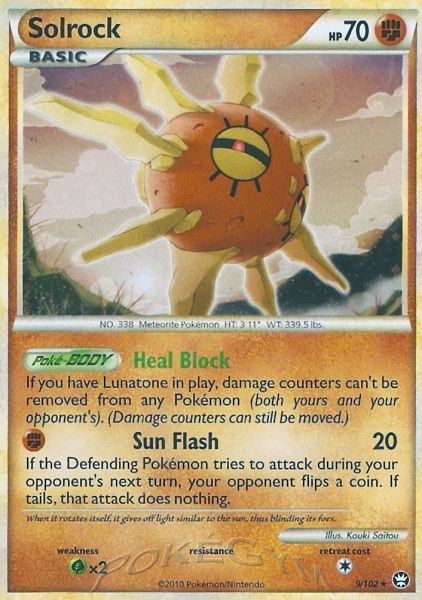
Used For– Solrock and Lunatone are tech cards that are used to counter Gothitelle and Ross Dot Deck decks.  Both Gothitelle and Ross Dot Deck decks like to pile up damage counters and then heal them with cards like Blissey Prime and Max Potion.  Solrock has a Poke-Body that does not allow healing, so Solrock can be used to cunter these decks.  If these decks are allowed to pile up damage and then heal, you will never be able to pile up enough damage.  If Solrock and Luntone are in play, the damage counters will pile up fast.

Used In– A meta game that is heavy with item lock.

Why it may be a good choice– It only takes up 2 deck spaces and really gives you an advantage against Gothitelle.

Why there may be better choices–  A lot of decks take up most of their bench spaces already, so using 2 more spaces is not feasable in some decks.

Ditto Triumphant 

Used For–  As mentioned earlier, bench spaces are at a premium in this format.  A lot of decks use bench sitters like Vileplume and Reuniclus, and can clog up their bench really fast.  If you play Ditto down your opponent will have to discard one of their Pokemon, if they have 5 on the bench.  They will also not be able to play another one down until Ditto is taken out of play.  This can be a very disruptive card, especially when people tend to put a lot of extra basics on the bench to make up for the Pokemon Catcher threat.

Used In– Can be used in any deck.

Why it may be a good choice– It is a  very versatile tech that can be very disruptive against a lot of decks.

Why there may be better choices–  You never know when Ditto will be needed, so it is hard to recommend using it.  Also, the meager 40 HP is sniping bait for Yanmega Prime.

Tornadus  

Used For– It is a Donphan Counter.  It has an attack that can utilize DCE, and can knock out Donphan Prime in two hits.  It also can only get 3HKOed by Donphan and his “Earthquake” attack.  It is a card that has revolutionized the Zekrom deck and can be used in any deck with a bad Donphan matchup.

Used In– Zekrom and basically any other deck that uses DCE.

Why it may be a good choice–  It is a great Donphan counter that is easy to fit in to a lot of decks.  Not  a lot of cards can be you quite as good of a shot against Donphan Prime, but Tornadus can pull it off fairly easily.

Why there may be better choices– You may have another anti-Donphan tech in mind, but overall Tornadus is the best.

Smoochum/Aipom.

I can track the use of Aipom back to Worlds 2011.  Jason K. used it in a Mew lock deck to move the energy off the active onto the bench.  A very handsome guy named Joshua Pikka-

Ahh, I don’t think he’s that handsome.  I think he’s a fat guy who sits all day writing articles on a poor quality Pokemon website that nobody reads.

well I prefer handsome.  Anyway, I can only track the use of Smoochum to my use in a mew lock deck in early September of 2011.  I used it as a substiute for Aipom.  Aipom is not a bad play, but Smoochum does what he does for free and retreats for free, although it is a lot tougher to donk Aipom. 

Used For– Stalling, moving energy off of the active to a benched player.  A lot of the Stage 1 Rush decks out there only play about 6 fighting energies.  Imagine that you have 1 of those fighting energies prizes, 1 in the discard pile, 1 on  the active, and 3 left in a 40 card deck.  If the energy in play was moved onto the active, it could be pretty hard to get that energy back onto a Pokemon such as Donphan. 

Used In– Mewlock, but anything with Vileplume. 

Why it may be a good choice–  If you cannot match each player’s hand size for Yanmega Prime, Donphan Prime will be a difficult change for a Mew deck. But, if you can move the energy off of Donphan, that player may not be able to attack next turn.  This card could change the shape of a lot of different matchups.   

Where there may be better choices– It is kind of hard to know if your opponent has another energy in his/her hand.  To change the odds you can tech in Mr. Mime Cl, but that would take another valueable bench space.  You might think that it could be better to just run that super bass, Basculin. 

boom  badoom, boom, boom, badoom.

Indeed.  Well, Pedro we are finally done with this article. 

You mean you are done speculating about cards that probably w on’t be played at all.

Yeah, that’s pretty much it. 

Okay, then can I end the article?

I guess so, how are you going to end the article tonight.

How we always do it, just like the Teletubbies do.  Bye bye Tinky Winky, bye bye Dipsy, bye bye Lala, bye bye Po.  The sun is setting in sky, Teletubbies say good bye. 

Wow, that was great Pedro, even though I don’t think that is how we usually end the articles, you had everything except that creepy baby in the sun.

I know, that baby was pretty creepy. You know I like these articles, we don’t pretend to know anything, we just sit here and talk about the Teletubbies.  

Exactly, cause I know I don’t know anything.  And you aren’t even human, you of course are a extra dimensional being without a body, so you can’t even play Pokemon.

True, but it is time to end the article,  Teletubbie Bye Bye.

Green Light Gridlock! Lilligant/Vileplume/Yanmega

Hello All and welcome to my first Article! 

Biography

Allow me to briefly introduce myself, My name is Mark McDonald. I am a native of Detroit, Mi. I am a member of the Michigan based Team Warp Point, and friend of the well known Pikkdogs. I’m relatively new to the card game. Nationals 2010 was my first tournament ever. I hadn’t even seen a battle roads, and there i was in the largest tournament of pokemon history. I ended 6-3 with dialgachomp (that i learned how to play a week prior) missing top cut in 75th place of my flight. In 2011, nationals saw me  ending with a  5-4 record with zekrom. But that’s enough about me. Today’s topic is lilligant!

The Idea:

On the horizon of the 2012 tournament seasons start we all have been in search of the deck that will handle the various threats the current format pose. The obvious presence of Pokemon catcher is definitely not being overlooked and the hype of gothitelle is spreading like wildfire. The release of Emerging Powers brought some interesting cards into the format with the potential to stir up our competitive meta game and question deck choices for events. Lilligant is an interesting card to say the least.

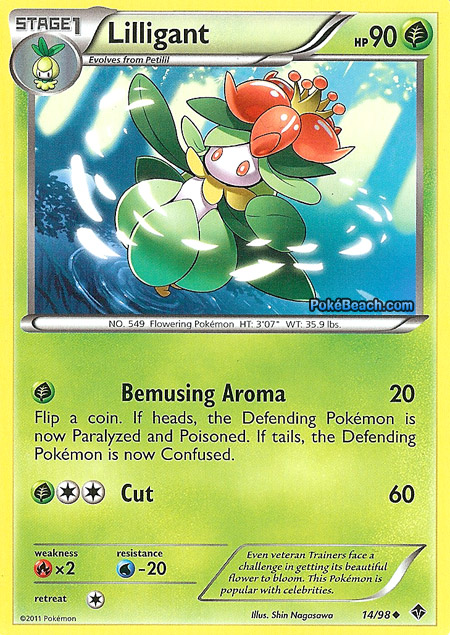
In a format with such huge early game damage output and massive HP basics, Lilligant brings a high degree of potential disruption. First lets ‘go over Lilligant. With a not so impressive 90 hp for a stage 1 Lilligant is pretty frail, however, it makes up for it with  low energy attacks that can be devastating for the opponent. For 1 grass energy Bemusing Aroma does 20 damage to the defending pokemon with the chance to poison AND paralyze the defending Pokemon with a heads on a  coin flip. With a result of tails the defending pokemon becomes confused. Lilligant has a good retreat cost of only 1, a x2 fire weakness, and decent water resistance (for beartic). At first glance this seems decent and not really ground breaking due to the heavy play of free retreat pokemon such as mew and yanmega. But that’s where Vilplume comes into play. With a benched Vileplume in play you are able to not only eliminate trainers but ensure that the active pokemon cant be switched by any means other than paying retreat cost. When matched up with popular decks such as donphan, magnezone, zekrom, reshiram, beartic, gothitelle or anything with a 2 or more retreat cost, Lilligant can render them useless for several turns if not the entire game. Yanmega Prime also serves as a secondary attacker, given its ability to snipe around stuck active pokemon for easy ko’s or simply deal good damage in general for no energy.

Paralysis and Poison Or Confusion:

With only 20 damage output, Lilligant is far from 1 shotting a Pokemon but it’s the residual damage that makes it such a scary card. By paralyzing the opponent it ensures that during the following turn, that particular Pokemon cant attack or retreat. Since trainer lock is present, it means that there is absolutely nothing the opponent can do. Since the defending Pokemon is also poisoned the attack technically does 30 damage because of the 1 damage poison adds. with a guaranteed damage after the opponents turn that equals a total of 40 damage and without the opponent being able to respond. In the case that confusion occurs, it presents the chance that the opponent can inflict 30 damage to itself by attempting to attack which in a way increases the initial damage output to 50, the downside is in this case the defending Pokemon can retreat. Confusion isn’t really the ideal result. but is relatively disruptive due to the current structure of decks relying on benched supporting Pokemon that rarely, if ever, attack. Lilligants second attack, “Cut”, does 60 damage for 1 grass and a DCE, and isn’t really worth using but it has potential to finish off a  crippled Pokemon after the status effects have taken its toll. Overall the point is to get vileplume up as early as possible preventing the opponents accelerated setup and catchers while getting early K.O.’s with Yanmega Prime and stalling out Pokemon that need to set up to attack with Lilligant.

Other cards that make this deck a force to be reckoned with:

A few techs that i have been trying out include Smoochum from HGSS, for it’s the ability to additionally disrupt the opponent by moving energy from any Pokemon on they’re field to any other Pokemon. By doing this you can target their main attackers early while you set up and render valuable energy drops useless as you stall them in return. Another benefit of moving an energy to another [Pokemon is, if you plan to snipe that Pokemon with Yanmega or especially if the Pokemon can’t utilize the type of energy moved.

Sunflora from HGSS is another option for this deck, for it s ability to search out grass Pokemon with it’s Poke Power “Sunshine Grace”.  You can use the power to search things  such as Vileplume, Yanmega or Lilligant. With no Pokemon Communication in the deck, this method of search is great for helping you set up.

Spinarak is an amazing tech to completely lock the opponent from retreating a Pokemon that can’t attack, which buys you more time to set up. Since the deck is all grass, it will be easy to find the correct energy for Spinorak to attack with.

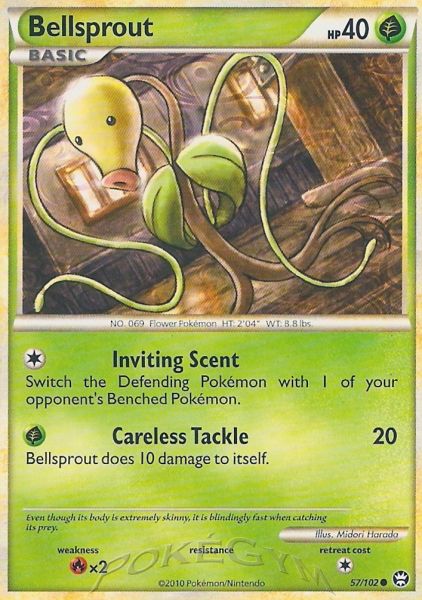
The last tech I will talk about is Bellsprout from Triumphant. Bellsprout has an extremely useful Pokemon Catcher like attack built into it that can provide disruption and set up the defending pokemon for Lilligant on your following turn. For 1 colorless energy Bellsprout’s ‘Inviting Scent” simply allows you to switch the defending Pokemon with a Pokemon of your choice on the opponent’s bench. This works great with Yanmega and Lilligant.

My list for you to reference:

Lilligant can be partnered with other Pokemon for different variants of this deck but i feel this version with Vileplume and Yanmega is the most consistent. Here’s the list I’ve been trying.

27 Pokemon 23 Trainers/Supporters 10 Energy
3-4 Yanma
3 Yanmega Prime
3 Petilil
3 Lilligant Emerging Powers
3 Oddish
2 Gloom
2 Vileplume
2 Sunkern
2 Sunflora
1 Cleffa
1 Smoochum
1 Bellsprout
1 Spinarak
4 Pokemon Collector
4 Twins
3 Copycat
3 PONT
2 Sages Training
2 Juniper
2 Judge
3 Rare Candy
7 grass
3 Rescue

In conclusion:

By no means am i trying to convince anyone this deck is the BDIF but i believe it could be a lot of fun to play. It has the potential to lock the opponent in multiple ways, It can hit hard or snipe the bench and lock trainers also. Again the biggest weakness is its frailty and sort of luck reliance on coin flips.

 Definitely consider trying it out, and please comment below and give any advice that you think would help this deck. I hope i did okay for my first article and I plan on getting better to provide my perspective on different ideas. Thanks for reading!

Pikkdogs Pikks Three: Typhlosion Prime, Ruins of Alph, and Durant

A big hello to all you OHKOers out there.  This is Pikkdogs here with a Pikk Three article for you.  If you are not a frequent reader of this site I will explain this article series for you.  I will review three cards for you, one card is a commonly used card, another card is one that I think is under-used, and the third is a card that is from a new or yet un-released set.  Does anyone need to go the bathroom?  If not, we can start the show.

Card #1-The Staple-Typhlosion Prime

Description– Typhlosion is a stage 2 140 HP Fire Pokemon with a weakness to water and a 2 retreat cost.  Its Poke-Power afterburner lets you attach an energy card from the discard pile, and a damage counter to any of your Pokemon.  Its attack, called “Flare Destroy” does a lackluster 70 damage for FFC, but it has the awesome effect of requiring a discard from each of the active Pokemon.  The best part is that you get to choose which energy goes in both circumstances, that means you can discard the DCE on pesky Pokemon like Zoroark and Boufallant.

Analysis– Typhlosion saw a heck of a lot of play at U.S. Nationals this year with his buddy Reshiram.  Before that it was just a card that was used in rogue Ursaring Prime decks.

This card has a lot of synergy with the best draw Pokemon in the format, Ninetails HGSS, and one of the best basic attackers ever, in Reshiram BW.  Those buddies make Typhlosion pretty powerful.

Reshiphlosion did have a lot of success at both nationals and worlds, but some people doubt that it can succede with Pokemon Catcher.  In my testing I have found that Pokemon Catcher does not really hurt this deck, so I think this deck will still be powerful in the next season.

One knock on this card is that it is not the best attacker. 70 damage for 3 energies is not that great.  But, it is great to be able to disrput with the energy discard while attacking.  It can be game changing to discard an important DCE.  I know this firsthand, as I was crushing everything at Nats until Typhlosion discarded my DCE.

Final Rating8.5/10– Ya gotta love this card as a freind for Ninetails and Reshiram.  Because of this card, the deck can keep on re-using energy making the deck very hard to beat late game.

Card #2-The Underdog-Ruins of Alph

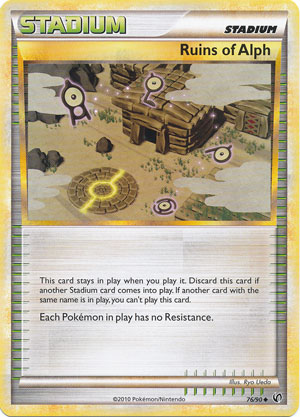
Description– Ruins of Alph is a stadium card, you know a stadium card, its like a trainer but it always stays in play.  We have seen so little decent stadium cards lately that I am afraid for the most part that stadiums are dead.  This little card does still have a use.  The effect of Ruins of Alph lets you ignore resistance on every Pokemon in play.

Analysis– Being able to stop resistance could be good, or it could be bad, you just need to use it in the right situation.  So what is the right situation?  I think this card is best used with Donphan Prime.  If Donphan Prime were to attack Yanmega Prime with “Earthquake”, it would only do 40 damage, and would setup Yanmega for a 3HKO.  But if Ruins of Alph is in play, “Earthquake” does 60 damage to Yanmega, setting it up for a more manageable 2HKO.

Sure there are drawbacks, if your opponent is playing Primetime they can bait you into playing this card, and then attack Donphan Prime with Magnezone Prime.  This move would allow the Magnezone player to do an extra 20 damage to Donphan and probably save an energy from going into the Lost Zone.

But I think for the most part, Ruins of Alph works very well with Donphan Prime.   I played 1 Ruins of Alph in my Donphan/Samurott deck at Nationals and the card saved me in about 2-3 of my games.

The uses for this card basically stop there.  Sure other cards do have resistance that it would be nice to take away, but the main use of Ruins of Alph would be for a Donphan deck against Yanmega.

Final Rating- 8/10-In this format the ability to run over Yanmega’s like Omar’s car (see out nationals reports for the story) is very impressive.  Yanmega is probably the most popular Pokemon out there, so if you can win that matchup you should have an easy time at winning the game.

Card #3- The Young Gun-Durant

Description– The next thing up for review is Durant

No, not that Durant, this Durant.

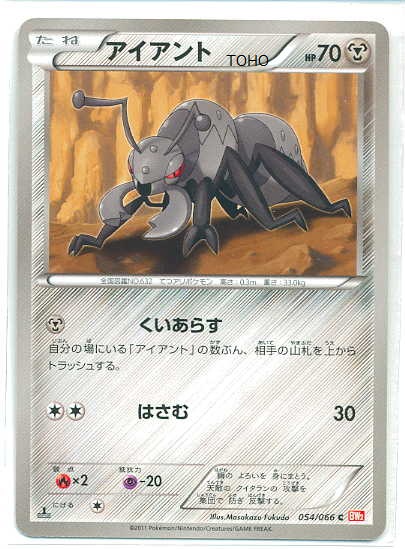
It is a basic Metal Pokemon, it has 70 HP, a weakness to fire, a resistance to psychic, and a 1 retreat cost.  This Pokemon will probably be featured in the Noble Victories expansion.  Its first attack is what everyone is talking about, it is called “Devour” and it lets you mill (or discard from the top of your opponent’s deck) an amount of cards equal to the amount of Durants that you have in play for 1 metal energy.  His second attack, “Vicegrip”, is not very good, it only does 30 for CC.

Analysis– One of my favorite aspects of this game is milling.  I love discarding cards from my opponent’s deck.  It just makes me feel good.  So I always like when a quick and easy milling card comes into the format.  But will it be any good?

Well first lets take a look at what it does.  It lets you mill a card for each Durant you have in play for just 1 metal energy.  Now, that doesn’t sound too hard to get out.  Just run 4 Collectors and 3  Dual Balls, and you should be able to get 4 Durants in play on turn 1 no problem (as long as they aren’t prized).  And the metal energy could be a special one, which takes you away from the OHKO range of Yanmega Prime.

That all sounds well and good, but things get worse from there.  Milling 4 cards a turn is not really that much.  If you mill 4 cards a turn for 7 turns (the time it will probably take your opponent to knock 6 Durant’s out) you will have only milled 28 cards.  If your opponent started with 7 cards, 6 prizes, drew 6 cards, that will leave him with 13 cards.  Now I know some of those 13 cards will get drawn with draw/hand refresh supporters, and others will get searched out, but I think leaving 13 cards in the pile is just too much.  Its hard to say exactly because with cards like Judge you will be putting cards you drew from your deck and as prizes back into your deck, and that to the effect of cards like Flowre Shop Lady and it is so hard to say exactly how many you need to mill. But, I think if you mill 28 cards with Durant (and I am being generous with 28) you still will be a little shrot, so lets look at other cards that can partner up with Durant.

First you got Kyorge/Groudon Legend.  It has an attack that lets you mill 5 cards.  This could be a good finisher for this deck.  There is also a Magmortar that allows you to mill based on the number of fire energies attached to him.  You could add an Emboar tech, and try to finish off with Magmortar.  But, because of energy requirments I do not like any of these cards.  I think that Durant does not have the partner he needs yet to be good.

Perhaps I will play this deck if the format changes so it is easier to trap things in the active spot, but until then I think this card juts has too much going against it.

Final Rating6/10- The format is not ready for Durant yet.

Well, thats all I got for ya guys today.  Please feel free to tell us what you think about this card in the comment box.

So long and thanks for all the fish!

Peering Into the Future

Ed asked me to write something, so I did. Apparently, I’m part of this guest writer week thing. I hear guys like Jay and Pooka are also doing it! That makes me feel super duper special :P. It would be even cooler if I won a sweet T-shirt like this awesome guy I know did. Eh, you can’t win ’em all. So, without further ado, let’s get started.

I think I might start doing something like this where I write about upcoming cards currently receiving hype. For each card, I’ll analyze it and then give my opinion on whether or not I think the hype is worth it. You might think this article seems really premature. You might be right, and if this information turns out to be wrong, it’s whatevs. Everything is subject to change. PONT was “bad”, and then it was in an odd LuxChomp list that happened to win Worlds. You never know what the future holds.

You know, with Red Collection, we get a lot of, hmm, unique cards. We get some tools, some abilities, and then like 90 other filler cards. There is one Pokemon with an ability that definitely stands out among the others. That Pokemon is Victini, playfully dubbed FlipTini or reFlipTini. Let’s look at the stats. Read More

The Post Pokemon Catcher Pokemon Stock Market

A big hello to all you OHKOers out there.  This is Pikkdogs here with a card discussion article.

It is no secret that Pokemon cards change value very easily.  Pokemon is one of the cheapest TCG’s out there, but cards that are really useful could command a fairly large price.  This means that cards that are cheap one day can be very expensive the next.  The most popular example is Yanmega Prime.  In the winter and spring Yanmega Prime was about a 5-7 dollar card.  It was used in a couple rogue decks, but for the most part people only wanted the card for fun decks.  Then in July the format changes and Yanmega is a lot easier to play.  All of a sudden that 5 dollar card is up to 14 times more expensive then it once was, commanding a 70 dollar price tag at U.S. Nationals.

Even though Yanmega is an extreme example, it is not unlike the value of other Pokemon cards.  Most cards value in price over their life time.  Some cards like Crobat Prime are hyped and command a high dollar amount early, but then crash and burn a couple months later.  While other cards like Sage’s Training are not talked about at all, and then all of a sudden jump up in price thanks to a higher demand.

The rotation was the biggest variable that has shaken up card prices in the recent months, but one card has the power to shake up the value of cards again, that card is Pokemon Catcher.  This article is all about how the release of Pokemon Catcher effects the playability of certain cards.  So we will go through several cards, some that have increased in play ability thanks to catcher, and others that have fell.  Keep your eyes out for these cards, it could save you from being stuck with a lot of cards like “usta” be good.

Buy!!!!-Cards on the Rise

1. Vileplume

Why?: We currently have a very trainer heavy format, and there are about to be even more important cards that are trainers (items).  So having an itemlock has never been more important.  The ability to lock items will shut down the search ability and disruption of most decks out there.  This makes it very hard for your opponent to setup and recover.  A lot of people will run decks that rely on easy knock outs with Yanmega Prime, Vileplume takes care of these decks too.  These facts make Vileplume very important next season.  Don’t be surprised if about half of the decks at your Battle Roads have Vileplume in them somewhere.

2.  Mew Prime

Why?:  Pokemon Catcher makes it pretty easy to get knock outs, so having Mew Prime in your active spot will not make it that much different than a deck that has Manaphy on their bench.  Pokemon Catcher also helps Mew Prime because his decks usually have trouble doing a lot of damage, so Mew can choose which Pokemon to attack, and what Pokemon in the Lost Zone to attack with.  It gives Mew’s deck a lot more choices, and for this deck, choices are very dangerous.  I can see Mew Prime being a great card next season.

3.  Anything with Free Retreat.

Why?: It might be better to use inferior cards that have free retreat to avoid having your deck stall out against Pokemon Catcher.  An example of this is Floatzel, he is not as good as Emboar in attaching energies, but some people are pairing him with Magnezone instead of Emboar, because of the free retreat. Free retreat has always been great, but it will never be better than it will be in the upcoming season.

4. Mismagius CL

Why?: I think Mismagius was an under-rated card during Nationals, now with Pokemon Catcher out the card will be even more powerful.  Vileplume will be very popular in the next format, and I think these decks should at least try out Mismagius.  It is not hard to add Rainbow energies and a 2-2 line of Mismagius.  Itemlock will be very important next season, so Mismagius will be in a pretty good position to prosper.

Sell!!! Cards on the decline

1. Emboar

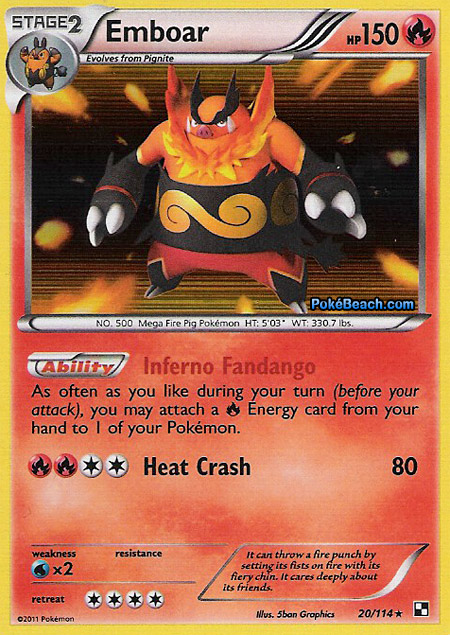
Why?: Emboar is a card that started off hot, but lately it just can’t seem to get a break.  First it was Typhlosion edging him out as the most popular combo to Reshiram, then Magneboar was broken apart at Nationals, and now the release of Pokemon Catcher might put that final nail in the coffin.  With a high retreat cost and a 4 energy attack that only does 80 damage, it is not fun to have Emboar active.  And that is just where Emboar will be once Catcher comes out.  I think you will see Emboar not being very popular until it gets another attack to pair up with.  It may be more of a rogue choice until then.

2.  Tyranitar Prime

Why?: I have never been a big fan of Tyranitar Prime.  Yes it has a big HP, but Donphan takes care of that.  Yes it can spread for 20 but that’s only 20 damage, it will take 5 turns before it starts piling up. The only real attack it has costs 4 energy and forces you to mill your own deck.  But, the card has had its share of supporters in the past.  It even had a couple good showings at this years nationals.  But, these showings each had bench sitters. The deck that used Reuniclus is gone because that deck just does not work now.  The deck with Serperior might still work because of the fact that Serperior can attack for 60 for GC.  But the fact is, these decks will be weakned by catcher more than they will be helped.  It looks like we may be seeing the end of Tyranitar, for now anyway.

3.  Boufallant

Why?:   The 2 retreat cost does hurt Boufallant, and does let him be brought up to be sniped around.  The unreliable attack also hurts his chances.  The good thing about Boufallant is that you don’t need to put it on your bench the turn before you attack.  You can play him down, attach a DCE, and retreat for him.  The problem is that once he is played, he can then be used to stall and snipe around.   Another problem is that if your opponent plays a Judge before he/she plays RDL, Cincinno, or whatever Pokemon you are using it against, it makes setting up Boufallant very hard.  Catcher will not kill Boufallant, but it is a little harder to play him. Machamp Prime

4.  Machamp Prime

Why?:   Machamp is usually played with Donphan as a heavy hitter.  It is usually played by having a Donphan active and building Machamps on the bench.  When the time is right you can evolve and do a “Fighting Tag”  for Machamp and then do a lot of damage.  But, in a format with Pokemon Catcher people can knock out Machokes and Machops before they can evolve.  Donphan Prime will still be a great card with Pokmeon Catcher, and Pokemon Catcher will not completely kill Machamp Prime, but for right now I think the Donchamp deck will not be as great with catcher.

Well that’s all for this article.  If ya know of any other cards that you think will be effected by Pokemon Catcher, please leave your thoughts in the comment box.  Remember Guest Writer week starts this Monday with Kyle “Pooka” Sucevich and continues Tuesday with Michael Slutsky.  Next week will be very exciting, so make sure you keep tuned to the website all week.

So long and thanks for all the fish!

Starters, Where Are We Now???

Hey all you OHKOers, this is Pikkdogs here with a strategy article. Starting Pokemon have been important since the rotation.  But, the way they are used have changed a lot over the summer.  To find out what will happen with them from now on, lets look back at what happened with Starters.

Before the Rotation

Before the rotation, most decks did not have a starter, decks were fast enough where you could probably do a decent attack on turn 1.  The decks that had a starter were Gyarados and Sabledonk, both of these decks ran Sableye.  Gyarados used it because that made it easier to put Magikarps in the discard pile, Sabledonk used it because it relied on two supporters working together in one turn.  Besides those exceptions, starting Pokemon were laughed at.

Leading up to Nationals

With the rotation Pokemon decks have lost a lot of draw power because of the loss of Uxie.  To respond to the HGSS on format, people have been using starting Pokemon in there deck.  These starting Pokemon have allowed decks to setup quickly without the need for draw power from Pokemon like Claydol or Uxie.

The most used starter at first was Cleffa.  It’s “Eeeeeek” attack lets you shuffle your hand in your deck and draw 6. It also puts itself to sleep, and thanks to his Poke-Body, he cannot receive damage from an attack while asleep.  The ability to hand refresh was really good, so most people put a lot of Cleffa’s in their Nationals deck.

Other starters that people were talking about were Manaphy, Tyrogue, and Stantler.  Manaphy has 60 HP, free retreat, and an attack that costs 1 energy and lets you shuffle your hand into your deck and draw 5.  Manaphy isn’t as good as Cleffa, but it has 30 more HP.  Tyrogue is a direct counter to Cleffa. I’m not sure if Tyrogue is an actual starter, but it is used early in the game.  It’s “Mischievous Punch” attack does the 30 damage neccessary to knock out Cleffa.  Stantler also was talked about, but not used as much. For one energy, Stantler let you search two basics from your deck and put them on your bench.

Nationals 

At nationals, most people decided to play a 3/1 mix of Cleffa and Tyrogue.  This gave them a good chance of getting a refreshed hand early, which means a great start, which means a better late game.  But, 4 baby Pokemon also meant that there was a good chance that you would start with a lone Baby.  This lead to a lot of games ending on the donk.  One player would start with a lone baby, the other would just Pokemon Collector for a Tyrogue, retreat, and end the game.  These donks happened a lot, and a lot of people got mad.  2nd place finisher Kyle. S used Manaphy as a starter instead, and just ran Tyrogue as a counter to Cleffa.  This helped him avoid being donked as much.  I also ran Manaphy instead of Cleffa, but I did not run Tyrgoue because my Pokemon had higher retreat cost, the inclusion of Manaphy instead of Cleffa was great because I did not suffer one donk the whole tournament.

Worlds

While, I’m not sure what the best decks at Worlds will contain, I do know what a lot of people are talking about now.  The talk now seems to be a 1/1/1 line of Cleffa/Tyrogue/and Manaphy.  As mentioned, Manaphy is good but not as good as Cleffa.  The 1/1/1/ line could change to a just 2 Manaphys if the player expects a lot of Tyrogue.  If the player does not expect a lot of Tyrogue, expect a Nationals like starter line of a lot of Cleffas.

It can be  expected that Manaphy will be the most popular starter for worlds.  Stakes are too high at worlds to run a deck that has a high shot at being donked, especially in the Grinders.  But, we must remember that although Worlds is a very important tournament, it is not a huge tournament.  In a 9 round Swiss tournament it is easy to get donked a couple times, it is a little harder to get donked in a smaller tournament like Worlds.  I think we could see Cleffa come back at Worlds.  We may not see as many Cleffas in one deck as we did at Nats, but I could see the average play being 2/1 with Cleffa and Tyrogue, but I know Manaphy will be very popular.  For testing purposes the 1/1/1 line is a good start.

I could also see a deck only running 1 Manaphy just in-case they need it, and not rely on starters as much.  As we saw at Nats, Starters can be a liability as well as an asset.

Pokemon Catcher and the Future 

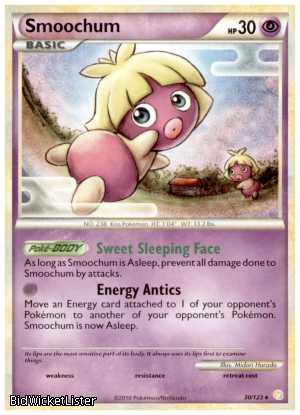
Pokemon Catcher will definitely change the role of starting Pokemon.  Baby Pokemon will not be as effective as walls with their “Sweet Sleeping Face” Poke-Body.  If you encounter a sleeping Baby you can just use Pokemon Catcher to bring up something else and attack that Pokemon.  It will still force the opponent to waste 1 Pokemon Catcher, and your opponent won’t always have a Catcher early in the game, but it still is a bad thing for  Baby Pokemon.  Catcher will also effect the non-Baby starters.  Opponents can now bring up Pokemon like Stantler to force you to waste your energy drop on a retreat. And if you try to Sacrifice Manaphy, your opponent can bring up your main attacker instead.

But Pokemon Catcher is not all bad for starters.  Stantler may see more play since it makes evolving a lot easier.  If you “Call for Family” for two of the same basic Pokemon, your opponent will only be able to knock out one of those basics. You are then free to evolve the other basic normally.  Stantler is really good in a Catcher heavy format for a deck that relies on evolutions.

Future sets will probably also change the role of starters.  We are not sure of what decks will be great in BR’s, Cities, and States; but we can be sure that the new decks will probably change the roles of starters somewhat.  However, there doesn’t seem to be any great draw cards coming out, or any starters that are better than Cleffa.  We can assume that the starters that are used immediately after Pokemon catcher, will also be used in the coming months.

So that’s all for now.  I hope you enjoyed this look back at starting Pokemon and can use it when you are making your Post Catcher decks.  Please tell us what you think about the upcoming role of starters in the comment box.

So long and thanks for all the fish.